Xia Hanting, Liu Jiangyuan, Yang Wenlong, Liu Min, Luo Yunfeng, Yang Zhijun, Xie Jingbo, Zeng Huiliang, Xu Rui, Ling Houfu, Zeng Qinghe, Xu Huihui, Fang Liang, Wang Hongyu, Tong Peijian, Jin Hongting, Yang Fengyun
The First Clinical College, Zhejiang Chinese Medical University, Hangzhou, China.
Institute of Orthopaedics and Traumatology, The First Affiliated Hospital of Zhejiang Chinese Medical University, Hangzhou, China.
Front Pharmacol. 2021 May 11;12:654714. doi: 10.3389/fphar.2021.654714. eCollection 2021.
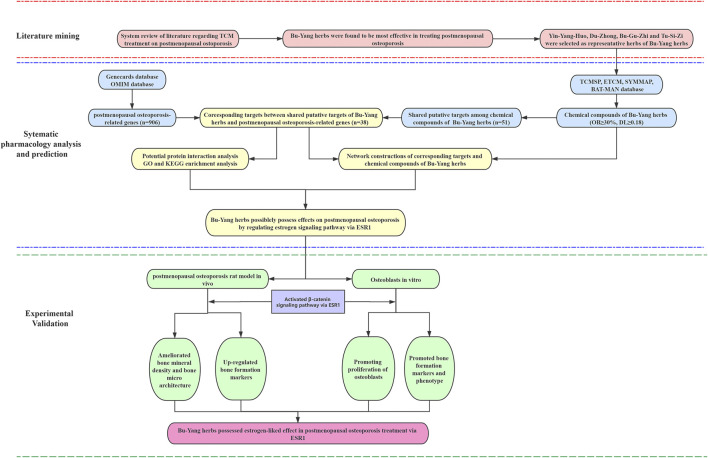
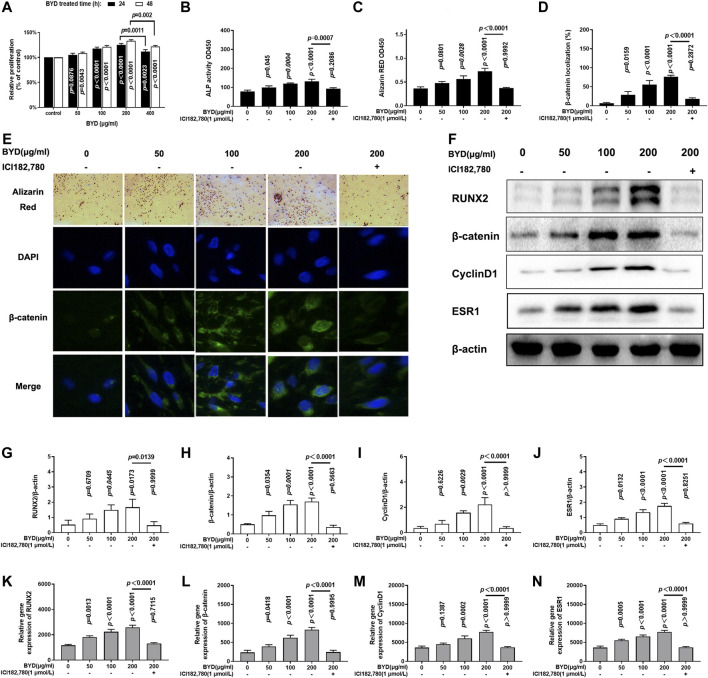
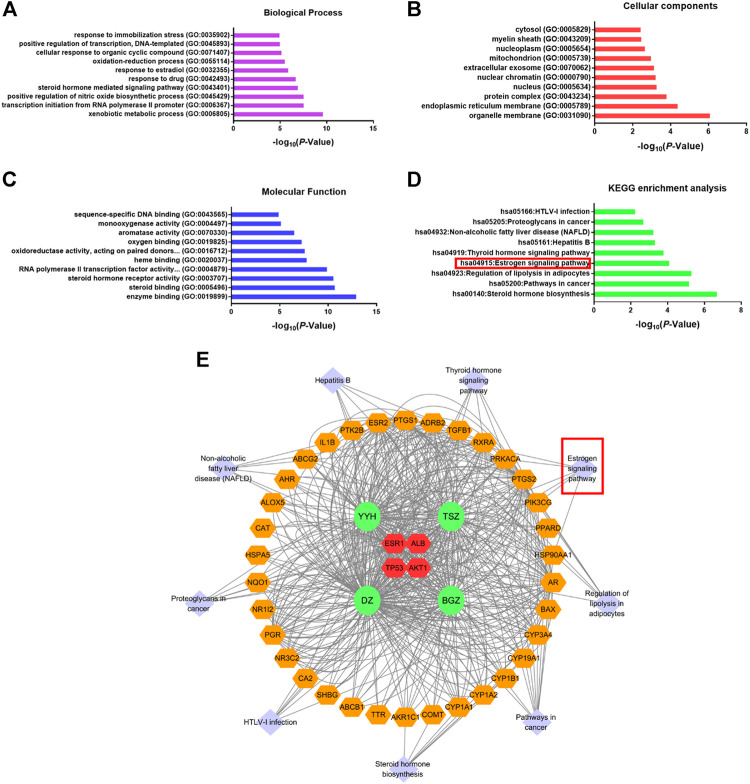
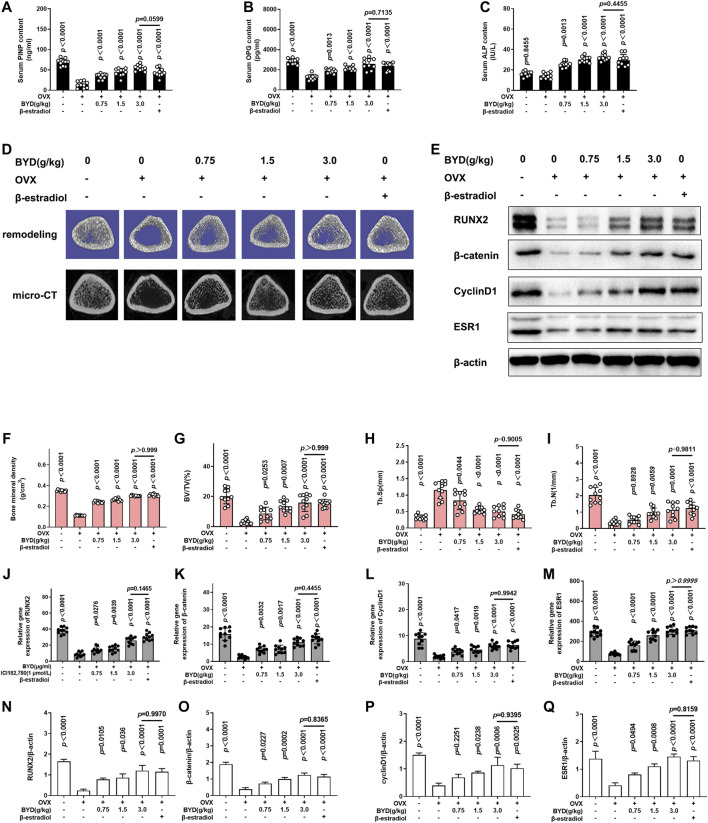
Postmenopausal osteoporosis (PMOP) is a type of bone metabolism disease-related to estrogen deficiency with an increasing incidence. Traditional Chinese (TCM) has always been used and showed effectiveness in treating PMOP. In the current study, Bu-Yang herbs were considered to be the most frequently used and efficient TCM herbs in PMOP treatment. However, chemical and pharmacological profiles were not elucidated. Network pharmacology was conducted on representative Bu-Yang herbs (Yin-Yang-Huo. Du-Zhong, Bu-Gu-Zhi, Tu-Si-Zi) to investigate the mechanism of Bu-Yang herbs on PMOP. Chemical compounds, potential targets, and disease related genes were available from the corresponding database. Results showed that Bu-Yang herbs could interact with ESR1 and estrogen signaling pathways. For further validation, the Bu-Yang decoction (BYD), formula consisted of the above-mentioned 4 Bu-Yang herbs was presented for experimental validation. , BYD significantly reversed ovariectomy (OVX)-induced osteoporosis progress in a dose-dependent manner by up-regulation of bone mineral density and amelioration of bone microarchitecture. , BYD dramatically improved the proliferation and mineral nodules formation of osteoblasts. Both and results illustrated that the phenotype change induced by BYD is correlated with up-regulated of ESR1 and activation of the β-catenin pathway. Meanwhile, inhibition of ESR1 by ICI182, 780 blocked the osteogenic phenotype and β-catenin pathway activation induced by BYD. In conclusion, the current study suggested that Bu-Yang herbs are the most useful TCM herbs in treating PMOP. Furthermore, the integrated strategy of network pharmacology prediction with experimental validation suggested that BYD exerted its anti-PMOP via ESR1 and the downstream mechanism might be activation of the β-catenin signaling pathway.
绝经后骨质疏松症(PMOP)是一种与雌激素缺乏相关的骨代谢疾病,发病率呈上升趋势。中医一直被用于治疗PMOP并显示出有效性。在当前研究中,补阳类中药被认为是治疗PMOP最常用且有效的中药。然而,其化学和药理特性尚未阐明。对代表性的补阳类中药(淫羊藿、杜仲、补骨脂、菟丝子)进行网络药理学研究,以探讨补阳类中药治疗PMOP的机制。从相应数据库中获取化合物、潜在靶点和疾病相关基因。结果表明,补阳类中药可与雌激素受体1(ESR1)及雌激素信号通路相互作用。为进一步验证,呈现了由上述4种补阳类中药组成的补阳汤(BYD)用于实验验证。结果显示,BYD通过上调骨密度和改善骨微结构,以剂量依赖的方式显著逆转去卵巢(OVX)诱导的骨质疏松进程。结果还显示,BYD显著促进成骨细胞的增殖和矿化结节形成。和的结果均表明,BYD诱导的表型变化与ESR1上调及β-连环蛋白通路激活相关。同时,ICI182,780对ESR1的抑制作用阻断了BYD诱导的成骨表型和β-连环蛋白通路激活。总之,当前研究表明补阳类中药是治疗PMOP最有效的中药。此外,网络药理学预测与实验验证相结合的策略表明,BYD通过ESR1发挥其抗PMOP作用,其下游机制可能是激活β-连环蛋白信号通路。