Lynch David R, Farmer Garrett
Division of Neurology, Departments of Neurology and Pediatrics, The Children's Hospital of Philadelphia, University of Pennsylvania School of Medicine, Philadelphia, PA 19104, U.S.A.
Neuronal Signal. 2021 May 17;5(2):NS20200093. doi: 10.1042/NS20200093. eCollection 2021 Jun.
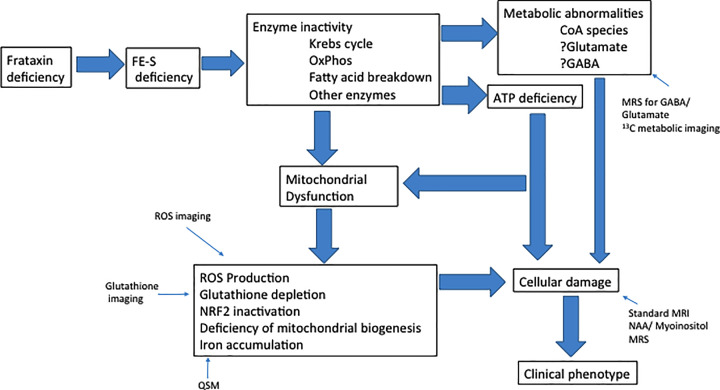
Friedreich ataxia (FRDA) is a recessive disorder resulting from relative deficiency of the mitochondrial protein frataxin. Frataxin functions in the process of iron-sulfur (Fe-S) cluster synthesis. In this review, we update some of the processes downstream of frataxin deficiency that may mediate the pathophysiology. Based on cellular models, models and observations of patients, ferroptosis may play a major role in the pathogenesis of FRDA along with depletion of antioxidant reserves and abnormalities of mitochondrial biogenesis. Ongoing clinical trials with ferroptosis inhibitors and nuclear factor erythroid 2-related factor 2 (Nrf2) activators are now targeting each of the processes. In addition, better understanding of the mitochondrial events in FRDA may allow the development of improved imaging methodology for assessing the disorder. Though not technologically feasible at present, metabolic imaging approaches may provide a direct methodology to understand the mitochondrial changes occurring in FRDA and provide a methodology to monitor upcoming trials of frataxin restoration.
弗里德赖希共济失调(FRDA)是一种隐性疾病,由线粒体蛋白铁硫蛋白相对缺乏所致。铁硫蛋白在铁硫(Fe-S)簇合成过程中发挥作用。在本综述中,我们更新了一些可能介导病理生理学的铁硫蛋白缺乏下游过程。基于细胞模型、动物模型和对患者的观察,铁死亡可能在FRDA的发病机制中起主要作用,同时伴有抗氧化储备耗竭和线粒体生物发生异常。目前正在进行的使用铁死亡抑制剂和核因子红细胞2相关因子2(Nrf2)激活剂的临床试验正针对上述每个过程。此外,更好地了解FRDA中的线粒体事件可能有助于开发用于评估该疾病的改进成像方法。尽管目前在技术上不可行,但代谢成像方法可能提供一种直接的方法来了解FRDA中发生的线粒体变化,并提供一种方法来监测即将进行的铁硫蛋白恢复试验。