Li Yuyi, Zhong Xingwei, Zhang Yunzhu, Lu Xinliang
Department of Gastroenterology, The Second Affiliated Hospital, Zhejiang University School of Medicine, Hangzhou, China.
Front Oncol. 2021 May 11;11:617677. doi: 10.3389/fonc.2021.617677. eCollection 2021.
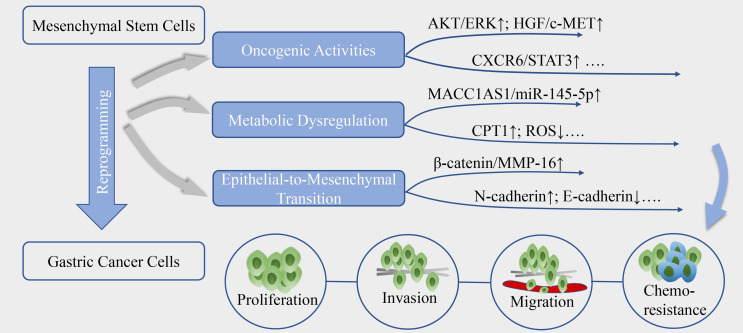
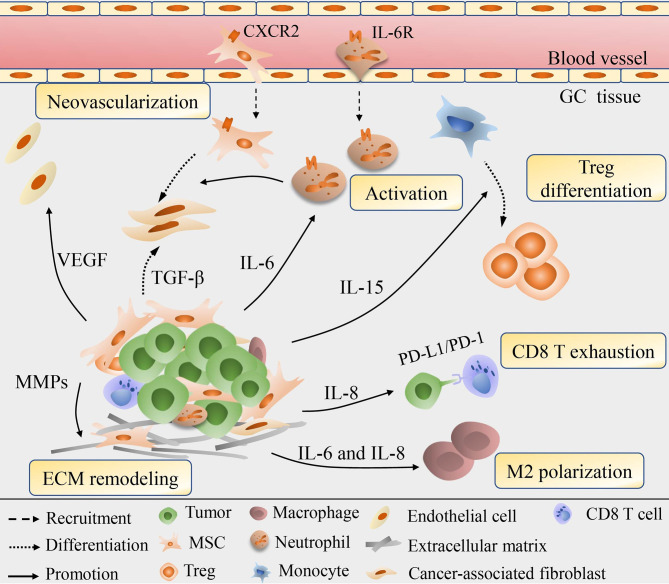
Tumor progression depends on the collaborative interactions between tumor cells and the surrounding stroma. First-line therapies direct against cancer cells may not reach a satisfactory outcome, such as gastric cancer (GC), with high risk of recurrence and metastasis. Therefore, novel treatments and drugs target the effects of stroma components are to be promising alternatives. Mesenchymal stem cells (MSC) represent the decisive components of tumor stroma that are found to strongly affect GC development and progression. MSC from bone marrow or adjacent normal tissues express homing profiles in timely response to GC-related inflammation signals and anchor into tumor bulks. Then the newly recruited "naïve" MSC would achieve phenotype and functional alternations and adopt the greater tumor-supporting potential under the reprogramming of GC cells. Conversely, both new-comers and tumor-resident MSC are able to modulate the tumor biology aberrant activation of oncogenic signals, metabolic reprogramming and epithelial-to-mesenchymal transition. And they also engage in remodeling the stroma better suited for tumor progression through immunosuppression, pro-angiogenesis, as well as extracellular matrix reshaping. On the account of tumor tropism, MSC could be engineered to assist earlier diagnosis of GC and deliver tumor-killing agents precisely to the tumor microenvironment. Meanwhile, intercepting and abrogating vicious signals derived from MSC are of certain significance for the combat of GC. In this review, we mainly summarize current advances concerning the reciprocal metabolic interactions between MSC and GC and their underlying therapeutic implications in the future.
肿瘤进展取决于肿瘤细胞与周围基质之间的协同相互作用。针对癌细胞的一线治疗可能无法达到令人满意的效果,例如胃癌(GC),其复发和转移风险很高。因此,针对基质成分作用的新型治疗方法和药物有望成为替代方案。间充质干细胞(MSC)是肿瘤基质的决定性成分,已发现其强烈影响GC的发生和进展。来自骨髓或邻近正常组织的MSC会及时响应GC相关的炎症信号并表达归巢特征,然后锚定到肿瘤块中。随后,新招募的“幼稚” MSC会实现表型和功能改变,并在GC细胞的重编程下具有更大的肿瘤支持潜力。相反,新来的和肿瘤驻留的MSC都能够调节肿瘤生物学——致癌信号的异常激活、代谢重编程和上皮-间质转化。它们还通过免疫抑制、促血管生成以及细胞外基质重塑参与重塑更适合肿瘤进展的基质。由于肿瘤嗜性,MSC可被改造用于辅助GC的早期诊断,并将肿瘤杀伤剂精确递送至肿瘤微环境。同时,拦截和消除源自MSC的恶性信号对于GC的治疗具有一定意义。在这篇综述中,我们主要总结了目前关于MSC与GC之间相互代谢相互作用及其未来潜在治疗意义的研究进展。