Endocrinology and Nutrition Department, Hospital Clínic of Barcelona, Barcelona, Spain.
Institute of Biomedical Investigations August Pi Sunyer (IDIBAPS), Barcelona, Spain, Barcelona, Spain.
J Diabetes Investig. 2021 Dec;12(12):2263-2266. doi: 10.1111/jdi.13604. Epub 2021 Jul 3.
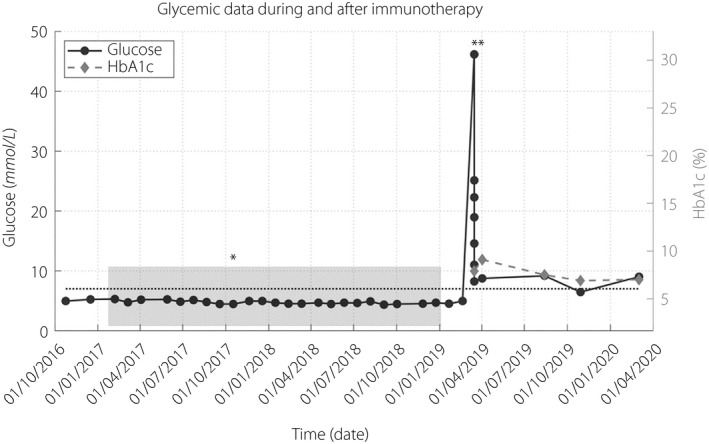
Diabetes is a rare, but potentially life-threatening, adverse event of immune checkpoint inhibitors that requires prompt recognition and treatment. It usually occurs in the first 3 months of treatment and is typically related to programmed cell death-1 antibodies, alone or in combined therapy. It has rarely been described developing after immunotherapy cessation. We present a 51-year-old man with metastatic melanoma, who developed acute-onset diabetes 52 days after combined immunotherapy cessation with nivolumab and ipilimumab, and 25.6 months after receiving the first dose. He presented with acute hyperglycemic symptoms, ketosis, complete insulin depletion and negative autoimmunity, fulfilling the criteria of fulminant type 1 diabetes. The patient had previously developed hypophysitis with isolated adrenocorticotropic hormone deficiency during immunotherapy. We describe a case of late-onset fulminant type 1 diabetes developing after immunotherapy cessation. Patient education and active follow up after immunotherapy discontinuation are crucial to warrant a timely intervention.
糖尿病是一种罕见但潜在危及生命的免疫检查点抑制剂的不良事件,需要及时识别和治疗。它通常发生在治疗的前 3 个月内,通常与程序性细胞死亡蛋白-1 抗体单独或联合治疗有关。它很少在免疫治疗停止后发生。我们报告了一例 51 岁男性转移性黑色素瘤患者,他在接受纳武单抗和伊匹单抗联合免疫治疗停止后 52 天,以及首次接受治疗后 25.6 个月时出现急性发作性糖尿病。他表现为急性高血糖症状、酮症、完全胰岛素耗竭和自身免疫阴性,符合暴发性 1 型糖尿病的标准。该患者在免疫治疗期间曾发生过垂体炎,伴有孤立性促肾上腺皮质激素缺乏症。我们描述了一例免疫治疗停止后发生的迟发性暴发性 1 型糖尿病病例。免疫治疗停止后对患者进行教育和积极随访对于保证及时干预至关重要。