Osimo Emanuele F, Baxter Luke, Stochl Jan, Perry Benjamin I, Metcalf Stephen A, Kunutsor Setor K, Laukkanen Jari A, Wium-Andersen Marie Kim, Jones Peter B, Khandaker Golam M
Department of Psychiatry, University of Cambridge, Cambridge, UK.
MRC London Institute of Medical Sciences, Institute of Clinical Sciences, Imperial College London, London, UK.
NPJ Schizophr. 2021 May 28;7(1):31. doi: 10.1038/s41537-021-00161-4.
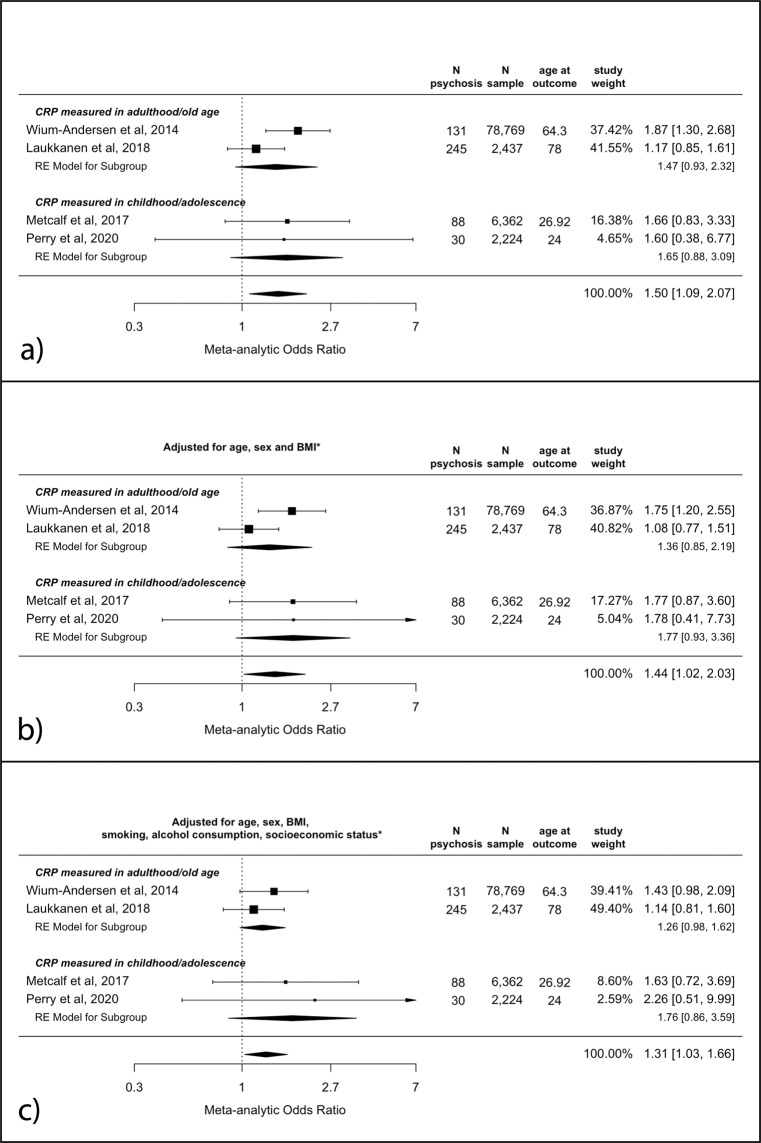
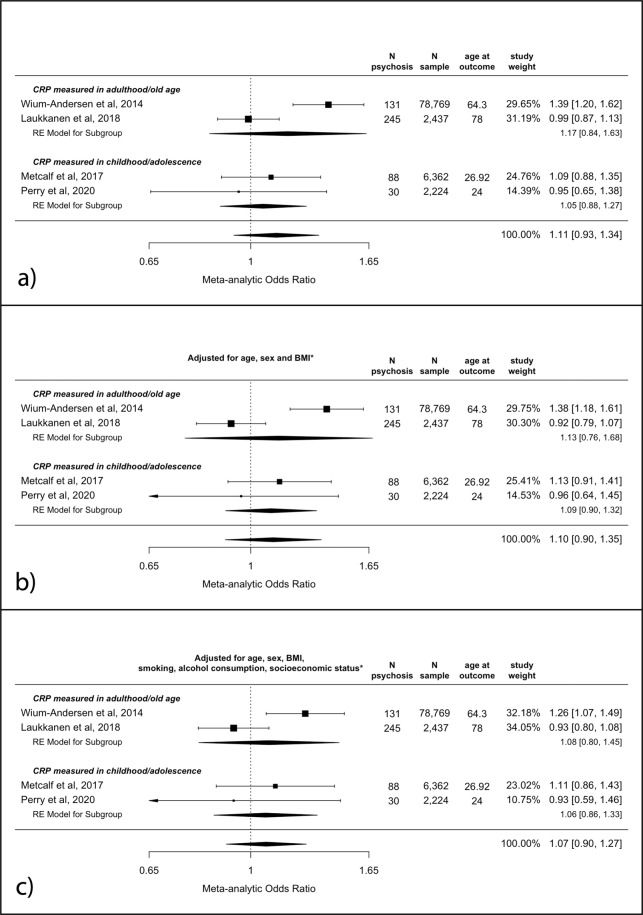
Meta-analyses of cross-sectional studies suggest that patients with psychosis have higher circulating levels of C-reactive protein (CRP) compared with healthy controls; however, cause and effect is unclear. We examined the prospective association between CRP levels and subsequent risk of developing a psychotic disorder by conducting a systematic review and meta-analysis of population-based cohort studies. Databases were searched for prospective studies of CRP and psychosis. We obtained unpublished results, including adjustment for age, sex, body mass index, smoking, alcohol use, and socioeconomic status and suspected infection (CRP > 10 mg/L). Based on random effect meta-analysis of 89,792 participants (494 incident cases of psychosis at follow-up), the pooled odds ratio (OR) for psychosis for participants with high (>3 mg/L), as compared to low (≤3 mg/L) CRP levels at baseline was 1.50 (95% confidence interval [CI], 1.09-2.07). Evidence for this association remained after adjusting for potential confounders (adjusted OR [aOR] = 1.31; 95% CI, 1.03-1.66). After excluding participants with suspected infection, the OR for psychosis was 1.36 (95% CI, 1.06-1.74), but the association attenuated after controlling for confounders (aOR = 1.23; 95% CI, 0.95-1.60). Using CRP as a continuous variable, the pooled OR for psychosis per standard deviation increase in log(CRP) was 1.11 (95% CI, 0.93-1.34), and this association further attenuated after controlling for confounders (aOR = 1.07; 95% CI, 0.90-1.27) and excluding participants with suspected infection (aOR = 1.07; 95% CI, 0.92-1.24). There was no association using CRP as a categorical variable (low, medium or high). While we provide some evidence of a longitudinal association between high CRP (>3 mg/L) and psychosis, larger studies are required to enable definitive conclusions.
横断面研究的荟萃分析表明,与健康对照相比,精神病患者的循环C反应蛋白(CRP)水平更高;然而,因果关系尚不清楚。我们通过对基于人群的队列研究进行系统评价和荟萃分析,研究了CRP水平与随后发生精神障碍风险之间的前瞻性关联。检索数据库以查找关于CRP与精神病的前瞻性研究。我们获得了未发表的结果,包括对年龄、性别、体重指数、吸烟、饮酒、社会经济地位以及疑似感染(CRP>10mg/L)的调整。基于对89792名参与者(随访期间有494例精神病发病病例)的随机效应荟萃分析,与基线时低(≤3mg/L)CRP水平的参与者相比,高(>3mg/L)CRP水平的参与者患精神病的合并比值比(OR)为1.50(95%置信区间[CI],1.09 - 2.07)。在对潜在混杂因素进行调整后(调整后OR[aOR] = 1.31;95%CI,1.03 - 1.66),这种关联的证据仍然存在。排除疑似感染的参与者后,患精神病的OR为1.36(95%CI,1.06 - 1.74),但在控制混杂因素后该关联减弱(aOR = 1.23;95%CI,0.95 - 1.60)。将CRP作为连续变量,log(CRP)每增加一个标准差,患精神病的合并OR为1.11(95%CI,0.93 - 1.34),在控制混杂因素后(aOR = 1.07;95%CI,0.90 - 1.27)以及排除疑似感染的参与者后(aOR = 1.07;95%CI,0.92 - 1.24),这种关联进一步减弱。使用CRP作为分类变量(低、中或高)时没有关联。虽然我们提供了一些高CRP(>3mg/L)与精神病之间纵向关联的证据,但需要更大规模的研究才能得出确定性结论。