Deng Shichang, Feng Xue
School of Management, Shanghai University of International Business and Economics, Shanghai, China.
School of Education and Sports Science, Yangtze University, Jingzhou, Hubei China.
Curr Psychol. 2022;41(6):3349-3362. doi: 10.1007/s12144-021-01792-7. Epub 2021 May 24.
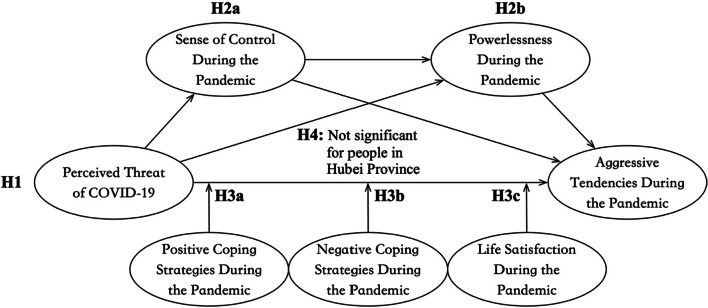
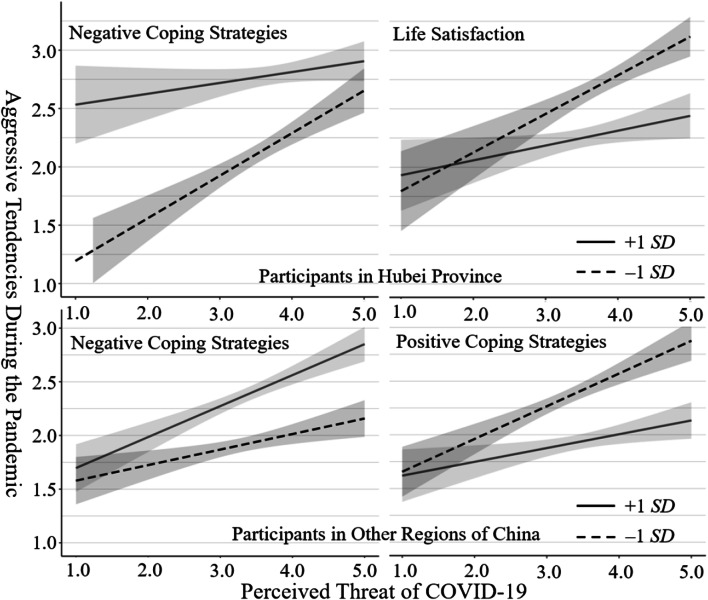
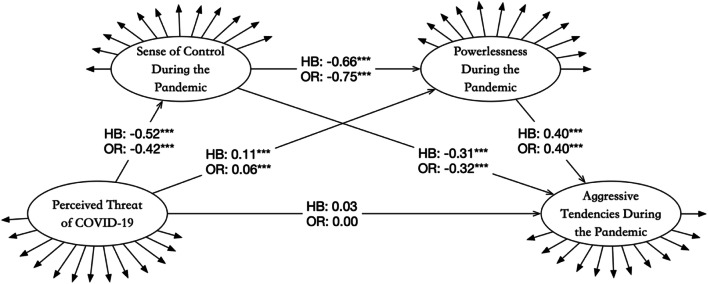
During the COVID-19 pandemic in early 2020, domestic violence, interpersonal conflicts, and cyberbullying have risen sharply in China. We speculate that the perceived threat of COVID-19 is related to a general, non-target-specific aggressive tendency during the pandemic. We surveyed 1556 Chinese people in April 2020 (757 people in Hubei Province, the pandemic epicenter in China, and 799 in other regions of China where the pandemic is relatively not severe). A multiple-group structural equation modeling analysis found significant total effects between perceived threat of COVID-19 and aggressive tendencies during the pandemic in both regional groups, and the effect between them was mainly achieved through the mediating roles of sense of control and powerlessness during the pandemic. For all participants, negative coping strategies significantly aggravated the association between perceived threat of COVID-19 and aggressive tendencies during the pandemic, but the buffers were different across regions of outbreak severity. For participants in other regions where the pandemic is relatively not severe, positive coping strategies could mitigate the association between perceived threat of COVID-19 and aggressions. However, for participants in Hubei Province, the epicenter of China's pandemic, higher life satisfaction was more effective in buffering. These findings extend the possible consequences of the perceived COVID-19 threat and suggest that improving the life satisfaction of residents in areas with severe outbreaks is more effective in mitigating the adverse effects of COVID-19.
The online version contains supplementary material available at 10.1007/s12144-021-01792-7.
在2020年初的新冠疫情期间,中国的家庭暴力、人际冲突和网络欺凌现象急剧增加。我们推测,对新冠疫情的感知威胁与疫情期间普遍的、非特定目标的攻击倾向有关。2020年4月,我们对1556名中国人进行了调查(湖北省757人,中国疫情中心;中国其他疫情相对不严重地区799人)。多组结构方程模型分析发现,两个地区组中,对新冠疫情的感知威胁与疫情期间的攻击倾向之间均存在显著的总效应,且两者之间的效应主要通过疫情期间的控制感和无力感的中介作用实现。对于所有参与者,消极应对策略显著加剧了疫情期间对新冠疫情的感知威胁与攻击倾向之间的关联,但不同疫情严重程度地区的缓冲因素不同。对于疫情相对不严重的其他地区的参与者,积极应对策略可以减轻对新冠疫情的感知威胁与攻击行为之间的关联。然而,对于中国疫情中心湖北省的参与者,更高的生活满意度在缓冲方面更有效。这些发现扩展了对新冠疫情感知威胁的可能后果,并表明提高疫情严重地区居民的生活满意度对减轻新冠疫情的不利影响更有效。
网络版包含可在10.1007/s12144-021-01792-7获取的补充材料。