Institute of Medicine, Chung Shan Medical University, Taichung, Taiwan.
Department of Obstetrics and Gynecology, Chiayi Chang Gung Memorial Hospital, Chiayi, Taiwan.
Front Immunol. 2021 May 12;12:626582. doi: 10.3389/fimmu.2021.626582. eCollection 2021.
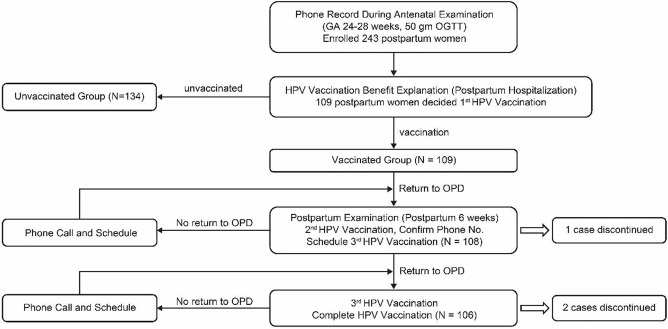
There is a need to increase the vaccine completion rates in women who have already received human papillomavirus (HPV) vaccines. With vaccines requiring multiple doses, designing a vaccination control program and increasing the proportion of women who complete vaccination are critical and remain as huge challenges. Currently, there are no published reports on the differences in the background characteristics between postpartum women who are vaccinated or unvaccinated against HPV. This study aimed to determine the vaccination rates of the second and third doses of HPV vaccination utilizing an achievable HPV vaccination program in postpartum women. In this retrospective study, 243 postpartum women attending Chiayi Chang Gung Memorial Hospital between March and September 2014 were enrolled. These women were classified into two groups: one group received the HPV vaccine under a practical, controlled postpartum HPV vaccination program, and the other group did not. The rates for the second and third rounds of HPV vaccination in postpartum women were calculated. The differences in the background characteristics between the two groups were determined using the Student's t test, chi-square test or Fisher's exact test, and the multiple logistic models, as appropriate. Under the controlled postpartum HPV vaccination program, the completion rate for the three doses of postpartum HPV vaccination was 97.2%. Significant differences were observed according to maternal age, gender of the newborn, and postpartum Pap smear results between the two groups in our study. In conclusion, the controlled postpartum HPV vaccination program is a reasonable method for achieving an excellent completion rate for the three doses of postpartum HPV vaccination and may be a good model for any multiple-dose vaccination protocol.
需要提高已经接种人乳头瘤病毒(HPV)疫苗的女性的疫苗完成率。由于疫苗需要多次接种,设计疫苗接种控制计划并提高完成疫苗接种的女性比例至关重要,这仍然是巨大的挑战。目前,尚无关于接种或未接种 HPV 疫苗的产后妇女在背景特征方面存在差异的已发表报告。本研究旨在确定利用产后可行 HPV 疫苗接种计划接种 HPV 疫苗第二和第三针的接种率。在这项回顾性研究中,共纳入 2014 年 3 月至 9 月在嘉义长庚纪念医院就诊的 243 名产后妇女。这些妇女被分为两组:一组按照实用的、控制产后 HPV 疫苗接种计划接种 HPV 疫苗,另一组不接种。计算了产后妇女接种 HPV 疫苗第二和第三针的比率。使用学生 t 检验、卡方检验或 Fisher 确切检验以及适当的多因素逻辑模型确定两组之间背景特征的差异。在控制产后 HPV 疫苗接种计划下,三剂产后 HPV 疫苗接种的完成率为 97.2%。我们的研究发现,两组之间的产妇年龄、新生儿性别和产后巴氏涂片结果存在显著差异。总之,控制产后 HPV 疫苗接种计划是实现三剂产后 HPV 疫苗接种的优秀完成率的合理方法,可能是任何多剂量疫苗接种方案的良好模式。