Department of Respiratory and Critical Care Medicine, West China Hospital, Sichuan University, No. 37 Guoxue Alley, Chengdu 610041, Sichuan, China.
Can Respir J. 2021 May 4;2021:6638048. doi: 10.1155/2021/6638048. eCollection 2021.
High-flow nasal cannula (HFNC) oxygen therapy has been recommended for use in coronavirus disease 2019 (COVID-19) patients with acute respiratory failure and many other clinical conditions. HFNC devices produced by different manufacturers may have varied performance. Whether there is a difference in these devices and the extent of the differences in performance remain unknown.
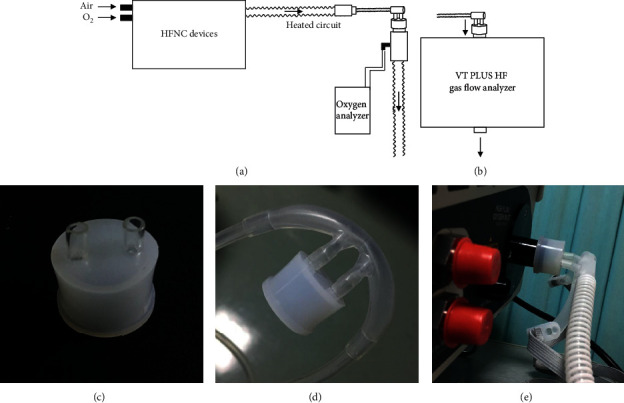
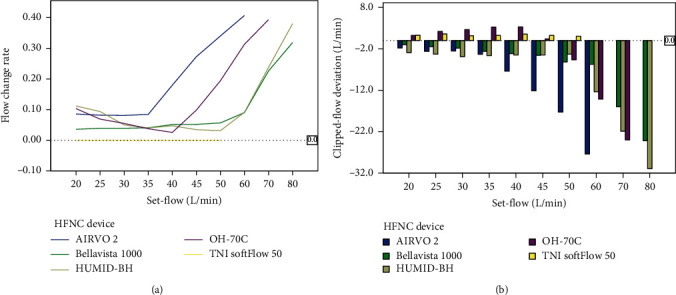
Four HFNC devices (AIRVO 2, TNI softFlow 50, HUMID-BH, and OH-70C) and a ventilator with an HFNC module (bellavista 1000) were evaluated. The flow was set at 20, 25, 30, 35, 40, 45, 50, 60, 70, and 80 L/min, and the FiO was set at 21%, 26%, 30%, 35%, 40%, 45%, 50%, 60%, 70%, 80%, and 90%. Then, one side of the cannulas was clipped to simulate the compression, bending, or blocking of the nasal cannulas. The flow and FiO of the delivered gas were recorded and compared among settings and devices.
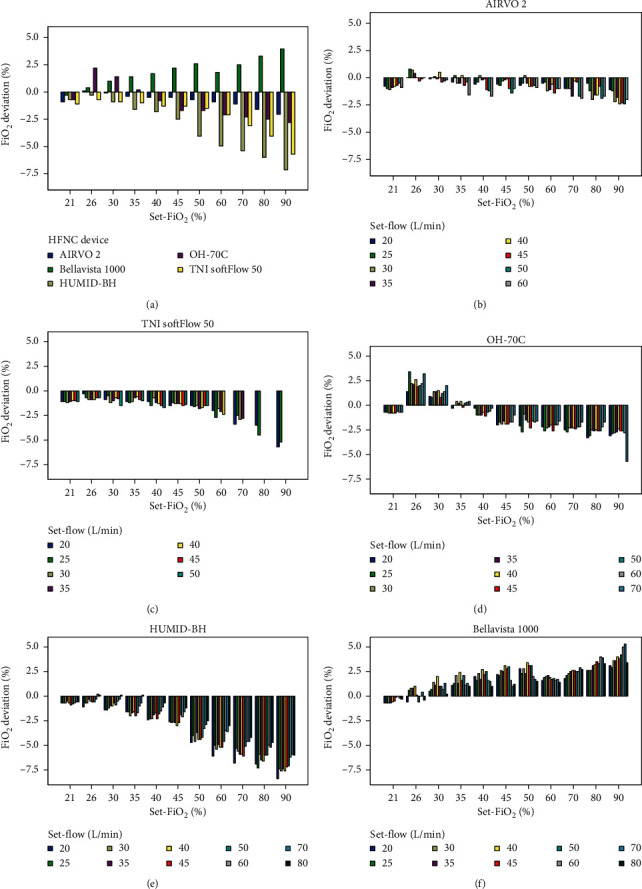
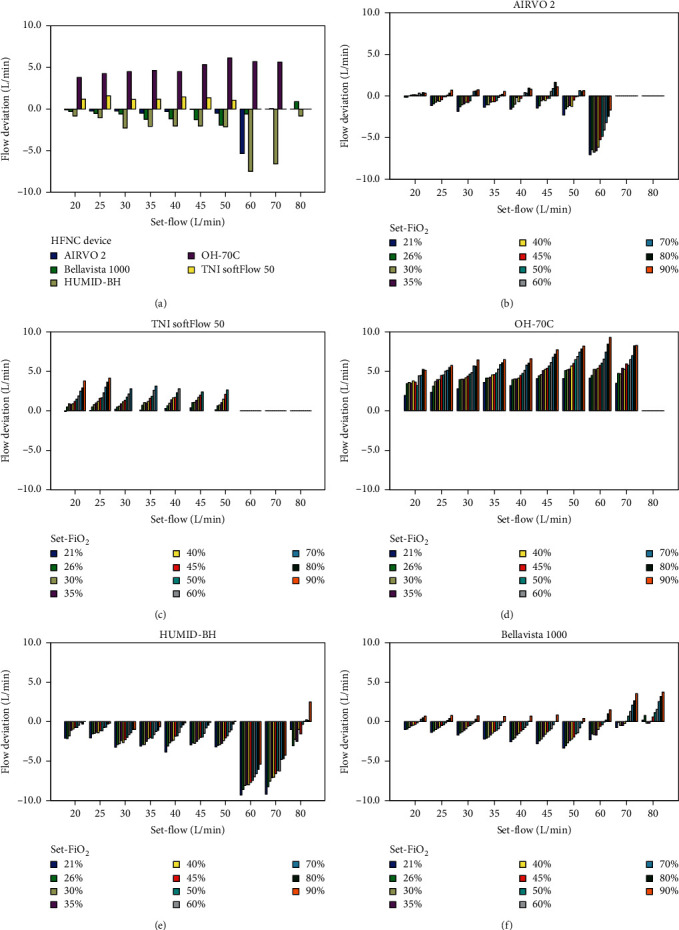
The actual-flow and actual-FiO delivered by different settings and devices varied. AIRVO 2 had superior performance in flow and FiO accuracy. bellavista 1000 and OH-70C had good performance in the accuracy of actual-flows and actual-FiO respectively. bellavista 1000 and HUMID-BH had a larger flow range from 10 to 80 L/min, but only bellavista 1000 could provide a stable flow with an excessive resistance up to 60 L/min. TNI softFlow 50 had the best flow compensation and could provide sufficient flow with excessive resistance at 20-50 L/min.
The variation in flow, FiO settings, and devices could influence the actual-flow and actual-FiO delivered. AIRVO 2 and OH-70C showed better FiO accuracy. TNI softFlow 50, bellavista 1000, and HUMID-BH could lower the risk of insufficient flow support due to accidental compression or blocking of the cannulas. In addition, ventilators with HFNC modules provided comparable flow and FiO and could be an alternative to standalone HFNC devices.
高流量鼻导管(HFNC)氧疗已被推荐用于 COVID-19 急性呼吸衰竭和许多其他临床病症的患者。不同制造商生产的 HFNC 设备可能具有不同的性能。这些设备之间是否存在差异以及性能差异的程度仍不清楚。
评估了四种 HFNC 设备(AIRVO 2、TNI softFlow 50、HUMID-BH 和 OH-70C)和带有 HFNC 模块的呼吸机(bellavista 1000)。将流量设置为 20、25、30、35、40、45、50、60、70 和 80 L/min,FiO 设置为 21%、26%、30%、35%、40%、45%、50%、60%、70%、80% 和 90%。然后,将鼻塞的一侧夹上,模拟鼻塞的压缩、弯曲或堵塞。记录输送气体的实际流量和 FiO,并比较不同设置和设备之间的差异。
不同设置和设备输送的实际流量和 FiO 存在差异。AIRVO 2 在流量和 FiO 精度方面表现出色。bellavista 1000 和 OH-70C 在实际流量和 FiO 精度方面表现良好。bellavista 1000 和 HUMID-BH 的流量范围从 10 到 80 L/min 较大,但只有 bellavista 1000 可以在超过 60 L/min 的阻力下提供稳定的流量。TNI softFlow 50 的流量补偿效果最佳,在 20-50 L/min 的阻力下可提供充足的流量。
流量、FiO 设置和设备的变化会影响输送的实际流量和 FiO。AIRVO 2 和 OH-70C 显示出更好的 FiO 精度。TNI softFlow 50、bellavista 1000 和 HUMID-BH 可以降低因鼻塞意外压缩或堵塞导致流量不足的风险。此外,带有 HFNC 模块的呼吸机可提供相当的流量和 FiO,是独立 HFNC 设备的替代选择。