Müller Sebastian A, Adolfsson Lars, Baum Cornelia, Müller-Gerbl Magdalena, Müller Andreas M, Rikli Daniel
Department of Orthopedic Surgery (S.A.M., C.B., A.M.M., and D.R.) and Institute of Anatomy (M.M.-G.), University of Basel, Basel, Switzerland.
Department of Orthopedic Surgery, Linköping University, Linköping, Sweden.
JB JS Open Access. 2021 May 5;6(2). doi: 10.2106/JBJS.OA.20.00160. eCollection 2021 Apr-Jun.
Despite new 3-dimensional imaging modalities, 2-dimensional fluoroscopy remains the standard intraoperative imaging modality. The elbow has complex anatomy, and defined standard fluoroscopic projections are lacking. Therefore, the aim of this study was to define standard projections of the elbow for intraoperative fluoroscopy.
This study consisted of 2 parts. In part I, dissected cadaveric elbows were examined under fluoroscopy, and their radiographic anatomical features were assessed, with focus on projections showing defined anatomical landmarks. In part II, projections from part I were verified on entire cadavers to simulate intraoperative imaging. Standard projections for anteroposterior (AP) and lateral views as well as oblique and axial views were recorded.
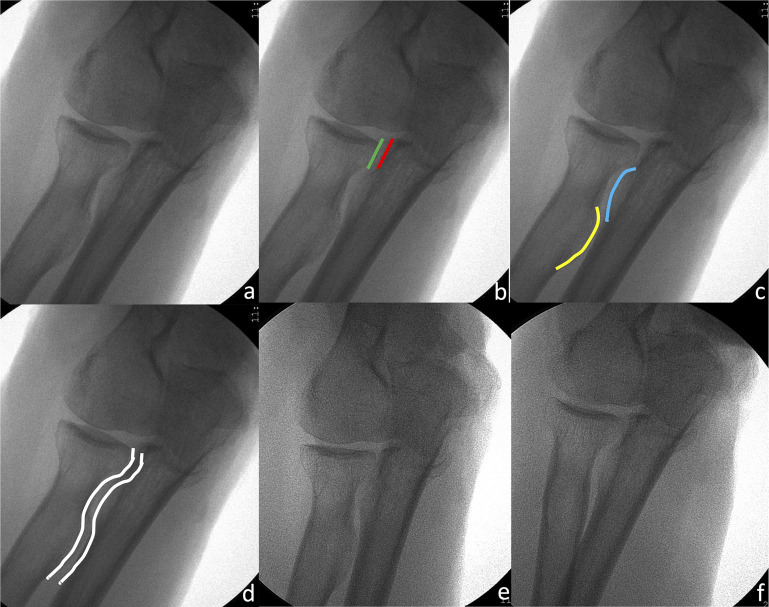
Eight standardized projections could be defined and included 3 AP, 1 lateral, 2 oblique, and 2 axial views. By applying these specific projections, we could visualize the epicondyles, the trochlea with its medial and lateral borders, the capitellum, the olecranon, the greater sigmoid notch, the coronoid process including its anteromedial facet, the proximal radioulnar joint with the radial tuberosity, and the anterior and posterior joint lines of the distal part of the humerus. These standard projections were reliably obtained using a specific sequence.
Knowledge about radiographic anatomy and standard projections is essential for visualizing important landmarks. With the presented standard projections of the elbow, important anatomical landmarks can be clearly examined. Thus, fluoroscopic visualization of anatomical fracture reduction and correct implant placement should be facilitated.
This basic science cadaveric study defines fluoroscopic standard projections of the elbow essential for visualization of anatomical landmarks during surgery.
尽管有新的三维成像方式,但二维荧光透视检查仍是术中成像的标准方式。肘部解剖结构复杂,缺乏明确的标准荧光透视投照。因此,本研究的目的是确定肘部术中荧光透视的标准投照。
本研究包括两部分。在第一部分中,对解剖后的尸体肘部进行荧光透视检查,并评估其放射学解剖特征,重点是显示明确解剖标志的投照。在第二部分中,在整个尸体上验证第一部分的投照,以模拟术中成像。记录前后位(AP)和侧位以及斜位和轴位的标准投照。
可以确定八个标准化投照,包括3个AP位、1个侧位、2个斜位和2个轴位。通过应用这些特定投照,我们可以观察到髁上突、带有内侧和外侧边界的滑车、肱骨小头、鹰嘴、大的乙状切迹、包括其前内侧小面的冠状突、带有桡骨粗隆的近端桡尺关节以及肱骨远端的前后关节线。使用特定序列可可靠地获得这些标准投照。
了解放射学解剖和标准投照对于观察重要标志至关重要。通过所呈现的肘部标准投照,可以清晰地检查重要的解剖标志。因此,应有助于荧光透视观察解剖复位和正确植入物放置。
这项基础科学尸体研究确定了肘部荧光透视标准投照,这对于手术中观察解剖标志至关重要。