Department of Physiotherapy, Monash University, Melbourne, VIC, Australia.
Department of Epidemiology and Preventive Medicine, Monash University, Melbourne, VIC, Australia.
Health Qual Life Outcomes. 2021 May 31;19(1):157. doi: 10.1186/s12955-021-01794-w.
The 12-item Short-Form Health Survey version 2 (SF-12v2), a widely used, generic patient-reported measure of health status that provides summary scores of physical and mental health. No study to date has examined the measurement properties of the SF-12v2 in patients with lung cancer using Rasch analysis. The aim of this study was to extend the psychometric evaluations of the SF-12 within the lung cancer population to ensure its validity and reliability to assess the health status in this population.
Participants in the Victorian Lung Cancer Registry (VLCR) who completed the SF-12v2 between 2012 and 2016 were included in this study. The structural validity of the SF-12v2 was assessed using Rasch analysis. Overall fit to the Rasch measurement model was examined as well as five key measurement properties: uni-dimensionality, response thresholds, internal consistency, measurement invariance and targeting.
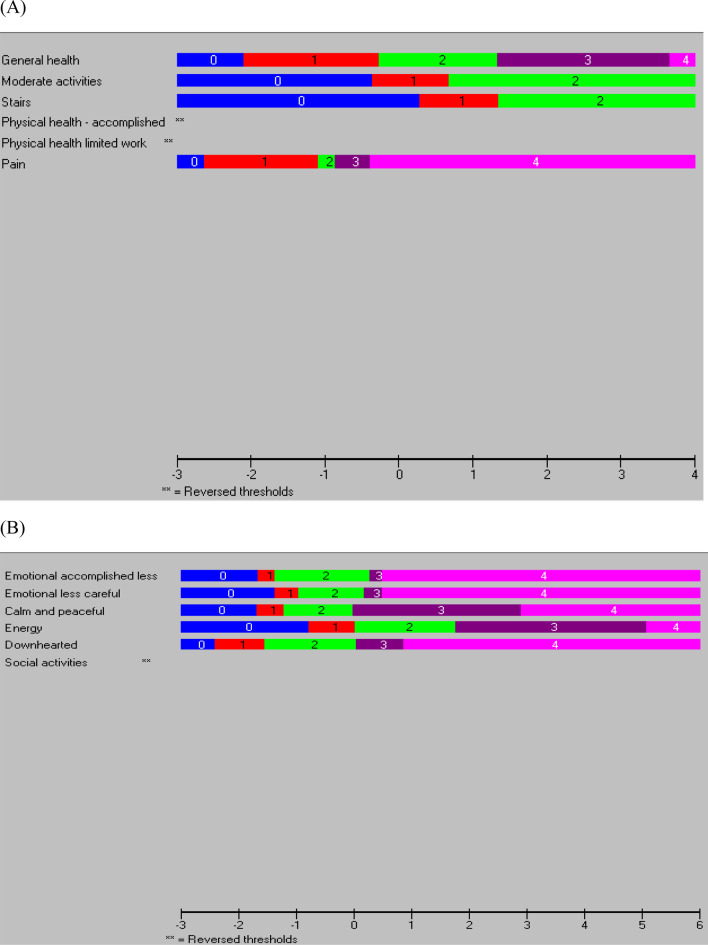
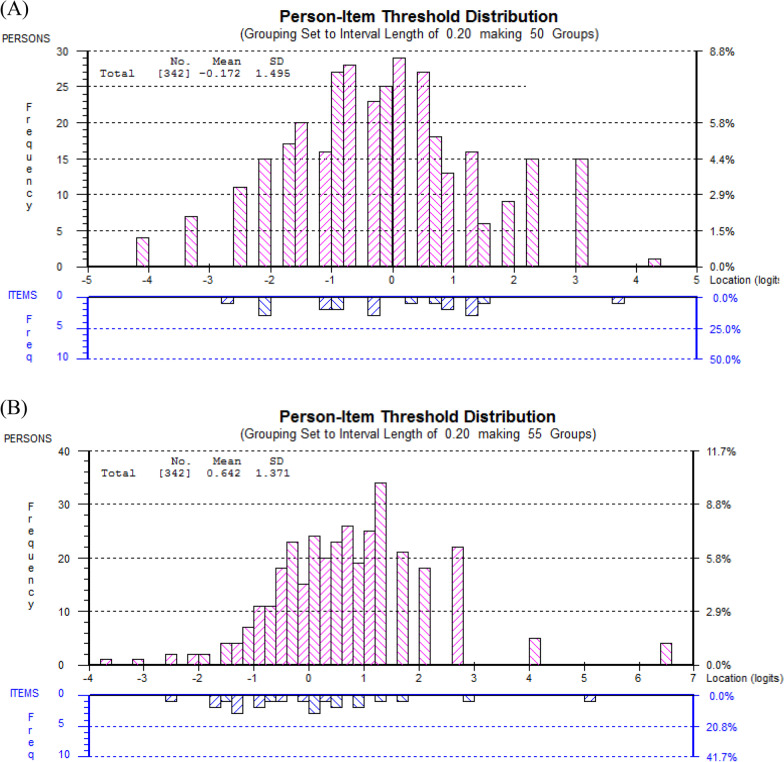
A total of 342 participants completed the SF-12v2 three months following their lung cancer diagnosis. The SF-12 Physical Component Score (PCS-12) did not fit the overall Rasch measurement model (χ 107.0; p < 0.001). Three items deviated significantly from the Rasch model (item fit residual beyond ± 2.5) with signs of dependency between item responses and disordered thresholds. Nevertheless, the PCS-12 was uni-dimensional with good internal consistency (person separation index [PSI] 0.83) and reasonable targeting. In contrast, the SF-12 Mental Component Score (MCS-12) had good overall model fit (χ 35.1; p = 0.07), reasonable targeting and good internal consistency (PSI 0.81).
Rasch analysis suggests that there is general support for the reliability of the SF-12v2 as a measure of physical and mental health in people with lung cancer. However, the appropriateness of some items (e.g. pain) in the PCS-12 is questionable and further refinement of the scale including changing the response options may be required to improve the ability of the SF-12v2 to more appropriately assess the health status of this population.
12 项简明健康量表第 2 版(SF-12v2)是一种广泛使用的、通用的患者报告健康状况衡量标准,提供身体和心理健康的综合评分。迄今为止,尚无研究使用 Rasch 分析来检验肺癌患者的 SF-12v2 的测量特性。本研究旨在扩展 SF-12 在肺癌人群中的心理测量评估,以确保其在该人群中评估健康状况的有效性和可靠性。
本研究纳入了 2012 年至 2016 年间在维多利亚肺癌登记处(VLCR)完成 SF-12v2 调查的参与者。使用 Rasch 分析评估 SF-12v2 的结构效度。检查了 SF-12v2 对 Rasch 测量模型的整体拟合,以及五个关键测量特性:单维性、反应阈值、内部一致性、测量不变性和目标定位。
共有 342 名参与者在肺癌诊断后三个月完成了 SF-12v2 调查。SF-12 生理成分量表(PCS-12)整体不符合 Rasch 测量模型(χ 107.0;p < 0.001)。有三个项目明显偏离 Rasch 模型(项目拟合残差超过±2.5),并且项目反应之间存在依赖关系和不规律的阈值。尽管如此,PCS-12 是单维的,具有良好的内部一致性(个体分离指数 [PSI] 0.83)和合理的目标定位。相比之下,SF-12 心理成分量表(MCS-12)整体模型拟合良好(χ 35.1;p = 0.07),目标定位合理,内部一致性良好(PSI 0.81)。
Rasch 分析表明,SF-12v2 作为衡量肺癌患者身体和心理健康的工具具有可靠性,这得到了普遍支持。然而,PCS-12 中某些项目(如疼痛)的适宜性值得怀疑,可能需要进一步细化量表,包括改变反应选项,以提高 SF-12v2 更恰当地评估该人群健康状况的能力。