Integrative Neuroscience and Cognition Center (UMR8002), CNRS, Paris, France.
Integrative Neuroscience and Cognition Center (UMR8002), Université de Paris, Paris, France.
Dev Sci. 2021 Nov;24(6):e13112. doi: 10.1111/desc.13112. Epub 2021 Jun 1.
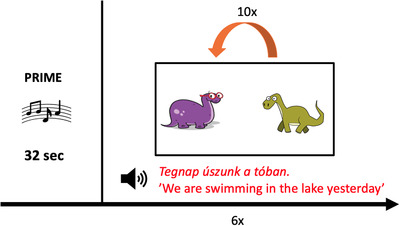
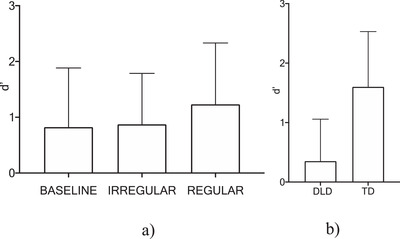
Research has described several features shared between musical rhythm and speech or language, and experimental studies consistently show associations between performance on tasks in the two domains as well as impaired rhythm processing in children with language disorders. Motivated by these results, in the current study our first aim was to explore whether a short exposure to a regular musical rhythm (i.e., rhythmic priming) can improve subsequent grammatical processing in preschool-aged Hungarian-speaking children with and without developmental language disorder (DLD). Second, we investigated whether rhythmic priming is specific to grammar processing by assessing priming in two additional domains: a linguistic but non-grammatical task (picture naming) and a non-linguistic task (nonverbal Stroop task). Third, to confirm that the rhythmic priming effect originates from the facilitating effect of the regular rhythm and not the negative effect of the control condition, we added a third condition, silence, for all the three tasks. Both groups of children showed better performance on the grammaticality judgment task in the regular compared to both the irregular and the silent conditions but no such effect appeared in the non-grammatical and non-linguistic tasks. These results suggest that (1) rhythmic priming can improve grammatical processing in Hungarian, a language with complex morphosyntax, both in children with and without DLD, (2) the effect is specific to grammar and (3) is a result of the facilitating effect of the regular rhythm. These results could motivate further research about integrating rhythmic priming into traditional speech-language therapy. A video abstract of this article can be viewed at https://youtu.be/zKzGuIjZyvU.
研究已经描述了音乐节奏和言语或语言之间的几个共同特征,实验研究一致表明,在这两个领域的任务表现以及语言障碍儿童的节奏处理受损之间存在关联。受这些结果的启发,在当前的研究中,我们的第一个目的是探索短时间接触有规律的音乐节奏(即节奏启动)是否可以改善有和没有发育性语言障碍(DLD)的学龄前匈牙利语儿童随后的语法处理。其次,我们通过评估两个额外领域(语言但非语法任务(图片命名)和非语言任务(非言语 Stroop 任务)中的启动,来研究节奏启动是否特定于语法处理。第三,为了确认节奏启动效应源自规则节奏的促进作用,而不是对照条件的负面影响,我们为所有三个任务添加了第三个条件,即沉默。两个儿童组在规则条件下的语法判断任务表现均优于不规则条件和沉默条件,但在非语法和非语言任务中没有出现这种效果。这些结果表明:(1) 节奏启动可以改善匈牙利语的语法处理,匈牙利语具有复杂的形态句法,在有和没有 DLD 的儿童中均如此,(2) 这种效果是特定于语法的,(3) 是规则节奏的促进作用的结果。这些结果可能会促使人们进一步研究将节奏启动纳入传统的言语语言治疗中。本文的视频摘要可在 https://youtu.be/zKzGuIjZyvU 观看。