Imperial College London, Department of Life Sciences, MRC Centre for Molecular Bacteriology and Infection, London, United Kingdom.
Science for Life Laboratory, Department of Molecular Biosciences, The Wenner-Gren Institute, Stockholm University, Stockholm, Sweden.
mBio. 2021 Jun 29;12(3):e0026221. doi: 10.1128/mBio.00262-21. Epub 2021 Jun 1.
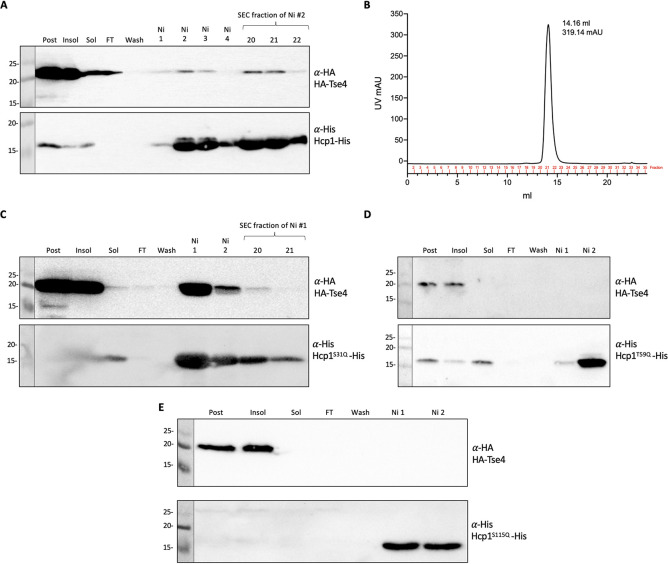
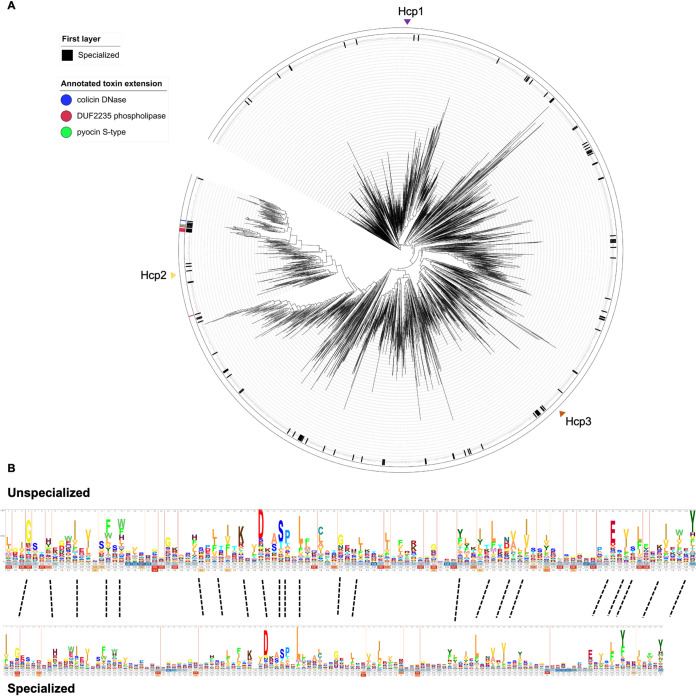
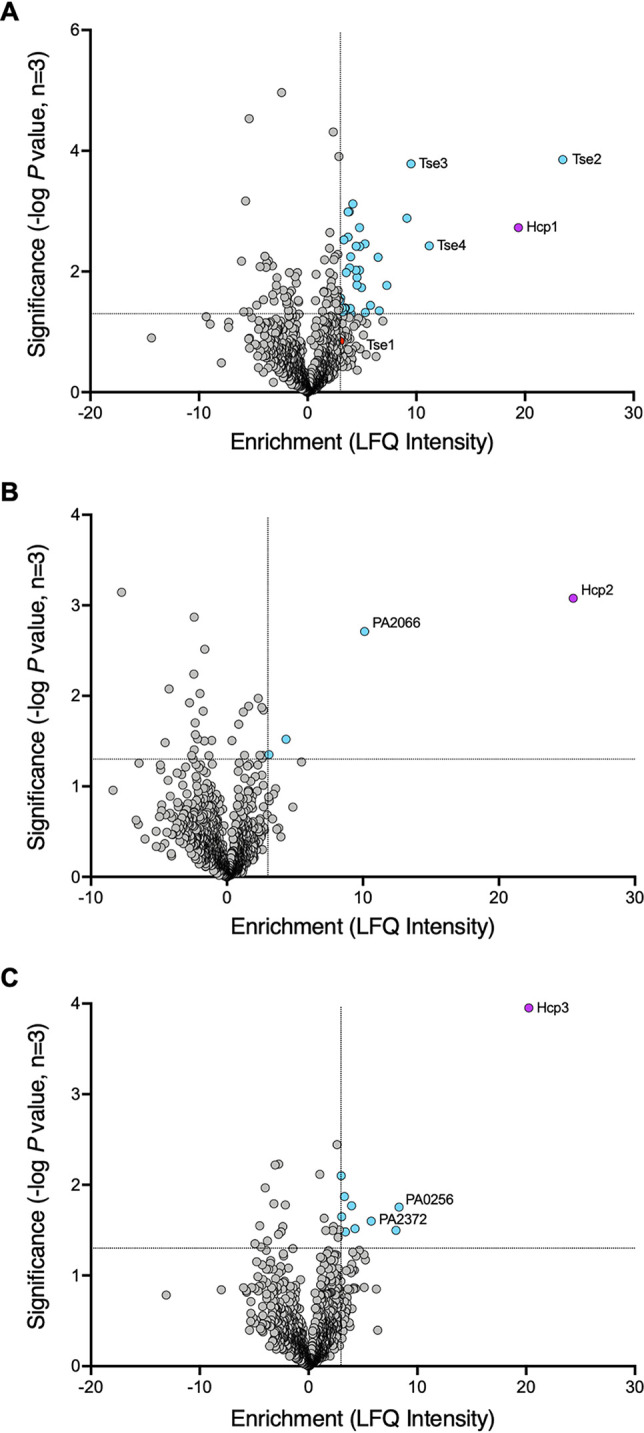
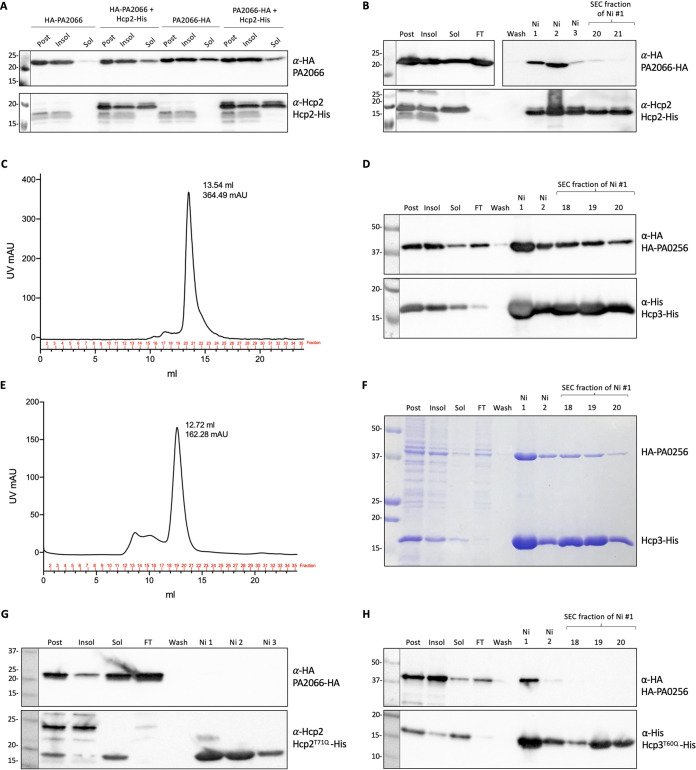
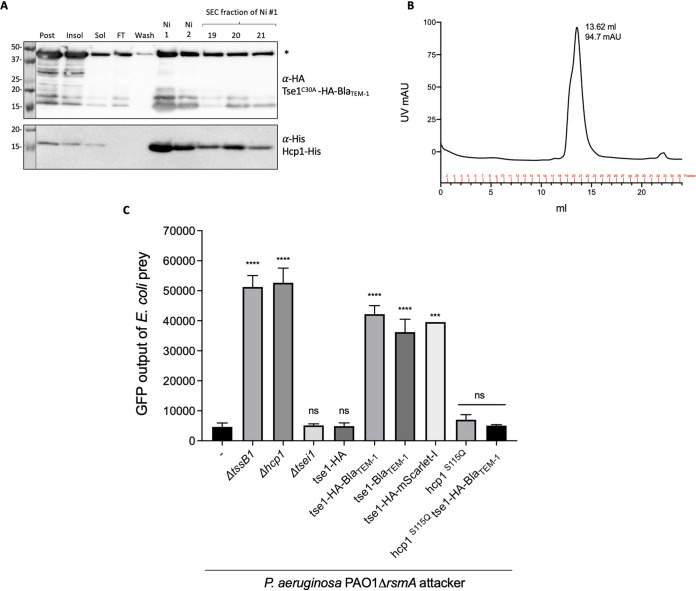
The type VI secretion system (T6SS) is a bacterial nanoscale weapon that delivers toxins into prey ranging from bacteria and fungi to animal hosts. The cytosolic contractile sheath of the system wraps around stacked hexameric rings of Hcp proteins, which form an inner tube. At the tip of this tube is a puncturing device comprising a trimeric VgrG topped by a monomeric PAAR protein. The number of toxins a single system delivers per firing event remains unknown, since effectors can be loaded on diverse sites of the T6SS apparatus, notably the inner tube and the puncturing device. Each VgrG or PAAR can bind one effector, and additional effector cargoes can be carried in the Hcp ring lumen. While many VgrG- and PAAR-bound toxins have been characterized, to date, very few Hcp-bound effectors are known. Here, we used 3 known Pseudomonas aeruginosa Hcp proteins (Hcp1 to -3), each of which associates with one of the three T6SSs in this organism (H1-T6SS, H2-T6SS, and H3-T6SS), to perform pulldown assays. We confirmed the known interactions of Hcp1 with Tse1 to -4, further copurified a Hcp1-Tse4 complex, and identified potential novel Hcp1-bound effectors. Moreover, we demonstrated that Hcp2 and Hcp3 can shuttle T6SS cargoes toxic to Escherichia coli. Finally, we used a Tse1-Bla chimera to probe the loading strategy for Hcp passengers and found that while large effectors can be loaded onto Hcp, the formed complex jams the system, abrogating T6SS function. The type VI secretion system (T6SS) is an effective weapon used by bacteria to outgrow or kill competitors. It can be used by endogenous commensal microbiota to prevent invasion by pathogens or by pathogens to overcome resident flora and successfully colonize a host or a specific environmental niche. The T6SS is a key contributor to this continuous arms race between organisms as it delivers a multitude of toxins directed at essential processes, such as nucleic acid synthesis and replication, cell wall and membrane integrity, protein synthesis, or cofactor abundance. Many T6SS toxins with unknown function remain to be discovered, whose yet-uncharacterized targets could be exploited for antimicrobial drug design. The systematic search for these toxins is not facilitated by the presence of readily recognizable T6SS motifs, and unbiased screening approaches are thus required. Here, we successfully used a known shuttle for cargo T6SS effectors, Hcp, as bait to identify uncharacterized toxins.
VI 型分泌系统(T6SS)是一种细菌纳米级武器,可将毒素输送到从细菌和真菌到动物宿主等各种猎物中。该系统的细胞质收缩鞘缠绕在 Hcp 蛋白的堆叠六聚体环上,形成一个内管。在这个管的尖端是一个穿孔装置,由顶部带有单体 PAAR 蛋白的三聚体 VgrG 组成。单个系统在每次发射事件中输送的毒素数量仍然未知,因为效应物可以加载到 T6SS 装置的不同部位,特别是内管和穿孔装置。每个 VgrG 或 PAAR 可以结合一种效应物,并且可以在 Hcp 环腔中携带额外的效应物货物。虽然已经表征了许多 VgrG 和 PAAR 结合的毒素,但迄今为止,已知的 Hcp 结合效应物很少。在这里,我们使用了 3 种已知的铜绿假单胞菌 Hcp 蛋白(Hcp1 到 -3),它们分别与该生物体中的 3 种 T6SS 之一(H1-T6SS、H2-T6SS 和 H3-T6SS)相关联,以进行下拉测定。我们证实了 Hcp1 与 Tse1 到 -4 的已知相互作用,进一步共纯化了 Hcp1-Tse4 复合物,并鉴定了潜在的新型 Hcp1 结合效应物。此外,我们证明 Hcp2 和 Hcp3 可以输送对大肠杆菌有毒的 T6SS 货物。最后,我们使用 Tse1-Bla 嵌合体来探测 Hcp 乘客的装载策略,发现虽然可以将大的效应物装载到 Hcp 上,但形成的复合物会堵塞系统,从而破坏 T6SS 的功能。VI 型分泌系统(T6SS)是细菌用来超越或杀死竞争对手的有效武器。它可以被内共生的共生微生物用来防止病原体的入侵,也可以被病原体用来克服常驻菌群并成功定植宿主或特定的环境小生境。T6SS 是生物体之间持续军备竞赛的关键贡献者,因为它输送了许多针对核酸合成和复制、细胞壁和膜完整性、蛋白质合成或辅因子丰度等基本过程的毒素。许多具有未知功能的 T6SS 毒素有待发现,其尚未表征的靶标可以被用于开发抗菌药物。这些毒素的系统搜索并不方便使用易于识别的 T6SS 基序,因此需要使用无偏见的筛选方法。在这里,我们成功地使用了一种已知的货物 T6SS 效应物穿梭蛋白 Hcp 作为诱饵来鉴定未表征的毒素。