Oncology Unit, Third Department of Medicine, Sotiria General Hospital, National and Kapodistrian University of Athens, 11527 Athens, Greece.
Int J Mol Sci. 2021 May 4;22(9):4862. doi: 10.3390/ijms22094862.
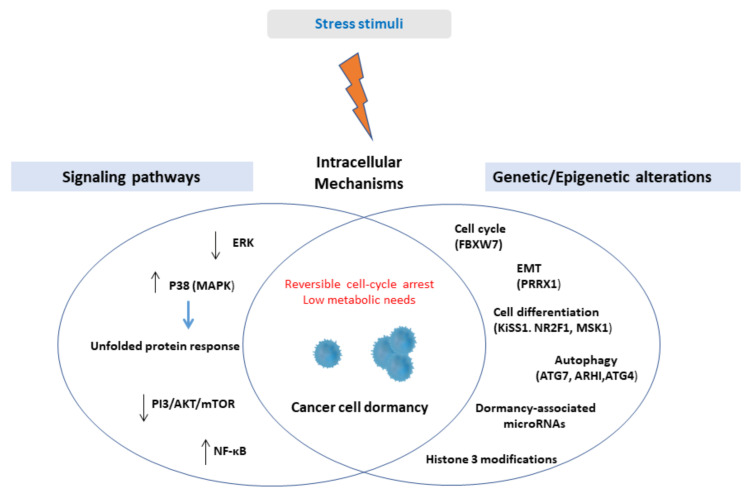
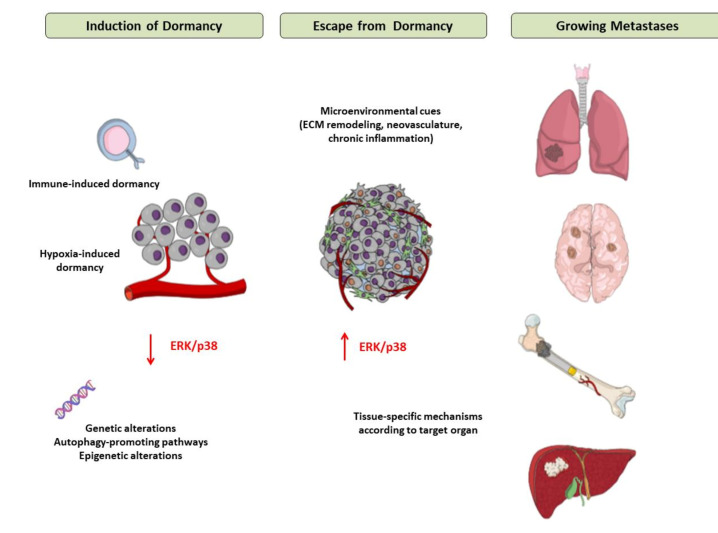
Tumor dormancy refers to a critical stage of cancer development when tumor cells are present, but cancer does not progress. It includes both the concept of cellular dormancy, indicating the reversible switch of a cancer cell to a quiescent state, and that of tumor mass dormancy, indicating the presence of neoplastic masses that have reached cell population equilibrium via balanced growth/apoptosis rates. Tumor dormancy provides the conceptual framework, potentially explaining a major challenge in clinical oncology, tumor recurrence, which may occur years after cancer diagnosis. The mechanisms by which tumors are kept dormant, and what triggers their reawakening, are fundamental questions in cancer biology. It seems that a plethora of intracellular pathways and extracellular factors are involved in this process, rewiring the cells to plastically alter their metabolic and proliferative status. This phenomenon is highly dynamic in space and time. Mechanistic insights into both cellular and tumor dormancy have provided the rationale for targeting this otherwise stable period of cancer development, in order to prevent recurrence and maximize therapeutic benefit.
肿瘤休眠是指肿瘤细胞存在但癌症没有进展的癌症发展的关键阶段。它包括细胞休眠的概念,表明癌细胞可逆地转换为静止状态,以及肿瘤块休眠的概念,表明存在通过平衡的生长/凋亡率达到细胞群体平衡的肿瘤块。肿瘤休眠提供了概念框架,可能解释了临床肿瘤学中的一个主要挑战,即癌症诊断后多年可能发生的肿瘤复发。肿瘤被休眠的机制,以及触发它们重新觉醒的原因,是癌症生物学中的基本问题。似乎有大量的细胞内途径和细胞外因子参与了这个过程,重新布线使细胞能够塑性改变其代谢和增殖状态。这种现象在空间和时间上都是高度动态的。对细胞和肿瘤休眠的机制研究为靶向这一相对稳定的癌症发展阶段提供了依据,以防止复发并最大限度地提高治疗效果。