Briggs Gabrielle Daisy, Lemmert Karla, Lott Natalie Jane, de Malmanche Theo, Balogh Zsolt Janos
School of Medicine and Public Health, University of Newcastle, Callaghan, NSW 2308, Australia.
Trauma Service, John Hunter Hospital, New Lambton Heights, NSW 2305, Australia.
J Clin Med. 2021 May 20;10(10):2207. doi: 10.3390/jcm10102207.
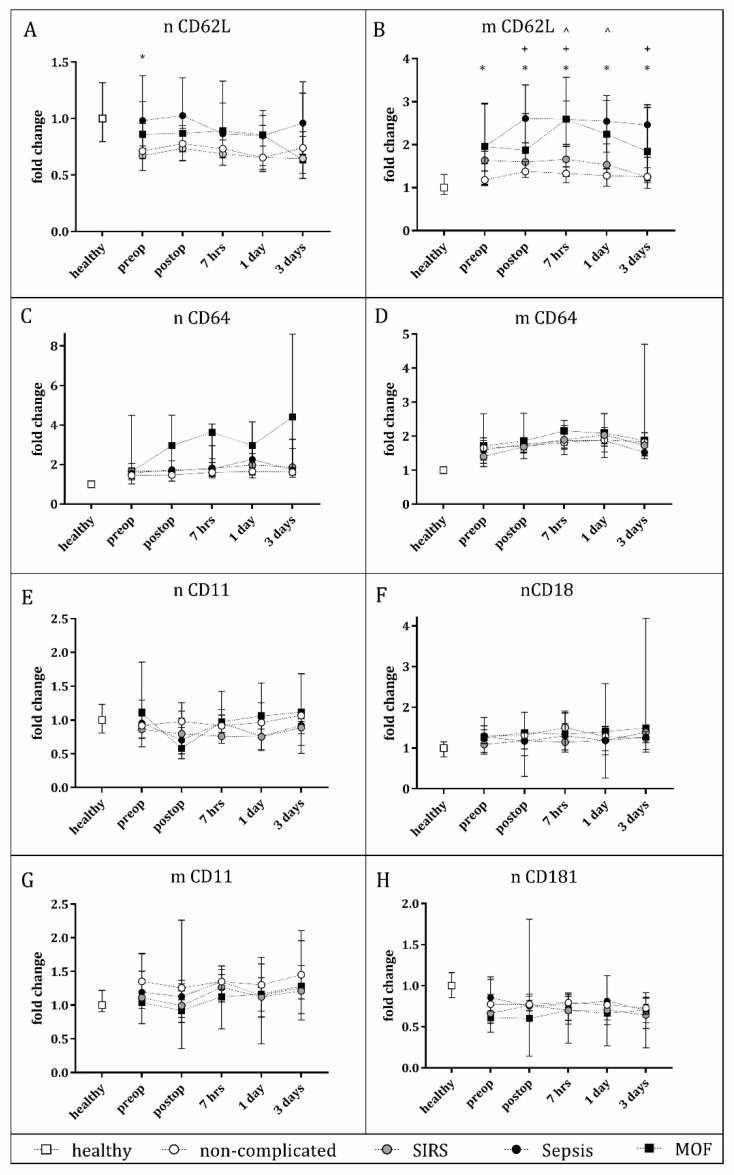
Deciding whether to delay non-lifesaving orthopaedic trauma surgery to prevent multiple organ failure (MOF) or sepsis is frequently disputed and largely based on expert opinion. We hypothesise that neutrophils and monocytes differentially express activation markers prior to patients developing these complications. Peripheral blood from 20 healthy controls and 162 patients requiring major orthopaedic intervention was collected perioperatively. Neutrophil and monocyte L-selectin, CD64, CD11, CD18, and CXCR1 expression were measured using flow cytometry. The predictive ability for MOF and sepsis was assessed using the Receiver Operating Characteristic (ROC) comparing to C-reactive protein (CRP). Neutrophil and monocyte L-selectin were significantly higher in patients who developed sepsis. Neutrophil L-selectin (AUC 0.692 [95%CI 0.574-0.810]) and monocyte L-selectin (AUC 0.761 [95%CI 0.632-0.891]) were significant predictors of sepsis and were not significantly different to CRP (AUC 0.772 [95%CI 0.650-0.853]). Monocyte L-selectin was predictive of MOF preoperatively and postoperatively (preop AUC 0.790 [95%CI 0.622-0.958]). CD64 and CRP were predictive of MOF at one-day postop (AUC 0.808 [95%CI 0.643-0.974] and AUC 0.809 [95%CI 0.662-0.956], respectively). In the perioperative period, elevated neutrophil and monocyte L-selectin are predictors of postoperative sepsis. Larger validation studies should focus on these biomarkers for deciding the timing of long bone/pelvic fracture fixation.
决定是否推迟非挽救生命的骨科创伤手术以预防多器官功能衰竭(MOF)或败血症常常存在争议,且很大程度上基于专家意见。我们推测,在患者出现这些并发症之前,中性粒细胞和单核细胞会差异表达激活标志物。在围手术期收集了20名健康对照者和162名需要进行重大骨科干预的患者的外周血。使用流式细胞术测量中性粒细胞和单核细胞的L-选择素、CD64、CD11、CD18和CXCR1表达。与C反应蛋白(CRP)相比,使用受试者工作特征(ROC)评估MOF和败血症的预测能力。发生败血症的患者中性粒细胞和单核细胞L-选择素显著更高。中性粒细胞L-选择素(曲线下面积[AUC] 0.692 [95%可信区间(CI)0.574 - 0.810])和单核细胞L-选择素(AUC 0.761 [95%CI 0.632 - 0.891])是败血症的显著预测指标,与CRP(AUC 0.772 [95%CI 0.650 - 0.853])无显著差异。单核细胞L-选择素在术前和术后均对MOF有预测作用(术前AUC 0.790 [95%CI 0.622 - 0.958])。CD64和CRP在术后一天对MOF有预测作用(分别为AUC 0.808 [95%CI 0.643 - 0.974]和AUC 0.809 [95%CI 0.662 - 0.956])。在围手术期,中性粒细胞和单核细胞L-选择素升高是术后败血症的预测指标。更大规模的验证研究应关注这些生物标志物,以确定长骨/骨盆骨折固定的时机。