Medical School, Izhevsk State Medical Academy, Kommunarov Street 281, 426034 Izhevsk, Russia.
Medical School, University of Patras, Rio, 26504 Patra, Greece.
Int J Mol Sci. 2021 May 20;22(10):5368. doi: 10.3390/ijms22105368.
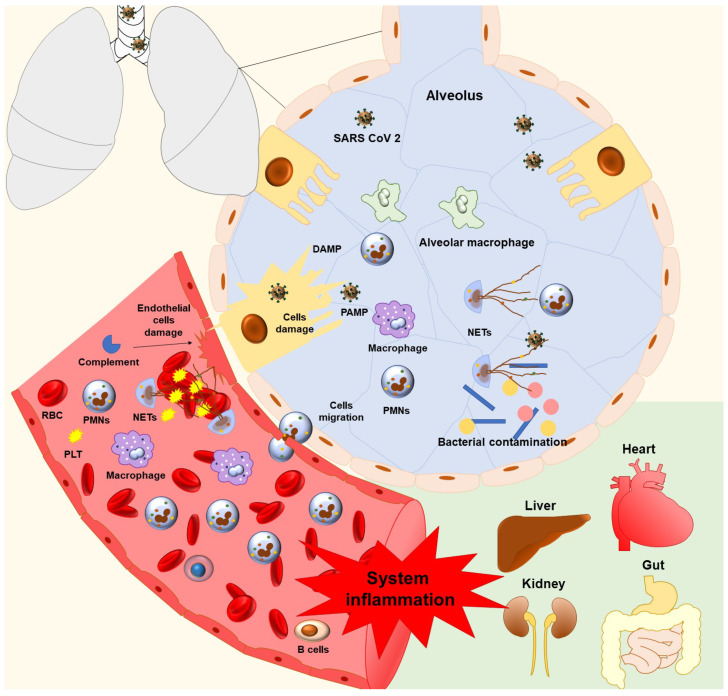
Previous studies have shown that COVID-19 leads to thrombotic complications, which have been associated with high morbidity and mortality rates. Neutrophils are the largest population of white blood cells and play a pivotal role in innate immunity. During an infection, neutrophils migrate from circulation to the infection site, contributing to killing pathogens. This mechanism is regulated by chemokines such as IL-8. Moreover, it was shown that neutrophils play an important role in thromboinflammation. Through a diverse repertoire of mechanisms, neutrophils, apart from directly killing pathogens, are able to activate the formation of thrombi. In COVID-19 patients, neutrophil activation promotes neutrophil extracellular trap (NET) formation, platelet aggregation, and cell damage. Furthermore, neutrophils participate in the pathogenesis of endothelitis. Overall, this review summarizes recent progress in research on the pathogenesis of COVID-19, highlighting the role of the prothrombotic action of neutrophils in NET formation.
先前的研究表明,COVID-19 可导致血栓并发症,这与高发病率和死亡率有关。中性粒细胞是白细胞中数量最多的群体,在先天免疫中发挥关键作用。在感染过程中,中性粒细胞从循环系统迁移到感染部位,有助于杀死病原体。这种机制受趋化因子(如 IL-8)的调节。此外,已经表明中性粒细胞在血栓炎症中发挥重要作用。通过多种机制,中性粒细胞除了直接杀死病原体外,还能够激活血栓形成。在 COVID-19 患者中,中性粒细胞的激活促进中性粒细胞胞外诱捕网(NET)的形成、血小板聚集和细胞损伤。此外,中性粒细胞参与内皮炎症的发病机制。总的来说,本综述总结了 COVID-19 发病机制研究的最新进展,强调了中性粒细胞的促血栓作用在 NET 形成中的作用。