
使用两种特殊设计的人工晶状体进行二期无缝线后房型人工晶状体植入术:虹膜爪形人工晶状体与无缝线经巩膜塞固定人工晶状体。
Secondary Sutureless Posterior Chamber Lens Implantation with Two Specifically Designed IOLs: Iris Claw Lens versus Sutureless Trans-Scleral Plugs Fixated Lens.
作者信息
Seknazi Daniel, Colantuono Donato, Tahiri Rachid, Amoroso Francesca, Miere Alexandra, Souied Eric H
机构信息
Department of Ophthalmology, Centre Hospitalier Intercommunal de Créteil, 94010 Créteil, France.
Granville Center of Ophthalmology, 50400 Granville, France.
出版信息
J Clin Med. 2021 May 20;10(10):2216. doi: 10.3390/jcm10102216.
BACKGROUND
The management of patients with aphakia and/or lack of capsular support remains debated. The sutureless posterior chamber IOL (PCIOL) fixation is a very useful surgical option. The purpose of the study was to compare the early outcomes as well as post-operative best corrected visual acuity, refractive errors and complications of two different techniques of sutureless PCIOL secondary implantation.
METHODS
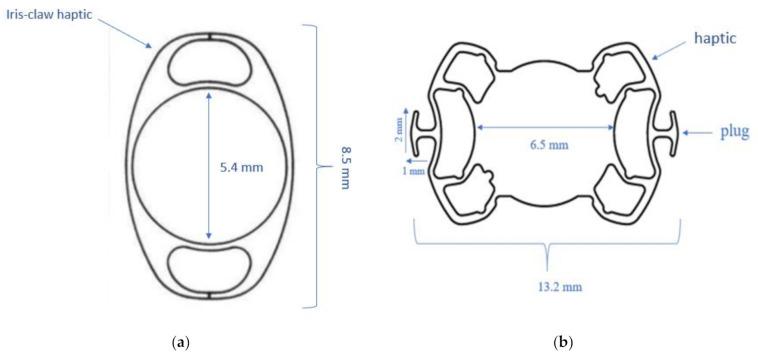
Patients who underwent secondary implantation from December 2019 to January 2021 in the Department of Ophthalmology of Creteil Hospital, and in the Granville Ophthalmology Center, were retrospectively included. Eyes implanted with the iris claw lens (Artisan Aphakia IOL model 205, Ophtec BV, Groningen, The Netherlands) were included in group 1, and eyes implanted with a newly developed sutureless trans-scleral plugs fixated lens (STSPFL, Carlevale lens, Soleko, Pontecorvo, Italy) were included in group 2.
RESULTS
Twenty-two eyes of 22 patients were enrolled in group 1, and twenty eyes of 20 patients in group 2. No difference was found in visual acuity between two groups (0.35 +/- 0.29 logmar for group 1 and 0.23 +/- 0.51 logmar for group 2) ( = 0.15) at mean post-operative follow up (6.19 +/- 3.44 months for group 1 and 6.42 +/- 3.96 months for group 2) ( = 0.13). Both the mean refractive error (MRE) and induced astigmatism (IA) were greater in group 1 compared to group 2, respectively: the MRE was 0.99 +/- 0.57 vs. 0.46 +/- 0.36 ( < 0.01), and IA was 1.72 +/- 0.96 vs. 0.72 +/- 0.52 ( < 0.01).
CONCLUSIONS
No significant differences in terms of the recovery of visual acuity were found between the two groups. Group 2 (STPFL) gives better results in our sample due to less post-operative induced astigmatism and less refractive error.
背景
无晶状体眼和/或缺乏晶状体囊膜支持的患者的治疗方案仍存在争议。无缝线后房型人工晶状体(PCIOL)固定术是一种非常有用的手术选择。本研究的目的是比较两种不同的无缝线PCIOL二期植入技术的早期疗效以及术后最佳矫正视力、屈光不正和并发症。
方法
回顾性纳入2019年12月至2021年1月在克雷泰伊医院眼科和格兰维尔眼科中心接受二期植入手术的患者。植入虹膜爪状人工晶状体(荷兰格罗宁根Ophtec BV公司的Artisan Aphakia IOL 205型号)的眼睛纳入第1组,植入新开发的无缝线经巩膜塞固定人工晶状体(STSPFL,意大利蓬泰科尔沃Soleko公司的Carlevale人工晶状体)的眼睛纳入第2组。
结果
第1组纳入22例患者的22只眼,第2组纳入20例患者的20只眼。术后平均随访时(第1组为6.19±3.44个月,第2组为6.42±3.96个月),两组视力无差异(第1组为0.35±0.29 logMAR,第2组为0.23±0.51 logMAR)(P = 0.15)。与第2组相比,第1组的平均屈光不正(MRE)和诱导散光(IA)更大,分别为:MRE为0.99±0.57对0.46±0.36(P < 0.01),IA为1.72±0.96对0.72±0.52(P < 0.01)。
结论
两组在视力恢复方面无显著差异。在我们的样本中,第2组(STPFL)由于术后诱导散光和屈光不正较小,效果更好。

 Zotero 插件