Chen Huey-Fen, Rose Angela M, Waisbren Susan, Ahmad Ayesha, Prosser Lisa A
Department of Health Management and Policy, School of Public Health, University of Michigan, Ann Arbor, MI 48109, USA.
Susan B. Meister Child Health Evaluation and Research Center, Department of Pediatrics, Medical School, University of Michigan, Ann Arbor, MI 48109, USA.
Children (Basel). 2021 May 12;8(5):381. doi: 10.3390/children8050381.
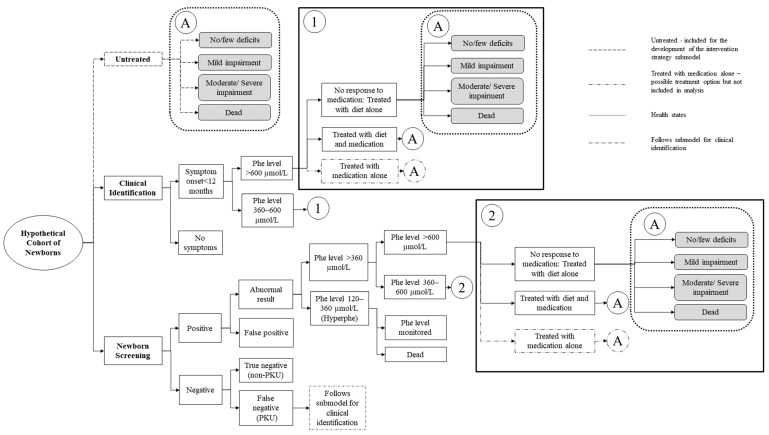
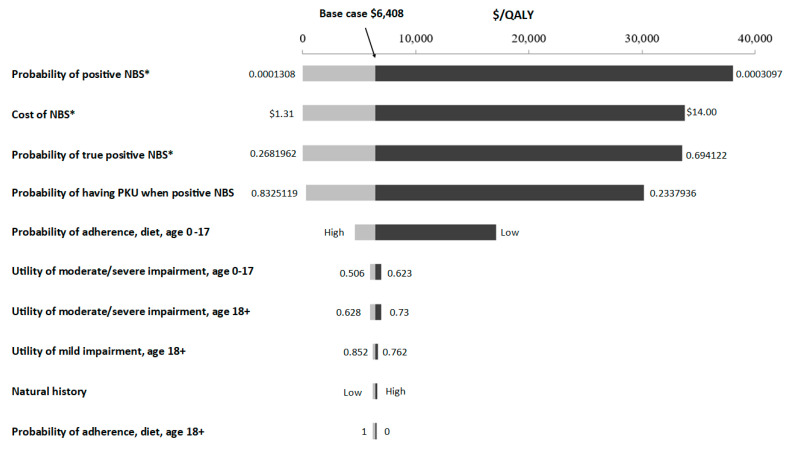
The objective of this study was to evaluate the cost-effectiveness of newborn screening and treatment for phenylketonuria (PKU) in the context of new data on adherence to recommended diet treatment and a newly available drug treatment (sapropterin dihydrochloride). A computer simulation model was developed to project outcomes for a hypothetical cohort of newborns with PKU. Four strategies were compared: (1) clinical identification (CI) with diet treatment; (2) newborn screening (NBS) with diet treatment; (3) CI with diet and medication (sapropterin dihydrochloride); and (4) NBS with diet and medication. Data sources included published literature, primary data, and expert opinion. From a societal perspective, newborn screening with diet treatment had an incremental cost-effectiveness ratio of $6400/QALY compared to clinical identification with diet treatment. Adding medication to NBS with diet treatment resulted in an incremental cost-effectiveness ratio of more than $16,000,000/QALY. Uncertainty analyses did not substantially alter the cost-effectiveness results. Newborn screening for PKU with diet treatment yields a cost-effectiveness ratio lower than many other recommended childhood prevention programs even if adherence is lower than previously assumed. Adding medication yields cost-effectiveness results unlikely to be considered favorable. Future research should consider conditions under which sapropterin dihydrochloride would be more economically attractive.
本研究的目的是在关于遵循推荐饮食治疗的新数据以及一种新可用药物治疗(盐酸沙丙蝶呤)的背景下,评估苯丙酮尿症(PKU)新生儿筛查和治疗的成本效益。开发了一个计算机模拟模型来预测一组假设的PKU新生儿的结局。比较了四种策略:(1)临床识别(CI)并进行饮食治疗;(2)新生儿筛查(NBS)并进行饮食治疗;(3)CI并进行饮食和药物治疗(盐酸沙丙蝶呤);以及(4)NBS并进行饮食和药物治疗。数据来源包括已发表的文献、原始数据和专家意见。从社会角度来看,与临床识别并进行饮食治疗相比,新生儿筛查并进行饮食治疗的增量成本效益比为每质量调整生命年(QALY)6400美元。在新生儿筛查并进行饮食治疗的基础上添加药物治疗,增量成本效益比超过每QALY 1600万美元。不确定性分析并未实质性改变成本效益结果。即使依从性低于先前假设,对PKU进行新生儿筛查并进行饮食治疗产生的成本效益比也低于许多其他推荐的儿童预防项目。添加药物治疗产生的成本效益结果不太可能被认为是有利的。未来的研究应考虑盐酸沙丙蝶呤在哪些情况下在经济上更具吸引力。