Gahtyari Navin C, Roy Chandan, He Xinyao, Roy Krishna K, Reza Mohamed M A, Hakim Md A, Malaker Paritosh K, Joshi Arun K, Singh Pawan K
ICAR-Vivekanand Parvatiya Krishi Anushandhan Sansthan, Almora, Uttarakhand 263601, India.
Department of Plant Breeding and Genetics, Bihar Agricultural University, Sabour, Bihar 813210, India.
Plants (Basel). 2021 May 13;10(5):973. doi: 10.3390/plants10050973.
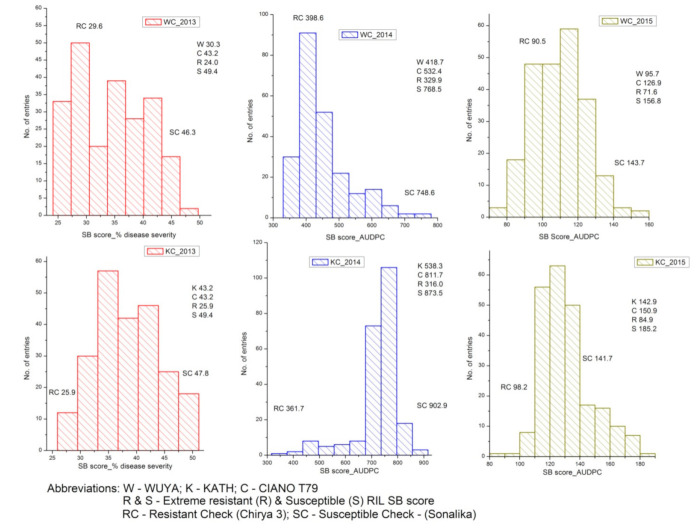
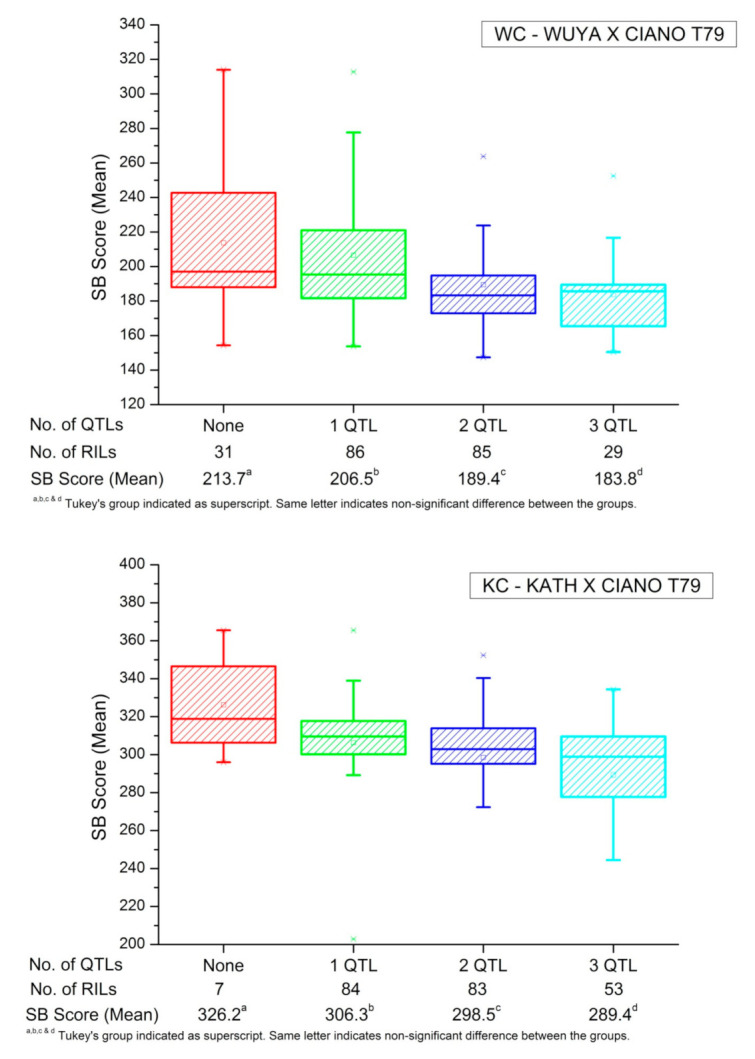
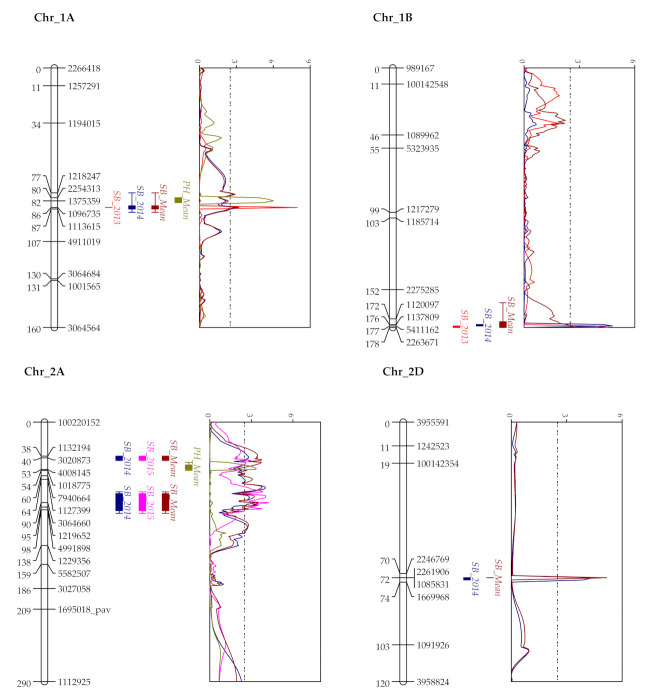
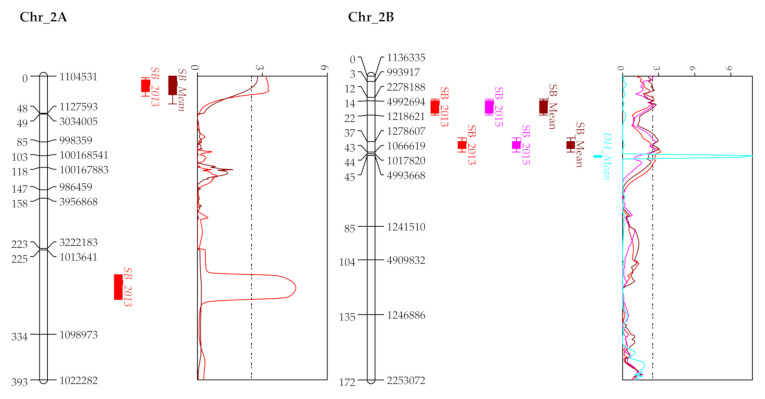
Spot blotch (SB) disease caused by the hemibiotrophic pathogen inflicting major losses to the wheat grown in warm and highly humid areas of the Indian subcontinent, including Bangladesh, necessitates identification of QTLs stably expressing in Indian subcontinent conditions. Thus, two RIL mapping populations, i.e., WC (WUYA × CIANO T79) and KC (KATH × CIANO T79), were phenotyped at Dinajpur, Bangladesh for three consecutive years (2013-2015) and genotyped on a DArTseq genotyping by sequencing (GBS) platform at CIMMYT, Mexico. In both populations, quantitative inheritance along with transgressive segregation for SB resistance was identified. The identified QTLs were mostly minor and were detected on 10 chromosomes, i.e., 1A, 1B, 2A, 2B, 2D, 4B, 4D, 5A, 5D, and 7B. The phenotypic variation explained by the identified QTLs ranged from 2.3-15.0%, whereby QTLs on 4B (13.7%) and 5D (15.0%) were the largest in effect. The identified QTLs upon stacking showed an additive effect in lowering the SB score in both populations. The probable presence of newly identified and durable resistance gene in the identified QTL regions indicates the importance of these genes in breeding for SB resistance in Bangladesh and the whole of South Asia.
由半活体营养型病原菌引起的叶斑病(SB)给印度次大陆温暖且高湿度地区(包括孟加拉国)种植的小麦造成了重大损失,因此有必要鉴定在印度次大陆条件下稳定表达的数量性状基因座(QTL)。为此,构建了两个重组自交系(RIL)作图群体,即WC(武育粳×CIANO T79)和KC(KATH×CIANO T79),连续三年(2013 - 2015年)在孟加拉国迪纳杰布尔进行表型分析,并在墨西哥国际玉米和小麦改良中心(CIMMYT)的DArTseq测序基因分型(GBS)平台上进行基因分型。在这两个群体中,均鉴定出了叶斑病抗性的数量遗传以及超亲分离现象。所鉴定出的QTL大多为微效QTL,分布在10条染色体上,即1A、1B、2A、2B、2D、4B、4D、5A、5D和7B。所鉴定出的QTL解释的表型变异范围为2.3% - 15.0%,其中4B染色体上的QTL(13.7%)和5D染色体上的QTL(15.0%)效应最大。将所鉴定出的QTL累加后,在两个群体中均显示出降低叶斑病评分的加性效应。在所鉴定出的QTL区域中可能存在新鉴定出的持久抗性基因,这表明这些基因在孟加拉国乃至整个南亚叶斑病抗性育种中具有重要意义。