Linnekamp Janneke F, Kandimalla Raju, Fessler Evelyn, de Jong Joan H, Rodermond Hans M, van Bochove Gregor G W, The Frans O, Punt Cornelis J A, Bemelman Willem A, van de Ven Anthony W H, Tanis Pieter J, Kemper Elles M, Koens Lianne, Dekker Evelien, Vermeulen Louis, van Laarhoven Hanneke W M, Medema Jan Paul
Laboratory for Experimental Oncology and Radiobiology (LEXOR), Center for Experimental and Molecular Medicine, Amsterdam UMC, University of Amsterdam, Cancer Center Amsterdam, Meibergdreef 9, 1105 AZ Amsterdam, The Netherlands.
Oncode Institute, 1105 AZ Amsterdam, The Netherlands.
Cancers (Basel). 2021 May 13;13(10):2357. doi: 10.3390/cancers13102357.
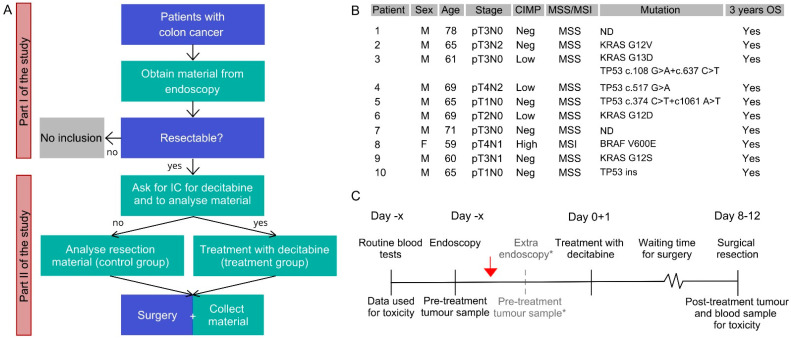
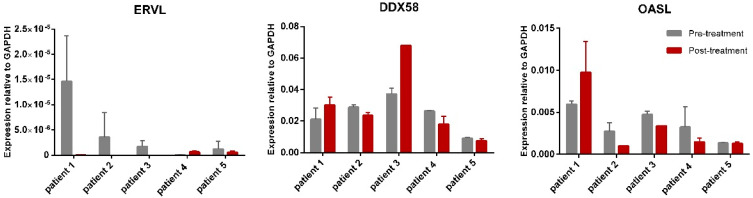
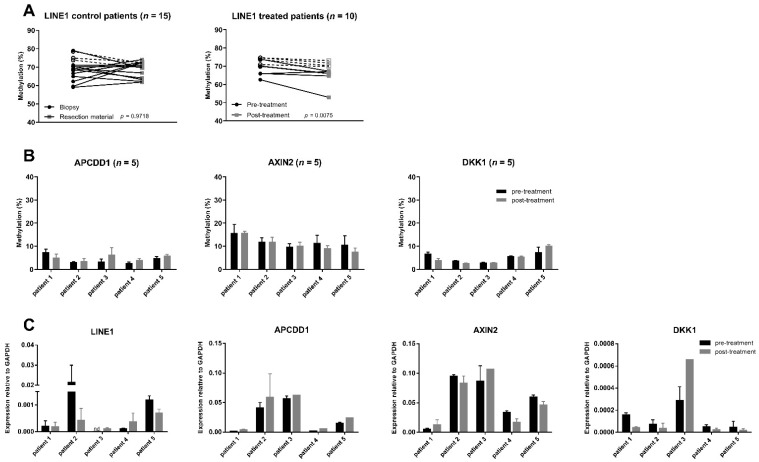
DNA hypermethylation is common in colon cancer. Previously, we have shown that methylation of WNT target genes predicts poor prognosis in stage II colon cancer. The primary objective of this study was to assess whether pre-operative treatment with decitabine can decrease methylation and increase the expression of WNT target genes , and in colon cancer patients. A clinical study was conducted, investigating these potential effects of decitabine in colon cancer patients (DECO). Patients were treated two times with 25 mg/m decitabine before surgery. Methylation and expression of and WNT target genes (primary outcome) and expression of endogenous retroviral genes (secondary outcome) were analysed in pre- and post-treatment tumour samples using pyrosequencing and rt-PCR. Ten patients were treated with decitabine and eighteen patients were used as controls. Decitabine treatment only marginally decreased methylation. More importantly, no differences in methylation or expression of WNT target or endogenous retroviral genes were observed. Due to the lack of an effect on primary and secondary outcomes, the study was prematurely closed. In conclusion, pre-operative treatment with decitabine is safe, but with the current dosing, the primary objective, increased WNT target gene expression, cannot be achieved.
DNA高甲基化在结肠癌中很常见。此前,我们已经表明,WNT靶基因的甲基化可预测II期结肠癌的预后不良。本研究的主要目的是评估术前使用地西他滨治疗是否能降低结肠癌患者中WNT靶基因的甲基化并增加其表达。开展了一项临床研究,调查地西他滨对结肠癌患者的这些潜在影响(DECO)。患者在手术前接受两次25mg/m²的地西他滨治疗。使用焦磷酸测序和逆转录-聚合酶链反应(rt-PCR)分析治疗前和治疗后肿瘤样本中WNT靶基因的甲基化和表达(主要结果)以及内源性逆转录病毒基因的表达(次要结果)。10名患者接受了地西他滨治疗,18名患者作为对照。地西他滨治疗仅略微降低了甲基化。更重要的是,未观察到WNT靶基因或内源性逆转录病毒基因的甲基化或表达存在差异。由于对主要和次要结果均无影响,该研究提前结束。总之,术前使用地西他滨治疗是安全的,但按照目前的剂量,无法实现增加WNT靶基因表达这一主要目标。