• 文献检索
  • 文档翻译
  • 深度研究
  • 学术资讯
  • Suppr Zotero 插件Zotero 插件
  • 邀请有礼
  • 套餐&价格
  • 历史记录
应用&插件
Suppr Zotero 插件Zotero 插件浏览器插件Mac 客户端Windows 客户端微信小程序
定价
高级版会员购买积分包购买API积分包
服务
文献检索文档翻译深度研究API 文档MCP 服务
关于我们
关于 Suppr公司介绍联系我们用户协议隐私条款
关注我们

Suppr 超能文献

核心技术专利:CN118964589B侵权必究
粤ICP备2023148730 号-1Suppr @ 2026

文献检索

告别复杂PubMed语法,用中文像聊天一样搜索,搜遍4000万医学文献。AI智能推荐,让科研检索更轻松。

立即免费搜索

文件翻译

保留排版,准确专业,支持PDF/Word/PPT等文件格式,支持 12+语言互译。

免费翻译文档

深度研究

AI帮你快速写综述,25分钟生成高质量综述,智能提取关键信息,辅助科研写作。

立即免费体验

禽流感 H7N9 病毒对人类宿主的适应。

Avian Influenza H7N9 Virus Adaptation to Human Hosts.

机构信息

Centre for Bioinformatics, School of Data Sciences, Perdana University, Wisma Chase Perdana, Changkat Semantan, Damansara Heights, Kuala Lumpur 50490, Malaysia.

Department of Pharmacology and Molecular Sciences, The Johns Hopkins University School of Medicine, 725 North Wolfe Street, Baltimore, MD 21205, USA.

出版信息

Viruses. 2021 May 10;13(5):871. doi: 10.3390/v13050871.

DOI:10.3390/v13050871
PMID:34068495
原文链接:https://pmc.ncbi.nlm.nih.gov/articles/PMC8150935/
Abstract

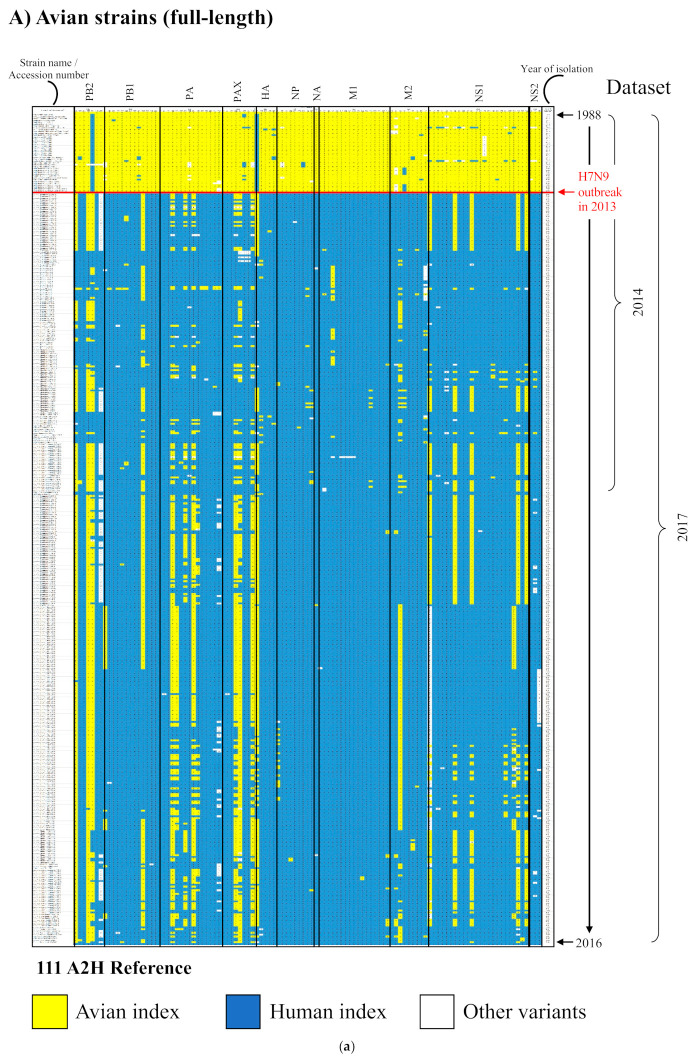
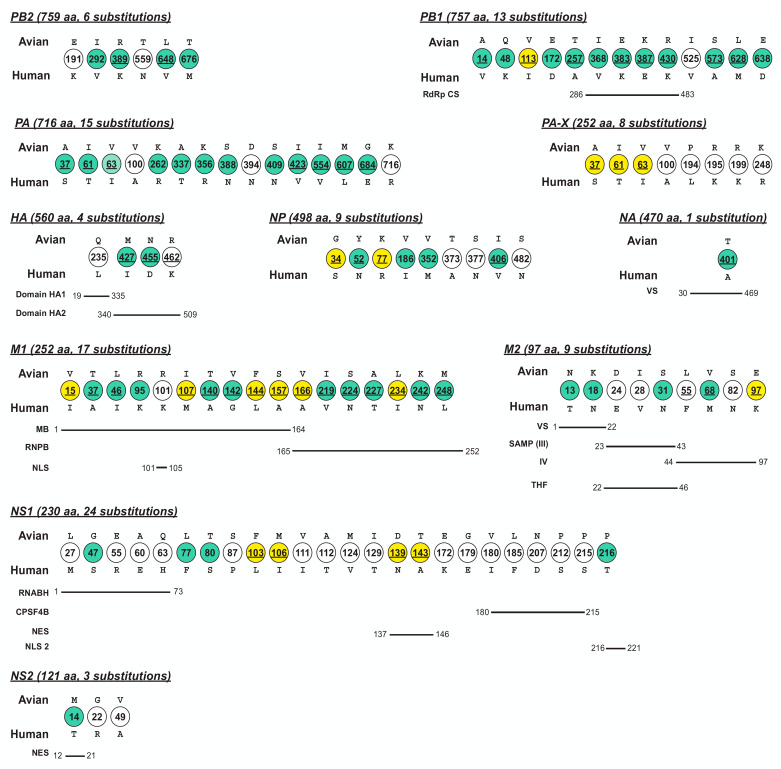
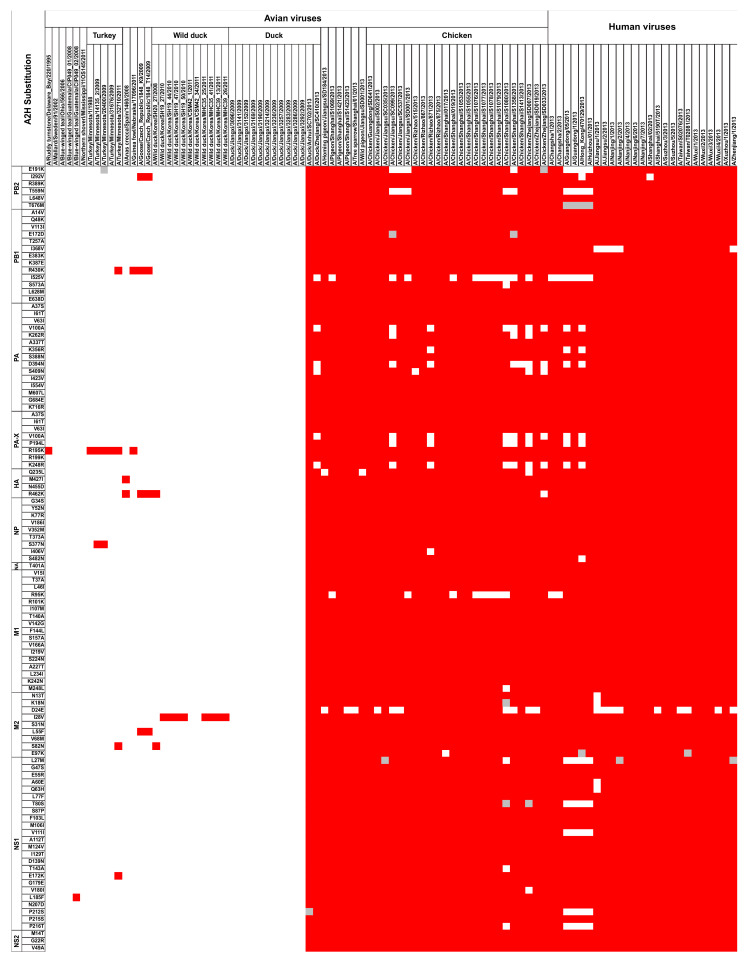
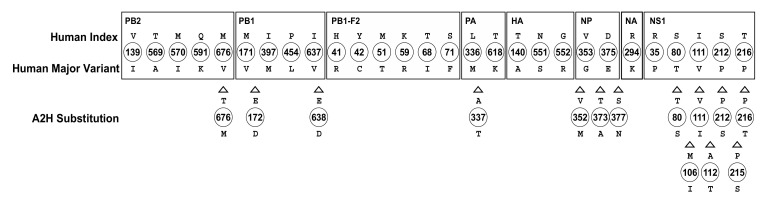
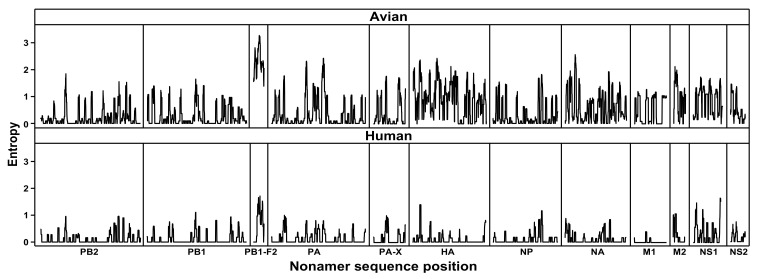
Avian influenza virus A (H7N9), after circulating in avian hosts for decades, was identified as a human pathogen in 2013. Herein, amino acid substitutions possibly essential for human adaptation were identified by comparing the 4706 aligned overlapping nonamer position sequences (1-9, 2-10, etc.) of the reported 2014 and 2017 avian and human H7N9 datasets. The initial set of virus sequences (as of year 2014) exhibited a total of 109 avian-to-human (A2H) signature amino acid substitutions. Each represented the most prevalent substitution at a given avian virus nonamer position that was selectively adapted as the corresponding index (most prevalent sequence) of the human viruses. The majority of these avian substitutions were long-standing in the evolution of H7N9, and only 17 were first detected in 2013 as possibly essential for the initial human adaptation. Strikingly, continued evolution of the avian H7N9 virus has resulted in avian and human protein sequences that are almost identical. This rapid and continued adaptation of the avian H7N9 virus to the human host, with near identity of the avian and human viruses, is associated with increased human infection and a predicted greater risk of human-to-human transmission.

摘要

甲型流感病毒 A(H7N9)在禽类宿主中循环传播数十年后,于 2013 年被鉴定为人病原体。在此,通过比较 2014 年和 2017 年报告的禽类和人类 H7N9 数据集的 4706 个对齐重叠九肽位置序列(1-9、2-10 等),确定了可能对人类适应至关重要的氨基酸取代。最初的病毒序列集(截至 2014 年)共显示 109 种禽源到人的(A2H)特征性氨基酸取代。每个序列都代表了在给定的禽病毒九肽位置上最普遍的取代,这些取代被选择性地适应为人类病毒的相应指标(最普遍的序列)。这些禽类取代中的大多数在 H7N9 的进化中由来已久,只有 17 种是在 2013 年首次检测到的,可能对人类的最初适应至关重要。引人注目的是,禽 H7N9 病毒的持续进化导致了禽源和人类蛋白序列几乎完全一致。这种禽源 H7N9 病毒对人类宿主的快速和持续适应,以及禽源和人类病毒的近乎一致,与人类感染的增加和预测的人际传播风险增加有关。
https://cdn.ncbi.nlm.nih.gov/pmc/blobs/3928/8150935/49846b15bee2/viruses-13-00871-g005a.jpg
https://cdn.ncbi.nlm.nih.gov/pmc/blobs/3928/8150935/b64d22d4cde9/viruses-13-00871-g001.jpg
https://cdn.ncbi.nlm.nih.gov/pmc/blobs/3928/8150935/f6ffc47a5315/viruses-13-00871-g002.jpg
https://cdn.ncbi.nlm.nih.gov/pmc/blobs/3928/8150935/58ad843580bb/viruses-13-00871-g003.jpg
https://cdn.ncbi.nlm.nih.gov/pmc/blobs/3928/8150935/b48ac09dbe5c/viruses-13-00871-g004.jpg
https://cdn.ncbi.nlm.nih.gov/pmc/blobs/3928/8150935/49846b15bee2/viruses-13-00871-g005a.jpg
https://cdn.ncbi.nlm.nih.gov/pmc/blobs/3928/8150935/b64d22d4cde9/viruses-13-00871-g001.jpg
https://cdn.ncbi.nlm.nih.gov/pmc/blobs/3928/8150935/f6ffc47a5315/viruses-13-00871-g002.jpg
https://cdn.ncbi.nlm.nih.gov/pmc/blobs/3928/8150935/58ad843580bb/viruses-13-00871-g003.jpg
https://cdn.ncbi.nlm.nih.gov/pmc/blobs/3928/8150935/b48ac09dbe5c/viruses-13-00871-g004.jpg
https://cdn.ncbi.nlm.nih.gov/pmc/blobs/3928/8150935/49846b15bee2/viruses-13-00871-g005a.jpg

相似文献

1
Avian Influenza H7N9 Virus Adaptation to Human Hosts.禽流感 H7N9 病毒对人类宿主的适应。
Viruses. 2021 May 10;13(5):871. doi: 10.3390/v13050871.
2
Emergence and Adaptation of a Novel Highly Pathogenic H7N9 Influenza Virus in Birds and Humans from a 2013 Human-Infecting Low-Pathogenic Ancestor.一种新型高致病性H7N9流感病毒从2013年感染人类的低致病性祖先毒株在鸟类和人类中出现及适应性演变。
J Virol. 2018 Jan 2;92(2). doi: 10.1128/JVI.00921-17. Print 2018 Jan 15.
3
Rapid adaptation of avian H7N9 virus in pigs.禽类 H7N9 病毒在猪体内的快速适应。
Virology. 2014 Mar;452-453:231-6. doi: 10.1016/j.virol.2014.01.016. Epub 2014 Feb 14.
4
Environmental connections of novel avian-origin H7N9 influenza virus infection and virus adaptation to the human.新型甲型 H7N9 流感病毒感染与病毒适应人体的环境联系。
Sci China Life Sci. 2013 Jun;56(6):485-92. doi: 10.1007/s11427-013-4491-3. Epub 2013 May 8.
5
Dynamic PB2-E627K substitution of influenza H7N9 virus indicates the in vivo genetic tuning and rapid host adaptation.流感 H7N9 病毒的动态 PB2-E627K 取代表明了体内遗传调整和快速的宿主适应。
Proc Natl Acad Sci U S A. 2020 Sep 22;117(38):23807-23814. doi: 10.1073/pnas.2013267117. Epub 2020 Sep 1.
6
Effects of HA and NA glycosylation pattern changes on the transmission of avian influenza A(H7N9) virus in guinea pigs.血凝素(HA)和神经氨酸酶(NA)糖基化模式变化对甲型H7N9禽流感病毒在豚鼠中传播的影响
Biochem Biophys Res Commun. 2016 Oct 14;479(2):192-197. doi: 10.1016/j.bbrc.2016.09.024. Epub 2016 Sep 6.
7
PB2-588 V promotes the mammalian adaptation of H10N8, H7N9 and H9N2 avian influenza viruses.PB2-588 V促进H10N8、H7N9和H9N2禽流感病毒对哺乳动物的适应性。
Sci Rep. 2016 Jan 19;6:19474. doi: 10.1038/srep19474.
8
Multiple Natural Substitutions in Avian Influenza A Virus PB2 Facilitate Efficient Replication in Human Cells.甲型禽流感病毒PB2中的多个自然替换促进其在人类细胞中的高效复制。
J Virol. 2016 Jun 10;90(13):5928-5938. doi: 10.1128/JVI.00130-16. Print 2016 Jul 1.
9
The nucleoprotein of newly emerged H7N9 influenza A virus harbors a unique motif conferring resistance to antiviral human MxA.新出现的甲型H7N9流感病毒的核蛋白含有一个赋予其对人类抗病毒蛋白MxA抗性的独特基序。
J Virol. 2015 Feb;89(4):2241-52. doi: 10.1128/JVI.02406-14. Epub 2014 Dec 10.
10
Genetic tuning of the novel avian influenza A(H7N9) virus during interspecies transmission, China, 2013.新型甲型 H7N9 禽流感病毒在物种间传播过程中的遗传进化,中国,2013 年。
Euro Surveill. 2014 Jun 26;19(25):20836. doi: 10.2807/1560-7917.es2014.19.25.20836.

引用本文的文献

1
An Alignment-Independent Approach for the Study of Viral Sequence Diversity at Any Given Rank of Taxonomy Lineage.一种用于研究分类谱系任意给定等级上病毒序列多样性的不依赖比对的方法。
Biology (Basel). 2021 Aug 31;10(9):853. doi: 10.3390/biology10090853.

本文引用的文献

1
Evolution and Adaptation of the Avian H7N9 Virus into the Human Host.禽流感H7N9病毒在人类宿主中的进化与适应性
Microorganisms. 2020 May 21;8(5):778. doi: 10.3390/microorganisms8050778.
2
Avian-to-Human Receptor-Binding Adaptation of Avian H7N9 Influenza Virus Hemagglutinin.禽流感 H7N9 流感病毒血凝素的禽-人受体结合适应性。
Cell Rep. 2019 Nov 19;29(8):2217-2228.e5. doi: 10.1016/j.celrep.2019.10.047.
3
Novel Avian Influenza A Virus Infections of Humans.新型禽流感病毒感染人类。
Infect Dis Clin North Am. 2019 Dec;33(4):907-932. doi: 10.1016/j.idc.2019.07.003.
4
The 2nd sialic acid-binding site of influenza A virus neuraminidase is an important determinant of the hemagglutinin-neuraminidase-receptor balance.流感 A 病毒神经氨酸酶的第 2 个唾液酸结合位点是影响血凝素-神经氨酸酶-受体平衡的重要决定因素。
PLoS Pathog. 2019 Jun 10;15(6):e1007860. doi: 10.1371/journal.ppat.1007860. eCollection 2019 Jun.
5
Update: Increase in Human Infections with Novel Asian Lineage Avian Influenza A(H7N9) Viruses During the Fifth Epidemic - China, October 1, 2016-August 7, 2017.更新:2016年10月1日至2017年8月7日中国第五波疫情期间新型亚洲谱系甲型禽流感(H7N9)病毒导致的人类感染病例增加情况
MMWR Morb Mortal Wkly Rep. 2017 Sep 8;66(35):928-932. doi: 10.15585/mmwr.mm6635a2.
6
GISAID: Global initiative on sharing all influenza data - from vision to reality.全球流感数据共享倡议组织:从愿景到现实的全球共享所有流感数据倡议
Euro Surveill. 2017 Mar 30;22(13). doi: 10.2807/1560-7917.ES.2017.22.13.30494.
7
Mutation of the Second Sialic Acid-Binding Site, Resulting in Reduced Neuraminidase Activity, Preceded the Emergence of H7N9 Influenza A Virus.第二个唾液酸结合位点的突变导致神经氨酸酶活性降低,该突变先于甲型H7N9流感病毒的出现。
J Virol. 2017 Apr 13;91(9). doi: 10.1128/JVI.00049-17. Print 2017 May 1.
8
Assessing Change in Avian Influenza A(H7N9) Virus Infections During the Fourth Epidemic - China, September 2015-August 2016.评估第四次人感染 H7N9 禽流感疫情期间的变化情况-中国,2015 年 9 月-2016 年 8 月。
MMWR Morb Mortal Wkly Rep. 2016 Dec 16;65(49):1390-1394. doi: 10.15585/mmwr.mm6549a2.
9
Two Outbreak Sources of Influenza A (H7N9) Viruses Have Been Established in China.中国已确定甲型H7N9流感病毒的两个暴发源头。
J Virol. 2016 May 27;90(12):5561-5573. doi: 10.1128/JVI.03173-15. Print 2016 Jun 15.
10
Is a highly pathogenic avian influenza virus H5N1 fragment recombined in PB1 the key for the epidemic of the novel AIV H7N9 in China, 2013?2013年在中国,重组于PB1基因中的高致病性禽流感病毒H5N1片段是新型禽流感病毒H7N9流行的关键因素吗?
Int J Infect Dis. 2016 Feb;43:85-89. doi: 10.1016/j.ijid.2016.01.002. Epub 2016 Jan 11.