
Remeex系统对男性压力性尿失禁患者的有效性
Remeex System Effectiveness in Male Patients with Stress Urinary Incontinence.
作者信息
Márquez-Sánchez Gerardo-Alfonso, Padilla-Fernández Bárbara-Yolanda, Perán-Teruel Miguel, Navalón-Verdejo Pedro, Valverde-Martínez Sebastián, Márquez-Sánchez Magaly-Teresa, Flores-Fraile Javier, Lorenzo-Gómez María-Fernanda
机构信息
Department of Surgery, University of Salamanca, 37007 Salamanca, Spain.
Section of Urology, Department of Surgery, University of La Laguna, 38200 Tenerife, Spain.
出版信息
J Clin Med. 2021 May 14;10(10):2121. doi: 10.3390/jcm10102121.
BACKGROUND
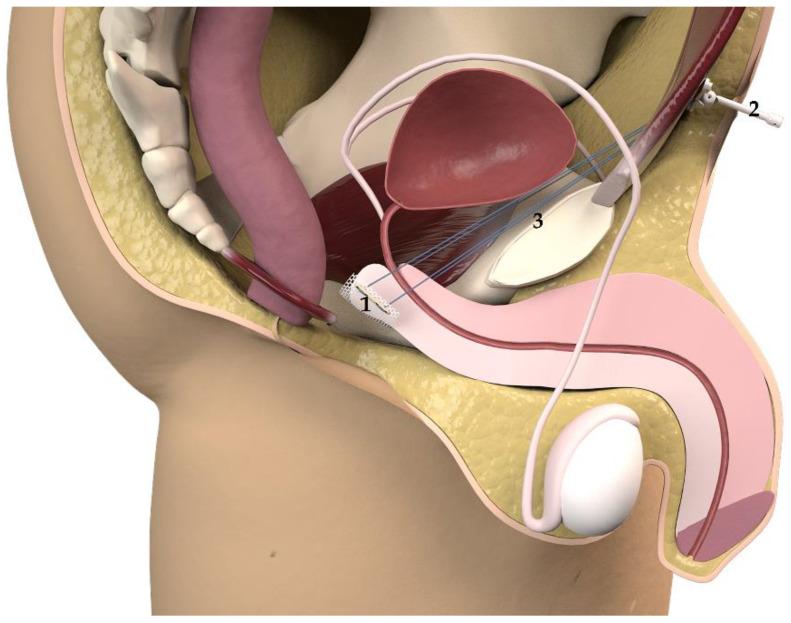
When conservative management fails, patients with stress urinary incontinence (SUI) are considered for surgical treatment. Simpler, more economical and less invasive surgical techniques, such as the Remeex system, have been developed.
OBJECTIVES
To analyze the objective effectiveness of the Remeex system in the treatment of male stress urinary incontinence. To study survival and complication rates of the Remeex system in male SUI patients.
MATERIALS AND METHODS
Prospective observational study between July 2015 and May 2020. Group A ( = 7; GA) patients with mild SUI. Group B ( = 22; GB) patients with moderate SUI. Group C ( = 18; GC) patients with severe SUI. Effectiveness was assessed by the number of patients achieving complete and partial dryness. Complete dryness was defined as patients using 0-1 safety pads per day; partial dryness as a >50% reduction in the number of pads used. Results were analyzed using descriptive statistics, Student's -test. Chi2, Fisher's exact test, ANOVA, and multivariate analysis. Significance was set at < 0.05.
RESULTS
Mean age 69.76 years, mean follow-up 33.52 months. Objective effectiveness was observed in 89.36% of patients with incontinence. The effectiveness was 85.71% in GA, 90.91% in GB and 88.89% in GC. There were no significant differences among groups ( = 1.0000). 34.04% of patients with an implant required at least one readjustment, while 66.00% did not require any. There were no significant differences among groups ( = 0.113) Chi2 = 4.352. 95.74% of implants remained in place by the end of follow-up. We observed complications in 17.02% of patients.
CONCLUSIONS
Remeex system is an effective and safe method for male stress urinary incontinence treatment, regardless of the severity of the incontinence, with high survival and low complication and removal rates. System readjustments are required in one-third of the cases.
背景
当保守治疗失败时,压力性尿失禁(SUI)患者会考虑接受手术治疗。已经开发出了更简单、更经济且侵入性更小的手术技术,如Remeex系统。
目的
分析Remeex系统治疗男性压力性尿失禁的客观有效性。研究Remeex系统在男性SUI患者中的存留率和并发症发生率。
材料与方法
2015年7月至2020年5月进行的前瞻性观察研究。A组(n = 7;GA)为轻度SUI患者。B组(n = 22;GB)为中度SUI患者。C组(n = 18;GC)为重度SUI患者。通过实现完全干爽和部分干爽的患者数量评估有效性。完全干爽定义为患者每天使用0 - 1片安全护垫;部分干爽定义为使用的护垫数量减少超过50%。使用描述性统计、学生t检验、卡方检验、费舍尔精确检验、方差分析和多变量分析对结果进行分析。显著性设定为P < 0.05。
结果
平均年龄69.76岁,平均随访33.52个月。89.36%的尿失禁患者观察到客观有效性。GA组有效性为85.71%,GB组为90.91%,GC组为88.89%。各组之间无显著差异(P = 1.0000)。34.04%植入该系统的患者至少需要一次重新调整,而66.00%的患者不需要任何调整。各组之间无显著差异(P = 0.113,卡方 = 4.352)。随访结束时,95.74%的植入物仍在位。我们观察到17.02%的患者出现并发症。
结论
无论尿失禁的严重程度如何,Remeex系统都是治疗男性压力性尿失禁的一种有效且安全的方法,具有高存留率、低并发症发生率和取出率。三分之一的病例需要对系统进行重新调整。




 Zotero 插件