Reginato Andressa, Veras Alana Carolina Costa, Baqueiro Mayara da Nóbrega, Panzarin Carolina, Siqueira Beatriz Piatezzi, Milanski Marciane, Lisboa Patrícia Cristina, Torsoni Adriana Souza
Biology Institute, State University of Rio de Janeiro, UERJ, Rio de Janeiro 20551-030, Brazil.
Faculty of Applied Science, University of Campinas, UNICAMP, Campinas 13484-350, Brazil.
Int J Mol Sci. 2021 May 19;22(10):5357. doi: 10.3390/ijms22105357.
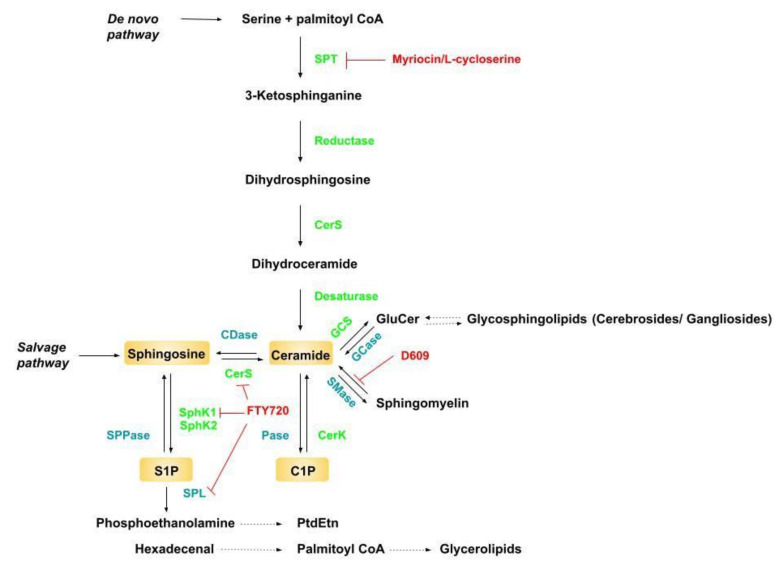
Obesity is a global health issue for which no major effective treatments have been well established. High-fat diet consumption is closely related to the development of obesity because it negatively modulates the hypothalamic control of food intake due to metaflammation and lipotoxicity. The use of animal models, such as rodents, in conjunction with in vitro models of hypothalamic cells, can enhance the understanding of hypothalamic functions related to the control of energy balance, thereby providing knowledge about the impact of diet on the hypothalamus, in addition to targets for the development of new drugs that can be used in humans to decrease body weight. Recently, sphingolipids were described as having a lipotoxic effect in peripheral tissues and the central nervous system. Specifically, lipid overload, mainly from long-chain saturated fatty acids, such as palmitate, leads to excessive ceramide levels that can be sensed by the hypothalamus, triggering the dysregulation of energy balance control. However, no systematic review has been undertaken regarding studies of sphingolipids, particularly ceramide and sphingosine-1-phosphate (S1P), the hypothalamus, and obesity. This review confirms that ceramides are associated with hypothalamic dysfunction in response to metaflammation, endoplasmic reticulum (ER) stress, and lipotoxicity, leading to insulin/leptin resistance. However, in contrast to ceramide, S1P appears to be a central satiety factor in the hypothalamus. Thus, our work describes current evidence related to sphingolipids and their role in hypothalamic energy balance control. Hypothetically, the manipulation of sphingolipid levels could be useful in enabling clinicians to treat obesity, particularly by decreasing ceramide levels and the inflammation/endoplasmic reticulum stress induced in response to overfeeding with saturated fatty acids.
肥胖是一个全球性的健康问题,目前尚未确立有效的主要治疗方法。高脂饮食的摄入与肥胖的发生密切相关,因为它会通过代谢性炎症和脂毒性对下丘脑的食物摄入控制产生负面影响。使用动物模型(如啮齿动物)结合下丘脑细胞的体外模型,可以增进对与能量平衡控制相关的下丘脑功能的理解,从而提供有关饮食对下丘脑影响的知识,以及可用于人类减轻体重的新药开发靶点。最近,鞘脂被描述为在外周组织和中枢神经系统中具有脂毒性作用。具体而言,脂质过载,主要来自长链饱和脂肪酸(如棕榈酸),会导致下丘脑可感知的神经酰胺水平过高,从而引发能量平衡控制的失调。然而,尚未对关于鞘脂,特别是神经酰胺和1-磷酸鞘氨醇(S1P)、下丘脑与肥胖的研究进行系统综述。本综述证实,神经酰胺与下丘脑因代谢性炎症、内质网(ER)应激和脂毒性而导致的功能障碍有关,进而导致胰岛素/瘦素抵抗。然而,与神经酰胺不同,S1P似乎是下丘脑中的一种中枢饱腹感因子。因此,我们的工作描述了与鞘脂及其在下丘脑能量平衡控制中的作用相关的现有证据。假设,调节鞘脂水平可能有助于临床医生治疗肥胖,特别是通过降低神经酰胺水平以及因饱和脂肪酸过量喂养而引发的炎症/内质网应激。