Fründt Thorben, Krause Linda, Hussey Elaine, Steinbach Bettina, Köhler Daniel, von Felden Johann, Schulze Kornelius, Lohse Ansgar W, Wege Henning, Schwarzenbach Heidi
Department of Medicine I, University Medical Center Hamburg-Eppendorf, 20246 Hamburg, Germany.
Institute of Medical Biometry and Epidemiology, 20246 Hamburg, Germany.
Cancers (Basel). 2021 May 19;13(10):2484. doi: 10.3390/cancers13102484.
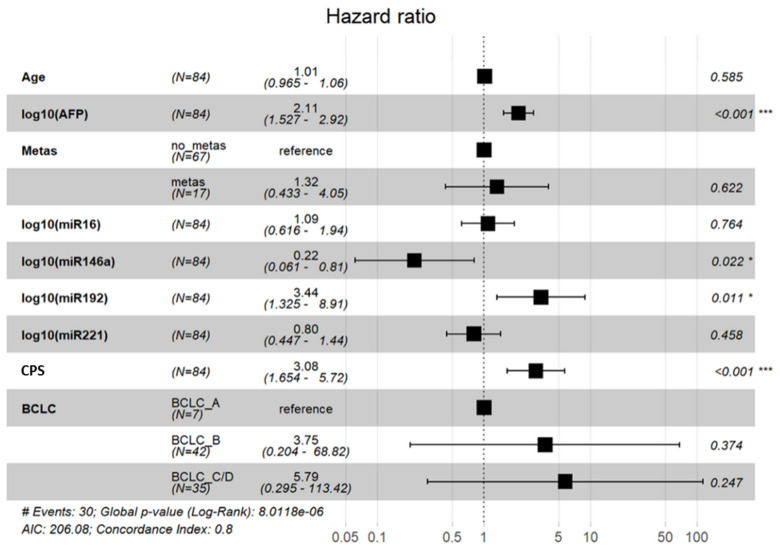
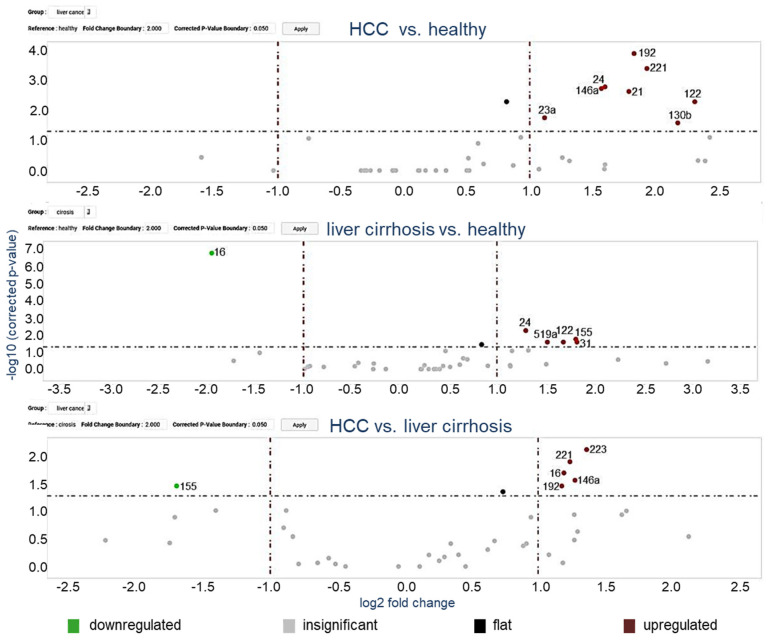
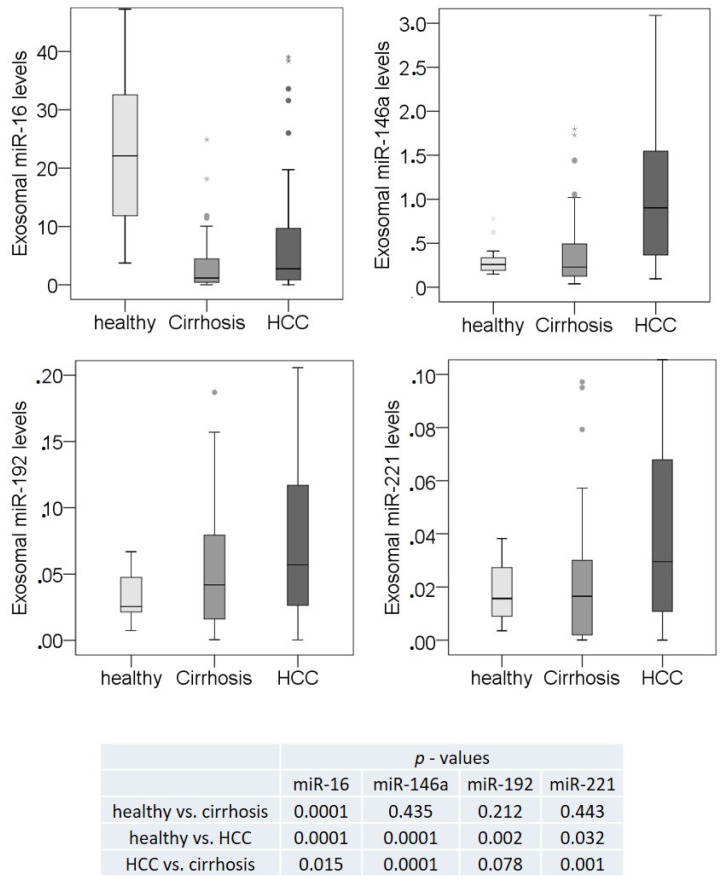
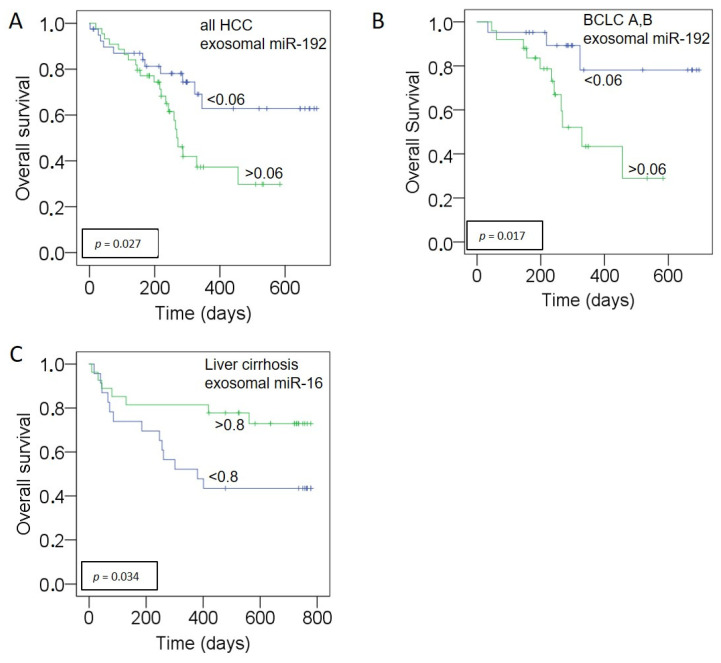
We aimed to identify a specific microRNA (miRNA) pattern to determine diagnostic and prognostic value in plasma exosomes of hepatocellular carcinoma (HCC) patients. A two-stage study was carried out: exosomal miRNAs were quantified in plasma of HCC patients and healthy individuals by PCR-based microarray cards containing 45 different miRNAs (training cohort). Then, four deregulated miRNAs (miR-16, miR-146a, miR-192, and miR-221) were quantified in the validation analysis using exosomes derived from 85 HCC patients, 50 liver cirrhosis patients, and 20 healthy individuals. Exosomal miR-146a ( = 0.0001), miR-192 ( = 0.002) and miR-221 ( = 0.032) were upregulated only in HCC patients. Repeated 10-fold cross validation showed that miR-146a differentiated HCC from liver cirrhosis patients with AUC of 0.80 ± 0.14 (sensitivity: 81 ± 13%, specificity: 58 ± 22%) in a logistic regression model. High miR-192 presence is associated with poor overall survival (OS) in all HCC patients ( = 0.027) and was predictor of OS in HCC patients in an uni- and multivariate Cox regression model. Moreover, decreased miR-16 levels correlated with OS in liver cirrhosis patients ( = 0.034). Our results emphasized that exosomes secreted into the plasma carry differentially expressed miRNAs of which in particular, miR-192, miR-146, and miR-16 are promising diagnostic and prognostic markers for both HCC and liver cirrhosis patients.
我们旨在识别一种特定的微小RNA(miRNA)模式,以确定其在肝细胞癌(HCC)患者血浆外泌体中的诊断和预后价值。我们进行了一项两阶段研究:通过基于PCR的包含45种不同miRNA的微阵列芯片对HCC患者和健康个体血浆中的外泌体miRNA进行定量(训练队列)。然后,在验证分析中,使用来自85例HCC患者、50例肝硬化患者和20例健康个体的外泌体对4种失调的miRNA(miR-16、miR-146a、miR-192和miR-221)进行定量。外泌体miR-146a(P = 0.0001)、miR-192(P = 0.002)和miR-221(P = 0.032)仅在HCC患者中上调。重复10倍交叉验证显示,在逻辑回归模型中,miR-146a区分HCC和肝硬化患者的曲线下面积(AUC)为0.80±0.14(敏感性:81±13%,特异性:58±22%)。高表达的miR-192与所有HCC患者的总生存期(OS)较差相关(P = 0.027),并且在单因素和多因素Cox回归模型中是HCC患者OS的预测指标。此外,miR-16水平降低与肝硬化患者的OS相关(P = 0.034)。我们的结果强调,分泌到血浆中的外泌体携带差异表达的miRNA,其中特别是miR-192、miR-146和miR-16有望成为HCC和肝硬化患者的诊断和预后标志物。