Department of Hematology-Oncology, Faculty of Medicine, Saint Joseph University, Beirut 166830, Lebanon.
Department of Medical Oncology and INSERMU830, Curie Institute, 75005 Paris, France.
Cells. 2021 May 18;10(5):1240. doi: 10.3390/cells10051240.
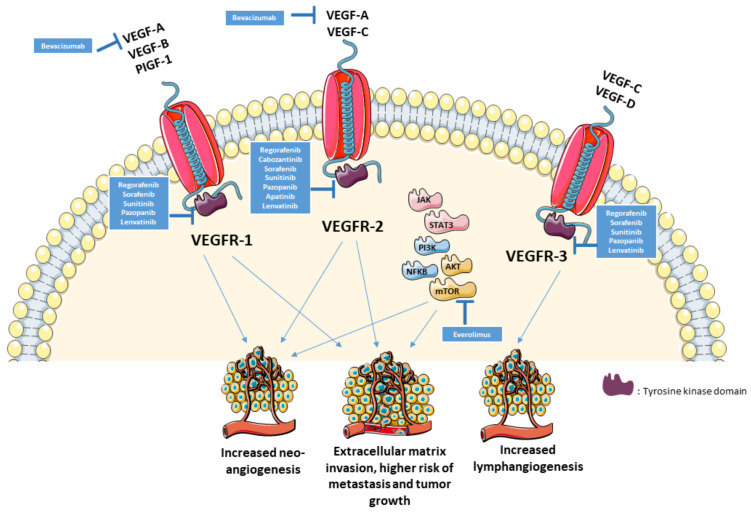
Osteosarcoma is the most common primary tumor of the bones affecting mainly young adults. Despite the advances in the field of systemic anticancer therapy, the prognosis of relapsed of metastatic osteosarcoma patients remain dismal with very short survival. However, the better understanding of the pathophysiology of this subtype of sarcoma has led to the identification of new targeted agents with significant activity. In fact, increased angiogenesis plays a major role in the tumor growth and survival of osteosarcoma patients. Several targeted agents have demonstrated a significant anti-tumor activity including multi-kinase inhibitors. In this review, we will discuss the pathophysiology, rationale, and role of targeting angiogenesis via the VEGF pathway in patients with osteosarcoma with emphasis on the published clinical trials and future directions.
骨肉瘤是最常见的原发性骨肿瘤,主要影响年轻人。尽管在系统抗癌治疗领域取得了进展,但复发性和转移性骨肉瘤患者的预后仍然很差,生存期非常短。然而,对这种亚型肉瘤的病理生理学的更好理解导致了具有显著活性的新靶向药物的识别。事实上,血管生成的增加在骨肉瘤患者的肿瘤生长和存活中起着主要作用。几种靶向药物已经显示出显著的抗肿瘤活性,包括多激酶抑制剂。在这篇综述中,我们将讨论骨肉瘤患者通过 VEGF 通路靶向血管生成的病理生理学、原理和作用,重点讨论已发表的临床试验和未来方向。