Gray Mark, Marland Jamie R K, Murray Alan F, Argyle David J, Potter Mark A
The Royal (Dick) School of Veterinary Studies and Roslin Institute, University of Edinburgh, Easter Bush, Roslin, Midlothian, Edinburgh EH25 9RG, UK.
School of Engineering, Institute for Integrated Micro and Nano Systems, University of Edinburgh, Scottish Microelectronics Centre, King's Buildings, Edinburgh EH9 3FF, UK.
J Pers Med. 2021 May 25;11(6):471. doi: 10.3390/jpm11060471.
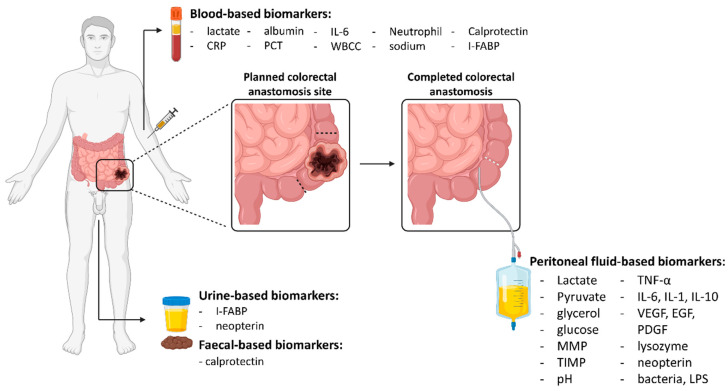
Development of an anastomotic leak (AL) following intestinal surgery for the treatment of colorectal cancers is a life-threatening complication. Failure of the anastomosis to heal correctly can lead to contamination of the abdomen with intestinal contents and the development of peritonitis. The additional care that these patients require is associated with longer hospitalisation stays and increased economic costs. Patients also have higher morbidity and mortality rates and poorer oncological prognosis. Unfortunately, current practices for AL diagnosis are non-specific, which may delay diagnosis and have a negative impact on patient outcome. To overcome these issues, research is continuing to identify AL diagnostic or predictive biomarkers. In this review, we highlight promising candidate biomarkers including ischaemic metabolites, inflammatory markers and bacteria. Although research has focused on the use of blood or peritoneal fluid samples, we describe the use of implantable medical devices that have been designed to measure biomarkers in peri-anastomotic tissue. Biomarkers that can be used in conjunction with clinical status, routine haematological and biochemical analysis and imaging have the potential to help to deliver a precision medicine package that could significantly enhance a patient's post-operative care and improve outcomes. Although no AL biomarker has yet been validated in large-scale clinical trials, there is confidence that personalised medicine, through biomarker analysis, could be realised for colorectal cancer intestinal resection and anastomosis patients in the years to come.
结直肠癌肠道手术后发生吻合口漏(AL)是一种危及生命的并发症。吻合口未能正确愈合可导致腹腔被肠内容物污染并引发腹膜炎。这些患者所需的额外护理与更长的住院时间和更高的经济成本相关。患者的发病率和死亡率也更高,肿瘤预后更差。不幸的是,目前AL的诊断方法缺乏特异性,这可能会延迟诊断并对患者的预后产生负面影响。为了克服这些问题,研究人员一直在继续寻找AL诊断或预测生物标志物。在这篇综述中,我们重点介绍了有前景的候选生物标志物,包括缺血代谢物、炎症标志物和细菌。尽管研究主要集中在血液或腹腔液样本的使用上,但我们也描述了用于测量吻合口周围组织生物标志物的可植入医疗设备。能够与临床状况、常规血液学和生化分析以及影像学结合使用的生物标志物,有可能有助于提供精准医疗方案,显著加强患者的术后护理并改善预后。尽管尚未有AL生物标志物在大规模临床试验中得到验证,但人们相信,在未来几年,通过生物标志物分析实现结直肠癌肠道切除和吻合术患者的个性化医疗是可行的。