College of Medicine and Medical Sciences, Arabian Gulf University (AGU), 323 Manama, Bahrain.
Department of Internal Medicine, University Medical Center (UMC), King Abdullah Medical City (KAMC), 323 Manama, Bahrain.
Medicina (Kaunas). 2021 May 23;57(6):525. doi: 10.3390/medicina57060525.
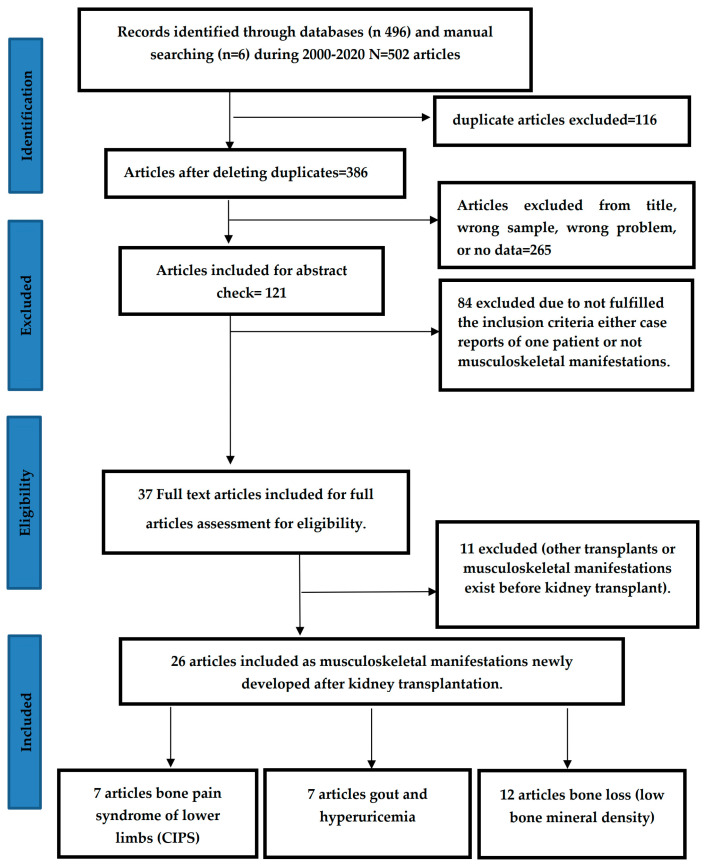
: The musculoskeletal (MSK) manifestations in the kidney transplant recipient (KTxR) could lead to decreased quality of life and increased morbidity and mortality. However, the prevalence of these MSK manifestations is still not well-recognized. This review aimed to investigate the prevalence and outcomes of MSK manifestations in KTxR in the last two decades. Research was performed in EBSCO, EMBASE, CINAHL, PubMed/MEDLINE, Cochrane, Google Scholar, PsycINFO, Scopus, Science Direct, and Web of Science electronic databases were searched during the years 2000-2020. The PRISMA flow diagram revealed the search procedure and that 502 articles were retrieved from the initial search and a total of 26 articles were included for the final report in this review. Twelve studies reported bone loss, seven studies reported a bone pain syndrome (BPS) or cyclosporine-induced pain syndrome (CIPS), and seven studies reported hyperuricemia (HU) and gout. The prevalence of MSK manifestations in this review reported as follow: BPS/CIPS ranged from 0.82% to 20.7%, while bone loss ranged from 14% to 88%, and the prevalence of gout reported in three studies as 7.6%, 8.0%, and 22.37%, while HU ranged from 38% to 44.2%. The post-transplantation period is associated with profound MSK abnormalities of mineral metabolism and bone loss mainly caused by corticosteroid therapy, which confer an increased fracture risk. Cyclosporine (CyA) and tacrolimus were responsible for CIPS, while HU or gout was attributable to CyA. Late diagnosis or treatment of post-transplant bone disease is associated with lower quality of life among recipients.
肌肉骨骼(MSK)表现可导致肾移植受者(KTxR)的生活质量下降、发病率和死亡率增加。然而,这些 MSK 表现的流行率仍未得到充分认识。本综述旨在研究过去二十年 KTxR 中 MSK 表现的流行率和结果。
研究人员在 EBSCO、EMBASE、CINAHL、PubMed/MEDLINE、Cochrane、Google Scholar、PsycINFO、Scopus、Science Direct 和 Web of Science 电子数据库中进行了研究,检索了 2000 年至 2020 年期间的文献。PRISMA 流程图显示了搜索过程,从最初的搜索中检索到 502 篇文章,并在本综述的最终报告中总共纳入了 26 篇文章。12 项研究报告了骨丢失,7 项研究报告了骨痛综合征(BPS)或环孢素诱导的疼痛综合征(CIPS),7 项研究报告了高尿酸血症(HU)和痛风。本综述中报告的 MSK 表现的流行率如下:BPS/CIPS 范围为 0.82%至 20.7%,而骨丢失范围为 14%至 88%,3 项研究报告的痛风流行率分别为 7.6%、8.0%和 22.37%,HU 范围为 38%至 44.2%。
移植后时期与矿物质代谢和骨丢失的深刻 MSK 异常相关,主要由皮质类固醇治疗引起,这增加了骨折风险。环孢素(CyA)和他克莫司导致 CIPS,而 HU 或痛风归因于 CyA。移植后骨病的诊断或治疗延迟与受者的生活质量下降有关。