Surgical Oncology, Department of Surgery, University of British Columbia, Vancouver, BC V5Z 1M9, Canada.
Surgical Oncology, Department of Surgery, University of Calgary, Calgary, AB T2N 2T9, Canada.
Curr Oncol. 2021 May 27;28(3):2040-2051. doi: 10.3390/curroncol28030189.
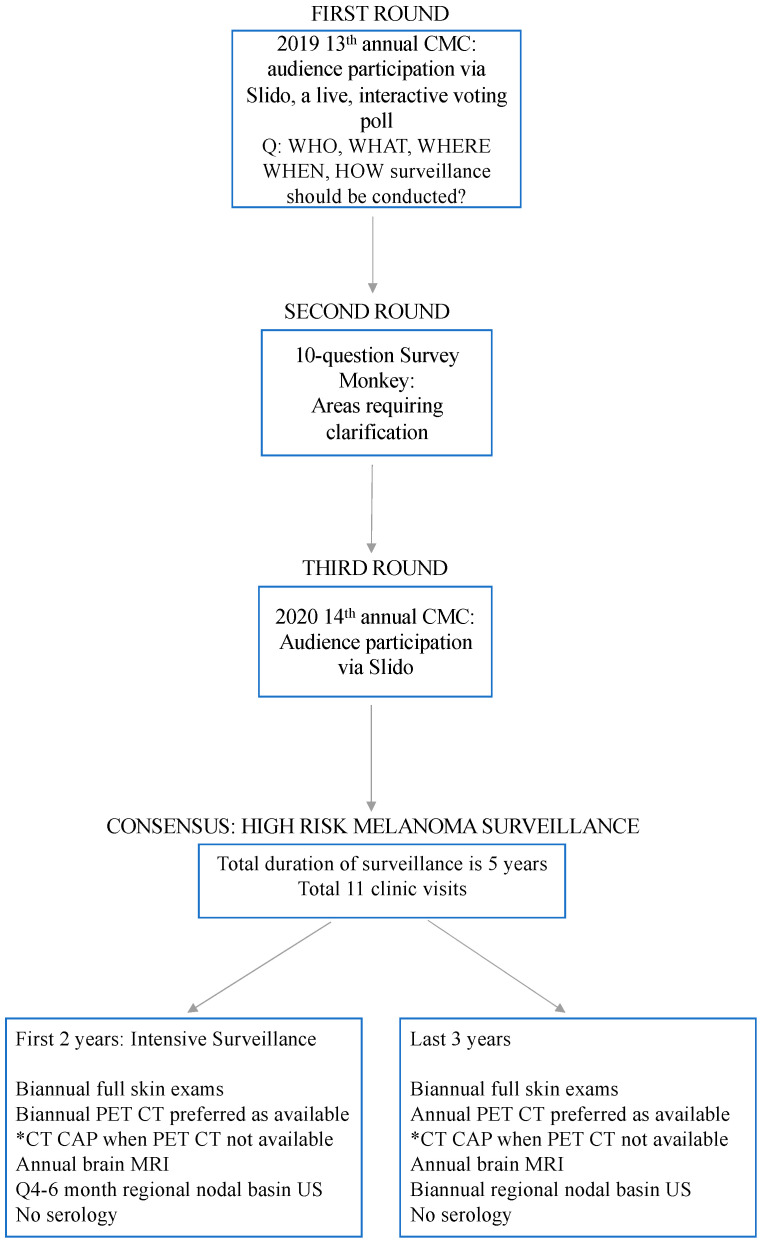
There are a lack of established guidelines for the surveillance of high-risk cutaneous melanoma patients following initial therapy. We describe a novel approach to the development of a national expert recommendation statement on high-risk melanoma surveillance (HRS). A consensus-based, live, online voting process was undertaken at the 13th and 14th annual Canadian Melanoma Conferences (CMC) to collect expert opinions relating to "who, what, where, and when" HRS should be conducted. Initial opinions were gathered via audience participation software and used as the basis for a second iterative questionnaire distributed online to attendees from the 13th CMC and to identified melanoma specialists from across Canada. A third questionnaire was disseminated in a similar fashion to conduct a final vote on HRS that could be implemented. The majority of respondents from the first two iterative surveys agreed on stages IIB to IV as high risk. Surveillance should be conducted by an appropriate specialist, irrespective of association to a cancer centre. Frequency and modality of surveillance favoured biannual visits and Positron Emission Tomography Computed Tomography (PET/CT) with brain magnetic resonance imaging (MRI) among the systemic imaging modalities available. No consensus was initially reached regarding the frequency of systemic imaging and ultrasound of nodal basins (US). The third iterative survey resolved major areas of disagreement. A 5-year surveillance schedule was voted on with 92% of conference members in agreement. This final recommendation was established following 92% overall agreement among the 2020 CMC attendees.
对于初始治疗后高危皮肤黑色素瘤患者的监测,目前缺乏既定的指南。我们描述了一种制定国家高危黑色素瘤监测(HRS)专家建议声明的新方法。在第 13 届和第 14 届加拿大黑色素瘤会议(CMC)上,采用基于共识的实时在线投票过程,收集有关 HRS“谁、什么、何处和何时”进行的专家意见。最初的意见是通过观众参与软件收集的,并作为基础,用于在线分发给第 13 届 CMC 与会者以及来自加拿大各地的黑色素瘤专家的第二轮迭代问卷。以类似的方式分发了第三轮问卷,以对可以实施的 HRS 进行最终投票。前两轮迭代调查的大多数受访者都认为 IIB 期到 IV 期为高危期。应通过适当的专家进行监测,无论是否与癌症中心有关。在现有的全身成像方式中,监测的频率和模式倾向于每两年进行一次检查,并结合正电子发射断层扫描计算机断层扫描(PET/CT)和脑磁共振成像(MRI)。最初对于全身成像和淋巴结区超声(US)的频率没有达成共识。第三次迭代调查解决了主要的分歧领域。92%的会议成员投票赞成 5 年的监测计划。在 2020 年 CMC 与会者中,92%的人总体上达成一致,从而确定了这一最终建议。