Rissmann Melanie, Lenk Matthias, Stoek Franziska, Szentiks Claudia A, Eiden Martin, Groschup Martin H
Institute of Novel and Emerging Infectious Diseases, Friedrich-Loeffler-Institut, Insel Riems, 17493 Greifswald, Germany.
Department of Experimental Animal Facilities and Biorisk Management, Friedrich-Loeffler-Institut, Insel Riems, 17493 Greifswald, Germany.
Pathogens. 2021 May 31;10(6):681. doi: 10.3390/pathogens10060681.
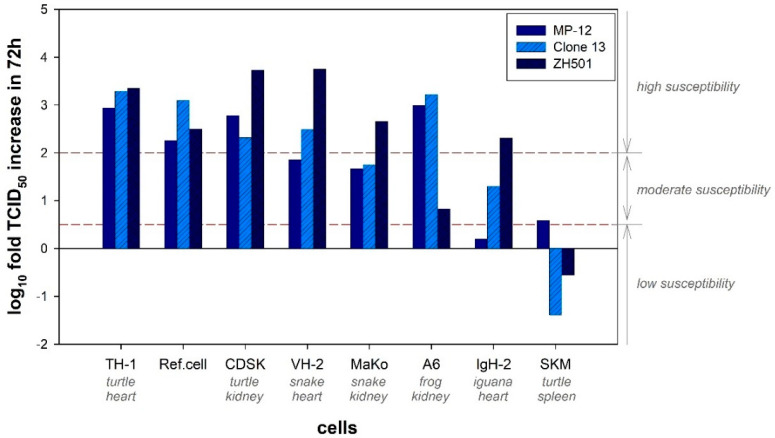
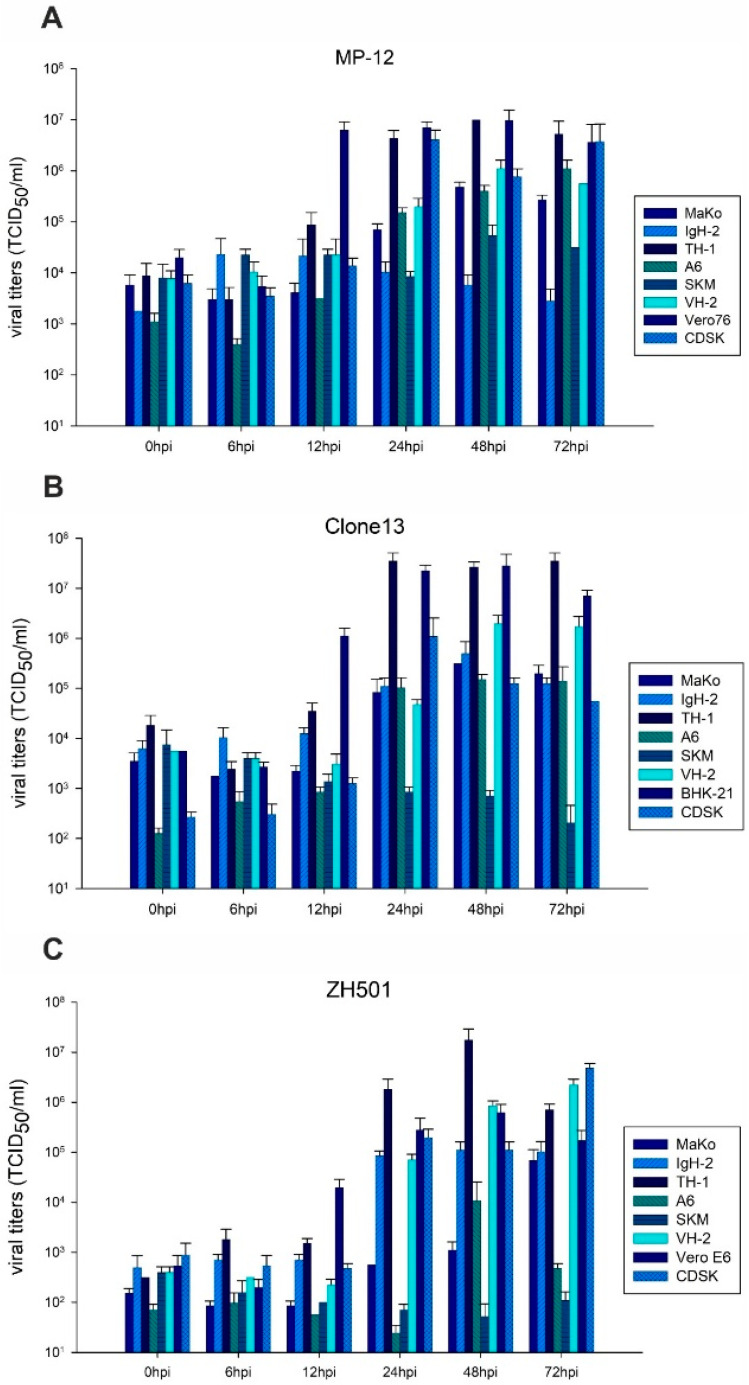
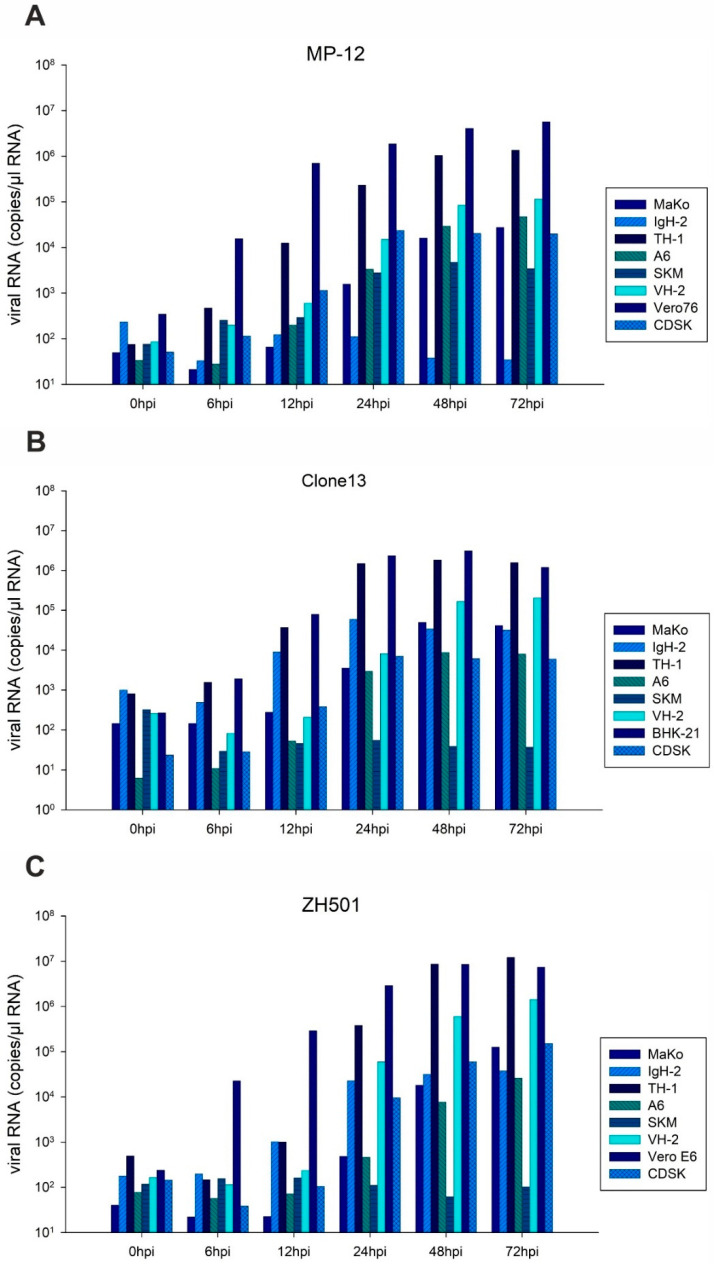
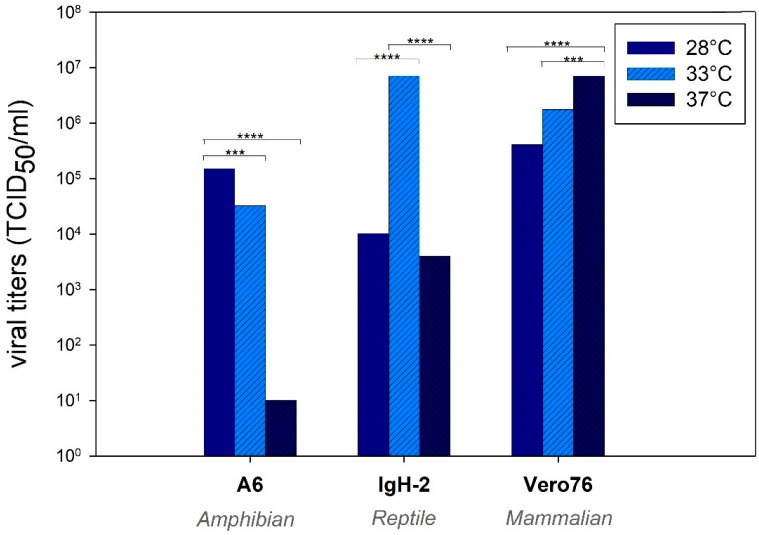
Rift Valley fever phlebovirus (RVFV) is a zoonotic arthropod-borne virus, which has led to devastating epidemics in African countries and on the Arabian Peninsula. Results of in-vivo, in-vitro and field studies suggested that amphibians and reptiles may play a role as reservoir hosts of RVFV, promoting its maintenance during inter-epidemic periods. To elucidate this hypothesis, we examined two newly established reptile-derived cell lines (Egyptian cobra and Chinese pond turtle) and five previously generated reptile- and amphibian-derived cell lines for their replicative capacity for three low- and high-pathogenic RVFV strains. At different time points after infection, viral loads (TCID), genome loads and the presence of intracellular viral antigen (immunofluorescence) were assessed. Additionally, the influence of temperatures on the replication was examined. Except for one cell line (read-eared slider), all seven cell lines were infected by all three RVFV strains. Two different terrapin-derived cell lines (Common box turtle, Chinese pond turtle) were highly susceptible. A temperature-dependent replication of RVFV was detected for both amphibian and reptile cells. In conclusion, the results of this study indicate the general permissiveness of amphibian and reptile cell lines to RVFV and propose a potential involvement of terrapins in the virus ecology.
裂谷热静脉病毒(RVFV)是一种人畜共患的节肢动物传播病毒,已在非洲国家和阿拉伯半岛引发了毁灭性的疫情。体内、体外和现场研究结果表明,两栖动物和爬行动物可能作为RVFV的储存宿主,在疫情间歇期促进其存续。为了阐明这一假设,我们检测了两种新建立的源自爬行动物的细胞系(埃及眼镜蛇和中华鳖)以及五种先前建立的源自爬行动物和两栖动物的细胞系对三种低致病性和高致病性RVFV毒株的复制能力。在感染后的不同时间点,评估病毒载量(组织培养感染剂量)、基因组载量以及细胞内病毒抗原的存在情况(免疫荧光法)。此外,还检测了温度对复制的影响。除一种细胞系(巴西彩龟)外,所有七种细胞系均被三种RVFV毒株感染。两种不同的龟类来源的细胞系(锦龟、中华鳖)高度易感。在两栖动物和爬行动物细胞中均检测到RVFV的温度依赖性复制。总之,本研究结果表明两栖动物和爬行动物细胞系对RVFV普遍具有易感性,并提出龟类可能参与病毒生态。