Frank Mariana, Selbuz Levent, Turan Ismail
Department of Physics, Concordia University, 7141 Sherbrooke St. West, Montreal, QC H4B 1R6 Canada.
Department of Engineering Physics, Ankara University, 06100 Ankara, Turkey.
Eur Phys J C Part Fields. 2021;81(5):466. doi: 10.1140/epjc/s10052-021-09218-1. Epub 2021 May 27.
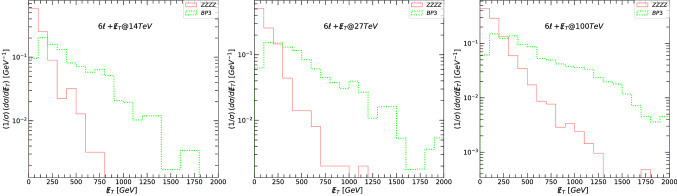
We study phenomenology at hadron colliders in an extended MSSM. We choose a model with a secluded sector, where the tension between the electroweak scale and developing a large enough mass for is resolved by incorporating three additional singlet superfields into the model. We perform a detailed analysis of the production, followed by decays, including into supersymmetric particles, of a boson with mass between 4 and 5.2 TeV, with particular emphasis on its possible discovery. We select three different scenarios consistent with the latest available experimental data and relic density constraints, and concentrate on final signals with , and . Including the SM background from processes with two, three or four vector bosons, we show the likelihood of observing a boson is not promising for the HL-LHC at 14 TeV. While at 27 and 100 TeV, the situation is more optimistic, and we devise specific benchmark scenarios which could be observed.
我们在扩展的最小超对称标准模型(MSSM)中研究强子对撞机中的现象学。我们选择一个具有隐蔽扇区的模型,其中通过将三个额外的单态超场纳入模型来解决电弱标度与为[具体粒子]发展出足够大质量之间的张力。我们对质量在4到5.2 TeV之间的一种玻色子的产生及其随后的衰变(包括衰变成超对称粒子)进行了详细分析,特别强调其可能的发现。我们选择了三种与最新可用实验数据和遗迹密度约束相一致的不同情景,并专注于具有[具体末态粒子1]、[具体末态粒子2]和[具体末态粒子3]的最终信号。包括来自涉及两个、三个或四个矢量玻色子过程的标准模型背景,我们表明在14 TeV的高亮度大型强子对撞机(HL-LHC)上观测到这种玻色子的可能性不大。而在27 TeV和100 TeV时,情况更为乐观,并且我们设计了可以被观测到的特定基准情景。