Department of Critical Care Medicine, Xuanwu Hospital, Capital Medical University, Beijing, China.
Department of Critical Care Medicine, Fu Xing Hospital, Capital Medical University, Beijing, China.
J Diabetes Investig. 2021 Dec;12(12):2212-2220. doi: 10.1111/jdi.13606. Epub 2021 Aug 3.
AIMS/INTRODUCTION: Hyperglycemia, hypoglycemia, and blood glucose fluctuation are associated with the outcome in critically ill patients, but the target of blood glucose control is debatable especially in patients with diabetes regarding the status of blood glucose control before admission to ICU. This study aimed to investigate the association between the glycemic gap which is calculated as the mean blood glucose level during the first 7 days after admission to ICU minus the A1C-derived average glucose and the outcome of critically ill patients with diabetes.
This study was undertaken in two intensive care units (ICUs) with a total of 30 beds. Patients with diabetes who were expected to stay for more than 24 h were enrolled, the HbA1c was tested within 3 days after admission and converted to the A1C-derived average glucose (ADAG) by the equation: ADAG = [(HbA1c * 28.7) - 46.7 ] * 18 , arterial blood glucose measurements were four per day routinely during the first 7 days after admission, the APACHE II score within the first 24 h, the mean blood glucose level (MGL), standard deviation (SD), and coefficient of variation (CV) during the first 7 days were calculated for each person, the GAP and GAP were calculated as the admission blood glucose and MGL minus the ADAG, respectively, the incidence of moderate hypoglycemia (MH) and severe hypoglycemia (SH), the total dosage of glucocorticoids and average daily dosage of insulin within 7 days, the duration of renal replacement therapy (RRT), ventilator-free hours, and non-ICU stay days within 28 days were also collected. The enrolled patients were divided into a survival group and a nonsurvival group according to survival or not at 28 days and 1 year after admission, and the relationship between parameters derived from blood glucose and mortality in the enrolled critically ill patients was explored.
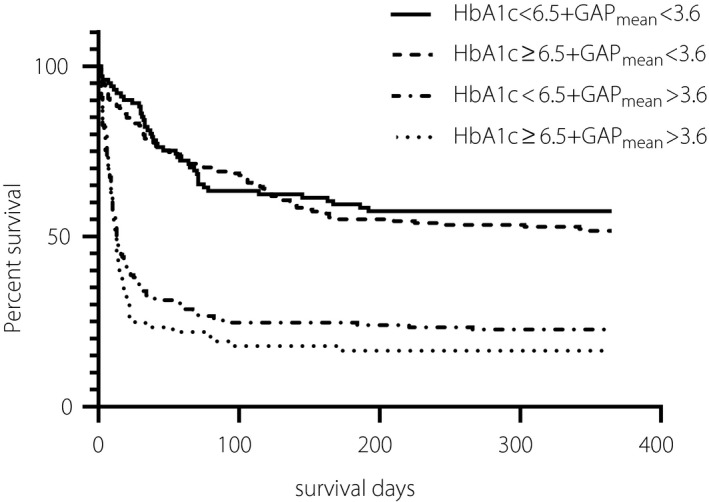
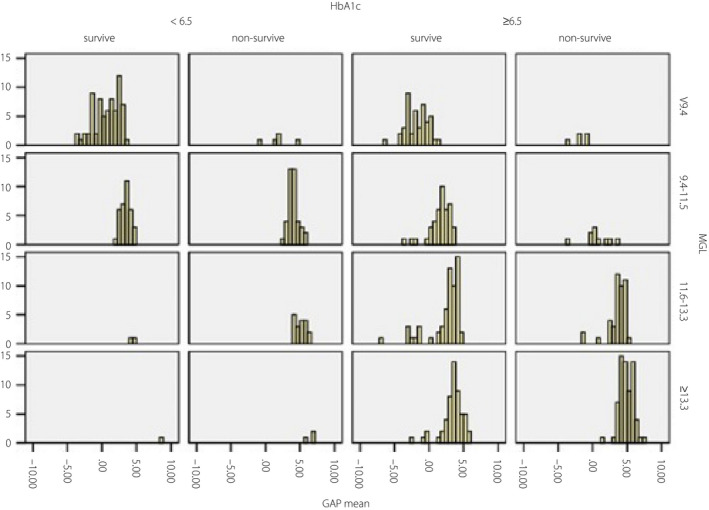
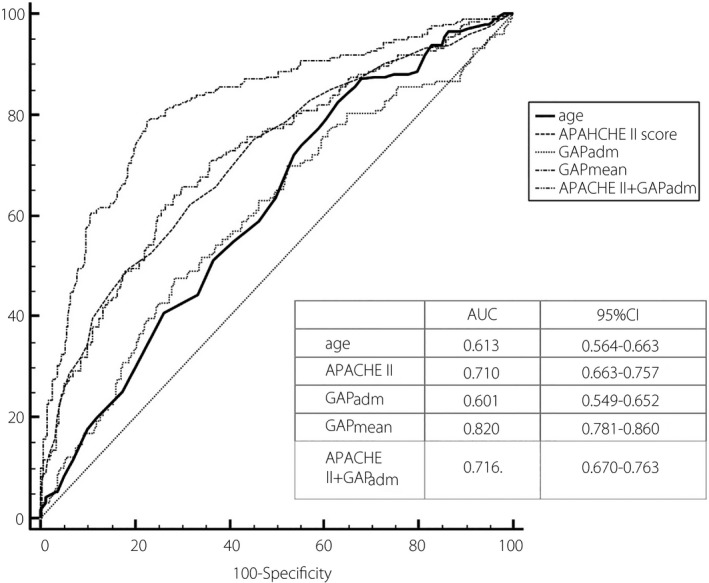
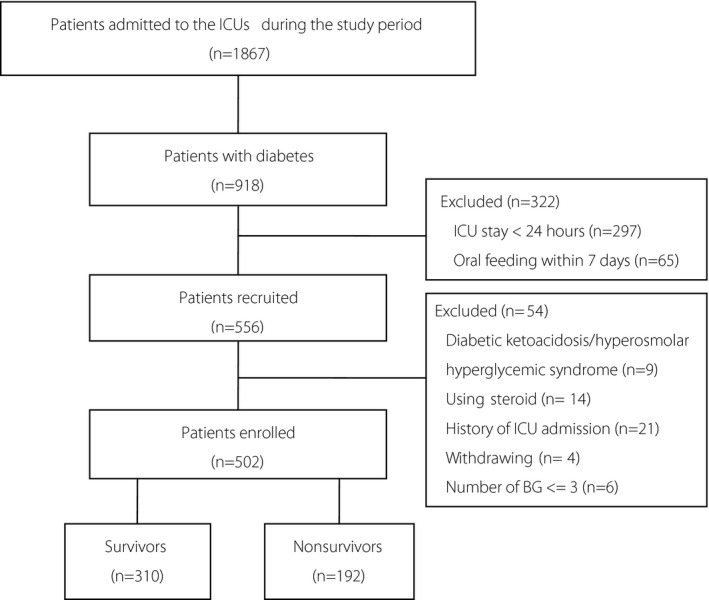
Five hundred and two patients were enrolled and divided into a survival group (n = 310) and a nonsurvival group (n = 192). It was shown that the two groups had a comparable level of HbA1c, the nonsurvivors had a greater APACHE II, MGL, SD, CV, GAP , GAP , and a higher incidence of hypoglycemia. A lesser duration of ventilator-free, non-ICU stay, and a longer duration of RRT were recorded in the nonsurvival group, who received a lower carbohydrate intake, a higher daily dosage of insulin and glucocorticoid. GAP had the greatest predictive power with an AUC of 0.820 (95%CI: 0.781-0.850), the cut-off value was 3.60 mmol/L (sensitivity 78.2% and specificity 77.3%). Patients with a low GAP tended to survive longer than the high GAP group 1 year after admission.
Glycemic GAP between the mean level of blood glucose within the first 7 days after admission to ICU and the A1C-derived average glucose was independently associated with a 28 day mortality of critically ill patients with diabetes, the predictive power extended to 1 year. The incidence of hypoglycemia was associated with mortality either.
目的/引言:高血糖、低血糖和血糖波动与危重症患者的预后相关,但血糖控制目标存在争议,尤其是对于入住 ICU 前血糖控制状况的糖尿病患者。本研究旨在探讨入住 ICU 后第 1 天至第 7 天的平均血糖水平减去糖化血红蛋白衍生平均血糖(ADAG)后的血糖差(glycemic gap,GAP)与糖尿病危重症患者预后之间的关系。
该研究在 2 个共 30 张床位的重症监护病房(ICU)进行。纳入预计入住时间超过 24 小时的糖尿病患者,入院后 3 天内检测糖化血红蛋白(HbA1c),并通过公式转换为 ADAG:ADAG = [(HbA1c * 28.7) - 46.7] * 18 ,入院后第 1 天常规监测 4 次/天的动脉血糖,计算入院后第 1 天至第 7 天的每例患者的急性生理学与慢性健康状况评分系统 II(APACHE II)评分、平均血糖水平(MGL)、标准差(SD)和变异系数(CV),GAP 和 GAP 分别为入院时血糖和 MGL 减去 ADAG。记录中度低血糖(MH)和严重低血糖(SH)的发生率、入住后第 7 天内糖皮质激素的总剂量和胰岛素的平均日剂量、肾脏替代治疗(RRT)持续时间、呼吸机脱机时间和入住后第 28 天非 ICU 停留天数。根据入院后 28 天和 1 年的生存情况,将入组患者分为存活组(n=310)和非存活组(n=192),并探索血糖相关参数与危重症患者死亡率之间的关系。
共纳入 502 例患者,分为存活组(n=310)和非存活组(n=192)。结果显示,两组患者的 HbA1c 水平相当,非存活组患者的 APACHE II、MGL、SD、CV、GAP、GAP 和低血糖发生率较高。非存活组患者的呼吸机脱机时间、非 ICU 停留时间较短,RRT 持续时间较长,碳水化合物摄入量较少,胰岛素和糖皮质激素日剂量较高。GAP 的预测能力最强,曲线下面积为 0.820(95%CI:0.781-0.850),截断值为 3.60mmol/L(灵敏度 78.2%,特异性 77.3%)。入院后 1 年,GAP 较低的患者存活时间长于 GAP 较高的患者。
入住 ICU 后第 1 天至第 7 天的平均血糖水平与糖化血红蛋白衍生平均血糖之间的血糖差与糖尿病危重症患者 28 天死亡率独立相关,其预测能力可延伸至 1 年。低血糖的发生率也与死亡率相关。