Cardiovascular Research Unit, Odense University Hospital Svendborg, Baagøes Allé 15, 5700, Svendborg, Denmark.
Department of Cardiology, Aarhus University Hospital Skejby, Palle Juul Jensens Boulevard 99, 8200, Aarhus, Denmark.
BMC Cardiovasc Disord. 2021 Jun 2;21(1):269. doi: 10.1186/s12872-021-02063-w.
Reduced left ventricular function, assessed by global longitudinal strain (GLS), is sometimes observed in asymptomatic patients with diabetes mellitus (DM) and is often present in patients with diabetes-related microvascular complications. Our aim was to assess the association between microvascular complications, coronary artery plaque burden (PB) and GLS in asymptomatic patients with DM and non-obstructive coronary artery disease (CAD).
This cross-sectional study included patients with DM without any history, symptoms or objective evidence of obstructive CAD. All patients were identified in the outpatient Clinic of Endocrinology at Odense University Hospital Svendborg. An echocardiography and a coronary computed tomography angiography were performed to assess GLS and the degree of CAD, respectively. A coronary artery stenosis < 50% was considered non-obstructive. A linear regression model was used to evaluate the impact of potential confounders on GLS with adjustment of body mass index (BMI), mean arterial pressure (MAP), microvascular complications, type of diabetes, tissue Doppler average early diastolic mitral annulus velocity (e') and PB.
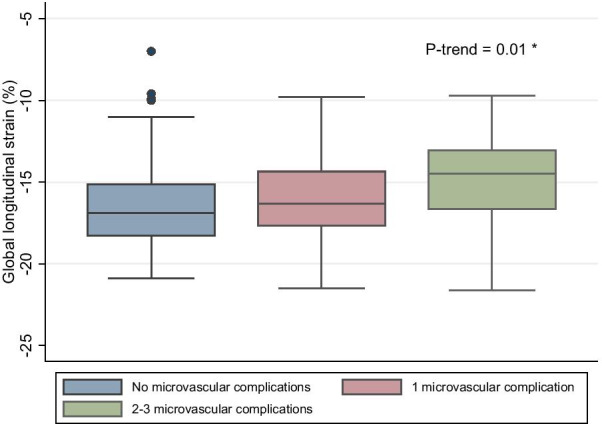
Two hundred and twenty-two patients were included, of whom 172 (77%) had type 2 DM and 50 (23%) had type 1 diabetes. One hundred and eleven (50%) patients had microvascular complications. GLS decreased as the burden of microvascular complications increased (P-trend = 0.01): no microvascular complications, GLS (- 16.4 ± 2.5%), 1 microvascular complication (- 16.0 ± 2.5%) and 2-3 microvascular complications (- 14.9 ± 2.8%). The reduction in GLS remained significant after multivariable adjustment (β 0.50 [95% CI 0.11-0.88], p = 0.01). BMI (β 0.12 [95% CI 0.05-0.19]) and MAP (β 0.05 [95% CI 0.01-0.08]) were associated with reduced GLS. In addition, an increased number of microvascular complications was associated with increased PB (β 2.97 [95% CI 0.42-5.51], p = 0.02) in a univariable linear regression model, whereas there was no significant association between PB and GLS.
The burden of microvascular complications was associated with reduced GLS independent of other cardiovascular risk factors in asymptomatic patients with DM and non-obstructive CAD. In addition, the burden of microvascular complications was associated with increasing PB, whereas PB was not associated with GLS.
左心室功能降低,通过整体纵向应变(GLS)评估,在无症状的糖尿病(DM)患者中有时会观察到,并且在与糖尿病相关的微血管并发症患者中通常存在。我们的目的是评估无症状 DM 患者中微血管并发症、冠状动脉斑块负担(PB)和 GLS 之间的关系与非阻塞性冠状动脉疾病(CAD)。
这项横断面研究纳入了在丹麦欧登塞大学医院斯文堡内分泌科门诊就诊的无任何阻塞性 CAD 病史、症状或客观证据的 DM 患者。所有患者均接受超声心动图和冠状动脉计算机断层血管造影检查,以评估 GLS 和 CAD 程度。冠状动脉狭窄<50%被认为是非阻塞性的。使用线性回归模型,在调整体重指数(BMI)、平均动脉压(MAP)、微血管并发症、糖尿病类型、组织多普勒平均早期舒张二尖瓣环速度(e')和 PB 后,评估潜在混杂因素对 GLS 的影响。
共纳入 222 例患者,其中 172 例(77%)为 2 型 DM,50 例(23%)为 1 型糖尿病。111 例(50%)患者存在微血管并发症。随着微血管并发症负担的增加,GLS 降低(P趋势=0.01):无微血管并发症,GLS(-16.4±2.5%)、1 种微血管并发症(-16.0±2.5%)和 2-3 种微血管并发症(-14.9±2.8%)。多变量调整后 GLS 的降低仍然显著(β0.50[95%CI 0.11-0.88],p=0.01)。BMI(β0.12[95%CI 0.05-0.19])和 MAP(β0.05[95%CI 0.01-0.08])与 GLS 降低相关。此外,在单变量线性回归模型中,微血管并发症数量的增加与 PB 的增加相关(β2.97[95%CI 0.42-5.51],p=0.02),而 PB 与 GLS 之间无显著相关性。
在无症状的 DM 患者和非阻塞性 CAD 患者中,微血管并发症的负担与 GLS 降低独立于其他心血管危险因素有关。此外,微血管并发症的负担与 PB 的增加有关,而 PB 与 GLS 无关。