Division of Urology, Perelman School of Medicine, University of Pennsylvania, 3400 Civic Center Boulevard, Philadelphia, PA, 19104, USA.
Division of Urology, Children's Hospital of Philadelphia, 3401 Civic Center Boulevard, Philadelphia, PA, 19104, USA.
J Pediatr Urol. 2021 Aug;17(4):480.e1-480.e7. doi: 10.1016/j.jpurol.2021.05.012. Epub 2021 May 20.
Widespread utilization of telemedicine in our practice to date has been limited to the evaluation of certain post-surgical patients. The COVID-19 pandemic acutely stressed our established system and required us to enhance our utilization of telemedicine. We hypothesized that expansion of telemedicine to new and follow up patient visits for pediatric urology could be done effectively in a way that satisfied patient and parental expectations.
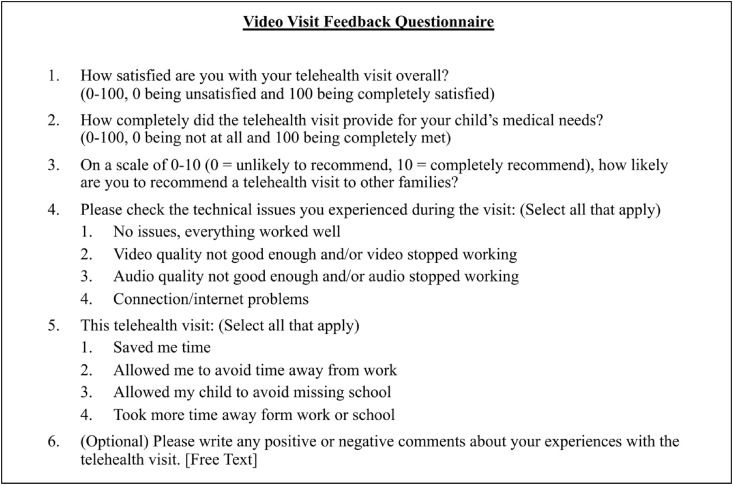
Using a pre-COVID-19 established telemedicine program based in our electronic medical record (EMR), patients and providers transitioned to primarily virtual visits when clinically appropriate. Guidelines were formulated to direct patient scheduling, provider and staff education was provided, including a process map designed for multiple providers to complete video visits (VV), and the EMR was redesigned to incorporate telehealth terminology. The number of VV per provider was recorded using the electronic medical record, and patient reported outcomes (PRO) were measured using a standardized questionnaire.
A total of 631 VV met inclusion criteria during the period of May 2018-April 2020. This included 334 follow up, 172 new, and 125 postoperative visits. The median age of patients at time of visit was 7 years (IQR 2-12 years), median visit time was 20 min (IQR 15-30 min), and the median travel distance saved by performing a VV was 12.2 miles (IQR 6.3-26.8 miles). Diagnoses were varied and included the entire breadth of a standard pediatric urology practice. The PRO questionnaire was completed for 325 of those patient visits. Families reported a high overall satisfaction with the video visits (median score of 10 out of 10) and felt that the visit met their child's medical needs. 90% stated that they would strongly recommend a telehealth visit to other families. Patients and parents reported benefits of VV including decreased travel costs and less time taken off from work and school.
The EMR enabled nimble redirection of clinical care in the setting of a global pandemic. The enhanced use of telemedicine has proved to be an alternative method to provide care for pediatric urology patients. Families indicate a high degree of satisfaction with this technology in addition to significant time and cost savings. Telemedicine should remain a key aspect of medical care and expanded from post-operative visits to new patient and follow up visits, even as we return to our normal practices as the pandemic restrictions soften.
迄今为止,我们的实践中远程医疗的广泛应用仅限于评估某些手术后的患者。COVID-19 大流行使我们既定的系统受到严重冲击,要求我们加强远程医疗的应用。我们假设,通过在电子病历(EMR)中建立的预先存在的远程医疗计划,为儿科泌尿科的新患者和随访患者就诊扩大远程医疗可以以满足患者和家长期望的方式有效实施。
在 COVID-19 之前,我们根据 EMR 建立了一个远程医疗计划,当临床需要时,患者和提供者就过渡到主要的虚拟访问。制定了指导患者预约的指南,为提供者和员工提供了教育,包括为多名提供者设计的用于完成视频访问(VV)的流程图,并重新设计了 EMR 以纳入远程医疗术语。使用电子病历记录每个提供者的 VV 数量,并使用标准化问卷测量患者报告的结果(PRO)。
在 2018 年 5 月至 2020 年 4 月期间,共有 631 次 VV 符合纳入标准。其中包括 334 次随访、172 次新患者和 125 次术后访问。就诊时患者的中位年龄为 7 岁(IQR 2-12 岁),中位就诊时间为 20 分钟(IQR 15-30 分钟),通过进行 VV 节省的中位旅行距离为 12.2 英里(IQR 6.3-26.8 英里)。诊断多种多样,包括标准儿科泌尿科实践的全部范围。其中 325 次就诊完成了 PRO 问卷。家庭对视频访问的整体满意度很高(中位数为 10 分中的 10 分),并认为访问满足了孩子的医疗需求。90%的人表示他们会强烈推荐其他家庭进行远程医疗访问。患者和家长报告说 VV 的好处包括减少旅行费用以及减少工作和上学的时间。
EMR 使临床护理能够在全球大流行的背景下灵活转向。远程医疗的使用得到了加强,事实证明这是为儿科泌尿科患者提供护理的替代方法。除了显著的时间和成本节省外,家庭对这项技术表示出高度的满意度。远程医疗应该仍然是医疗保健的一个关键方面,并从术后访问扩展到新患者和随访访问,即使随着大流行限制的放宽我们恢复正常实践。