Ferrario Lucrezia, Schettini Fabrizio, Avogaro Angelo, Bellia Chiara, Bertuzzi Federico, Bonetti Graziella, Ceriello Antonio, Ciaccio Marcello, Corsi Romanelli Massimiliano, Dozio Elena, Falqui Luca, Girelli Angela, Nicolucci Antonio, Perseghin Gianluca, Plebani Mario, Valentini Umberto, Zaninotto Martina, Castaldi Silvana, Foglia Emanuela
Centre for Health Economics, Social and Health Care Management, Università Carlo Cattaneo - LIUC, Castellanza, Italy.
Department of Medicine, University-Hospital of Padova, Padova, Italy.
Clinicoecon Outcomes Res. 2021 May 27;13:453-464. doi: 10.2147/CEOR.S304868. eCollection 2021.
To investigate the glycated albumin (GA) introduction implications, as an add-on strategy to traditional glycemic control (Hb1Ac and fasting plasma glucose - FPG) instruments, considering insulin-naïve individuals with type 2 diabetes mellitus (T2DM), treated with oral therapies.
A Health Technology Assessment was conducted in Italy, as a multi-dimensional approach useful to validate any innovative technology. The HTA dimensions, derived from the EUnetHTA Core Model, were deployed by means of literature evidence, health economics tools and qualitative questionnaires, filled-in by 15 professionals.
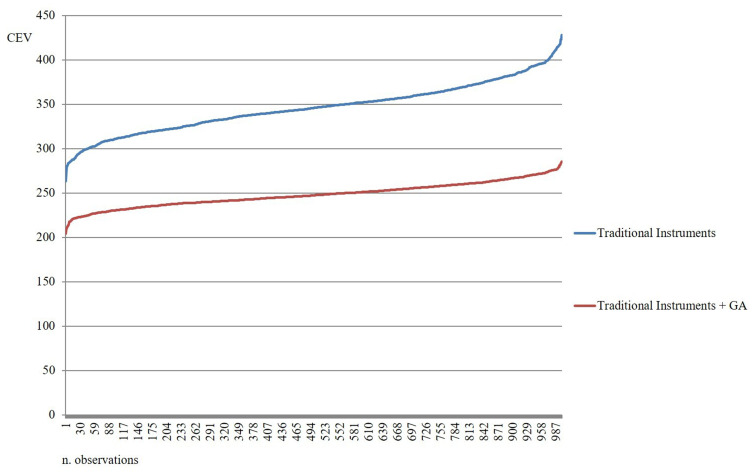
Literature stated that the GA introduction could lead to a higher number of individuals achieving therapeutic success after 3 months of therapy (97.0% vs 71.6% without GA). From an economic point of view, considering a projection of 1,955,447 T2DM insulin-naïve individuals, potentially treated with oral therapy, GA introduction would imply fewer individuals requiring a therapy switch (-89.44%), with a 1.06% in costs reduction, on annual basis, thus being also the preferable solution from a cost-effectiveness perspective (cost-effectiveness value: 237.74 vs 325.53). According to experts opinions, lower perceptions on GA emerged with regard to equity aspects (0.13 vs 0.72, p-value>0.05), whereas it would improve both individuals (2.17 vs 1.33, p-value=0.000) and caregivers quality of life (1.50 vs 0.83, p-value=0.000). Even if in the short term, GA required additional investments in training courses (-0.80 vs 0.10, p-value = 0.036), in the long run, GA could become the preferable technology (0.30 vs 0.01, p-value=0.018) from an organisational perspective.
Adding GA to traditional glycaemic control instruments could improve the clinical pathway of individuals with T2DM, leading to economic and organisational advantages for both hospitals and National Healthcare Systems.
对于初治2型糖尿病(T2DM)患者,在口服药物治疗基础上,研究糖化白蛋白(GA)作为传统血糖控制指标(糖化血红蛋白Hb1Ac和空腹血糖FPG)补充指标的意义。
在意大利进行了一项卫生技术评估,作为验证任何创新技术的多维度方法。源自欧盟卫生技术评估网络核心模型的卫生技术评估维度,通过文献证据、卫生经济学工具以及由15名专业人员填写的定性调查问卷进行应用。
文献表明,引入GA后,治疗3个月后达到治疗成功的个体数量可能更多(97.0%对比未引入GA时的71.6%)。从经济角度看,考虑到预计有1,955,447名初治T2DM患者可能接受口服治疗,引入GA意味着需要更换治疗方案的个体减少(-89.44%),每年成本降低1.06%,因此从成本效益角度也是更优方案(成本效益值:237.74对比325.53)。根据专家意见,在公平性方面对GA的认知较低(0.13对比0.72,p值>0.05),而它会改善个体(2.17对比1.33,p值=0.000)和照顾者的生活质量(1.50对比0.83,p值=0.000)。即使短期内,GA在培训课程方面需要额外投入(-0.80对比0.10,p值 = 0.036),从长期来看,从组织角度GA可能成为更优技术(0.30对比0.01,p值=0.018)。
在传统血糖控制指标中加入GA可改善T2DM患者的临床路径,为医院和国家医疗系统带来经济和组织方面的优势。