Duan Baoxue, Wang Changying, Liu Zeng, Yang Xiaoyu
Department of Dermatology, Xiangyang No.1 People's Hospital, Hubei University of Medicine, Xiangyang, Hubei, People's Republic of China.
Department of Oncology, Xiangyang No.1 People's Hospital, Hubei University of Medicine, Xiangyang, Hubei, People's Republic of China.
Cancer Manag Res. 2021 May 24;13:4181-4189. doi: 10.2147/CMAR.S300195. eCollection 2021.
The hyperactivation of receptor tyrosine kinase (RTK)-mediated pathways plays an important role in melanoma progression and resistance to therapy. The ubiquitin-specific protease 8 (USP8) is a deubiquitinating enzyme and its inhibition induces degradation of RTKs. This work explored the expression and role of USP8 in melanoma.
ELISA and qPCR were performed to assess USP8 expression in melanoma tissues and cells, as well as their normal counterparts. Cellular proliferation, migration and apoptosis assays were performed to determine USP8 functions in three melanoma cell lines. Western blot was performed to analyze RTK signaling in melanoma cells after USP8 inhibition.
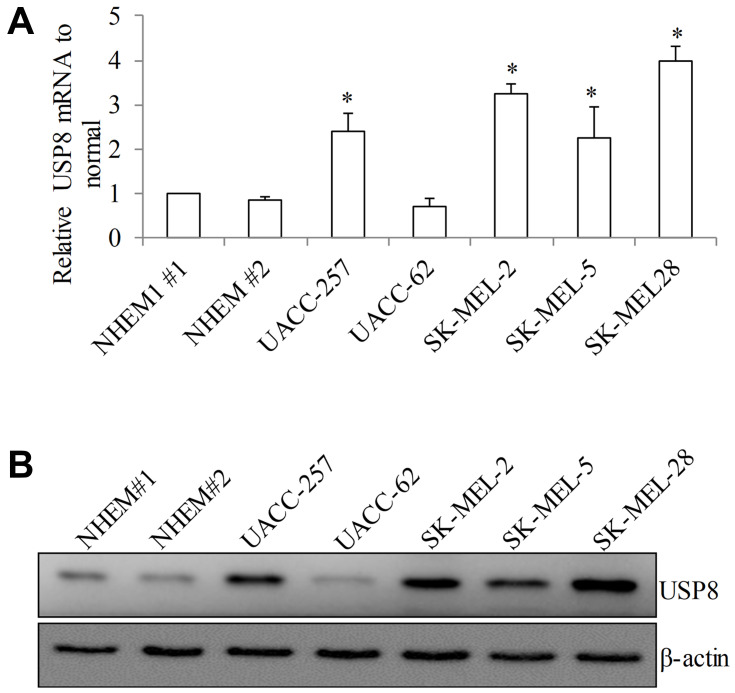
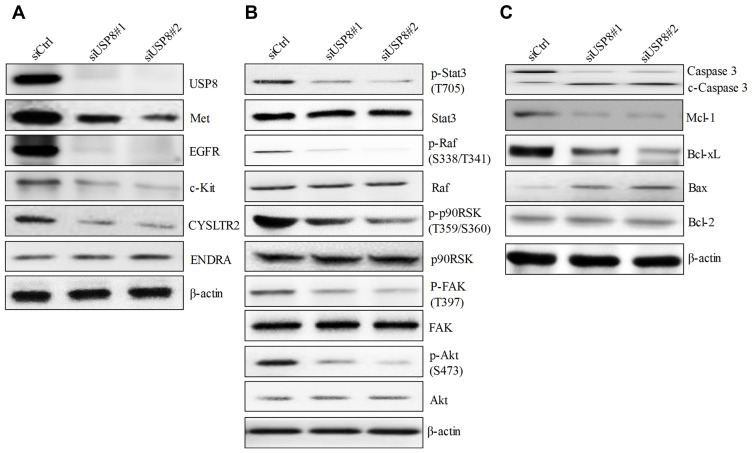
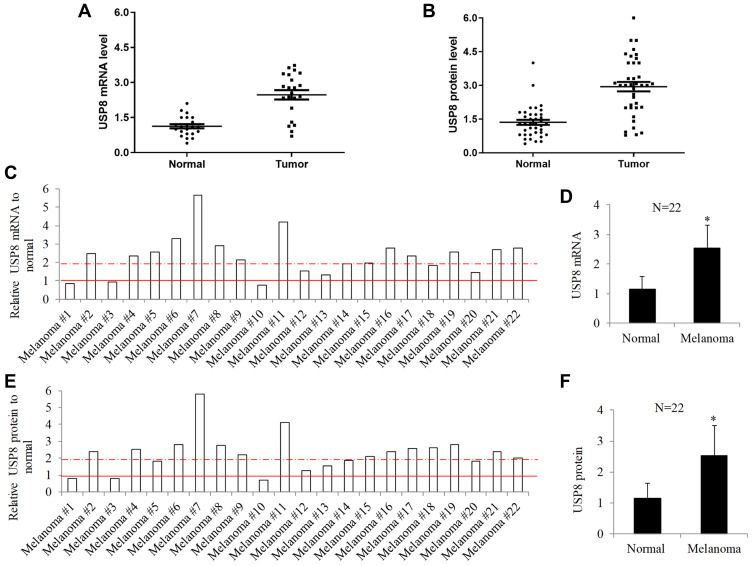
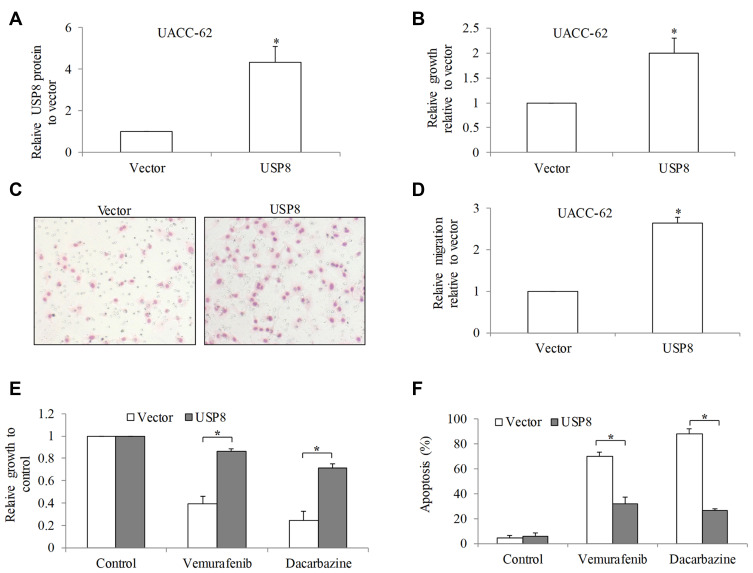
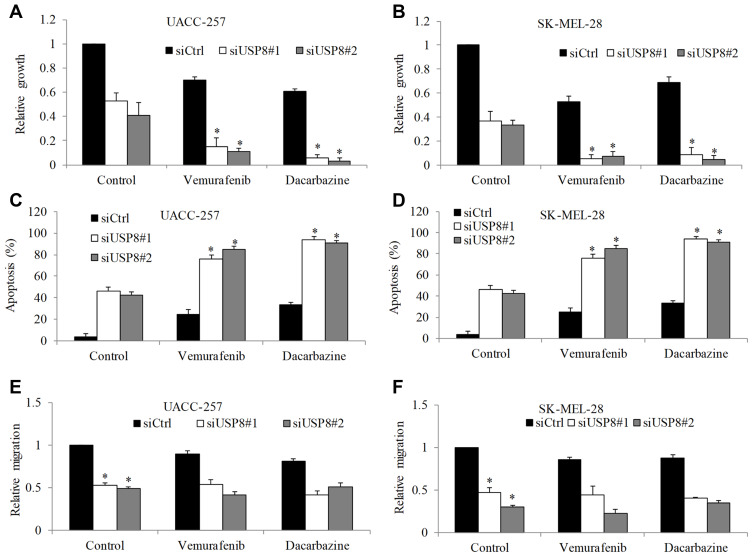
mRNA and protein level of USP8 were higher in melanoma cells than normal melanocytes. Higher USP8 expression was also found in tumors in the majority of melanoma patients. USP8 expression was not associated with clinicopathological features, such as age, disease stage, histology, ulceration and BRAF status. Functional analysis demonstrated that USP8 overexpression promoted melanoma cell activities and alleviated the inhibitory effects of therapeutic drugs. In contrast, USP8 knockdown suppressed melanoma cell growth, survival and migration, and augmented the inhibitory effects of therapeutic drugs. Mechanism studies revealed that USP8 inhibition remarkably reduced the expression level of multiple oncogenic RTKs, including c-Met, Kit, EGFR and GPCR. Consistently, RTK-mediated downstream pathways were disrupted in USP8-depleted cells, leading to the increased level of pro-apoptotic proteins and decreased level of anti-apoptotic proteins.
Inhibition of USP8 activity is a novel sensitizing strategy to overcome therapy resistance in melanoma.
受体酪氨酸激酶(RTK)介导的信号通路过度激活在黑色素瘤进展和治疗耐药中起重要作用。泛素特异性蛋白酶8(USP8)是一种去泛素化酶,抑制它可诱导RTK降解。本研究探讨了USP8在黑色素瘤中的表达及作用。
采用ELISA和qPCR检测黑色素瘤组织和细胞及其正常对照中USP8的表达。通过细胞增殖、迁移和凋亡实验确定USP8在三种黑色素瘤细胞系中的功能。采用蛋白质免疫印迹法分析USP8抑制后黑色素瘤细胞中的RTK信号传导。
黑色素瘤细胞中USP8的mRNA和蛋白水平高于正常黑素细胞。大多数黑色素瘤患者的肿瘤中也发现USP8表达较高。USP8表达与年龄、疾病分期、组织学、溃疡和BRAF状态等临床病理特征无关。功能分析表明,USP8过表达促进黑色素瘤细胞活性并减轻治疗药物的抑制作用。相反,USP8敲低抑制黑色素瘤细胞生长、存活和迁移,并增强治疗药物的抑制作用。机制研究显示,USP8抑制显著降低多种致癌RTK的表达水平,包括c-Met、Kit、EGFR和GPCR。一致地,在USP8缺失的细胞中RTK介导的下游信号通路被破坏,导致促凋亡蛋白水平升高和抗凋亡蛋白水平降低。
抑制USP8活性是克服黑色素瘤治疗耐药的一种新的增敏策略。