Herbst Rachel, Rybak Tiffany, Meisman Andrea, Whitehead Monica, Rosen Brittany, Crosby Lori E, Klein Melissa D, Real Francis J
Division of Behavioral Medicine and Clinical Psychology, Cincinnati Children's Hospital Medical Center, Cincinnati, OH, United States.
Department of Pediatrics, University of Cincinnati College of Medicine, Cincinnati, OH, United States.
JMIR Pediatr Parent. 2021 Jun 29;4(2):e29518. doi: 10.2196/29518.
Behavioral health disorders have steadily increased and been exacerbated by the COVID-19 pandemic. Though behavioral health disorders can be successfully mitigated with early implementation of evidence-based parent management strategies, education for pediatric residents on behavioral health anticipatory guidance has been limited to date, with training challenges compounded by the physical distancing requirements of the COVID-19 pandemic. Virtual reality (VR) simulations provide an opportunity to train residents on this complex competency by allowing deliberate practice of necessary skills while adhering to current social distancing guidelines.
This study explored the usability of a VR-based behavioral health anticipatory guidance curriculum for pediatric residents.
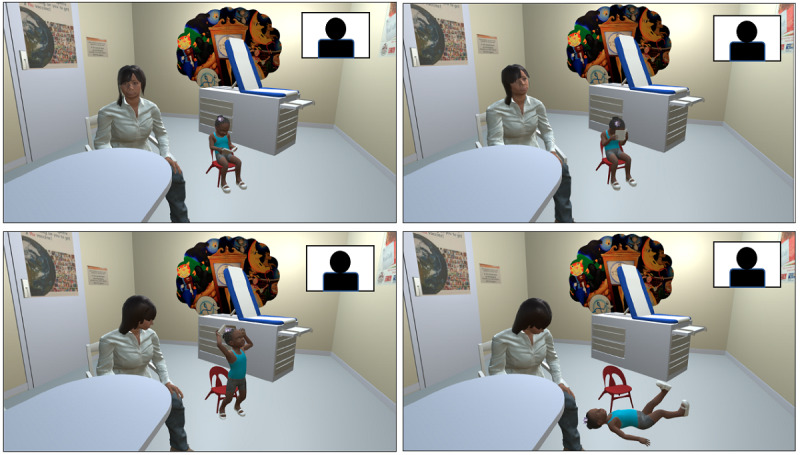
This mixed methods study included 14 postgraduate third-year pediatric residents who completed the behavioral health anticipatory guidance VR curriculum. Residents completed the MEC Spatial Presence Questionnaire to assess immersion in the virtual environment. Semistructured interviews were used to elucidate residents' perspectives on the curriculum's content and format. The interviews were analyzed using conventional content analysis.
Quantitatively, residents reported a high degree of immersion, spatial presence, and cognitive involvement. Most residents (11/14, 79%) agreed or strongly agreed that it seemed as though they took part in the action of the simulation. Qualitatively, two themes emerged from the data: (1) the curriculum expands behavioral health anticipatory guidance and motivational interviewing knowledge and skills and (2) VR technology is uniquely positioned to develop competence. These themes revealed that the curriculum expanded their current level of knowledge and skill, addressed training gaps, and was applicable to all residents. Additionally, residents experienced VR as immersive, feasible, realistic to the clinic setting, and a safe space to practice and learn new skills.
Pilot data indicates that VR may be an effective tool to teach pediatric residents behavioral health anticipatory guidance, meeting a current gap in medical education training. This VR curriculum is particularly relevant in the context of the COVID-19 pandemic given the increased behavioral health concerns of families.
行为健康障碍呈稳步上升趋势,且因新冠疫情而加剧。尽管通过早期实施循证家长管理策略可成功缓解行为健康障碍,但迄今为止,针对儿科住院医师的行为健康预期指导教育有限,新冠疫情的物理距离要求又使培训挑战更加复杂。虚拟现实(VR)模拟提供了一个机会,通过允许在遵守当前社交距离准则的同时对必要技能进行刻意练习,来培训住院医师掌握这一复杂能力。
本研究探讨了基于VR的行为健康预期指导课程对儿科住院医师的可用性。
这项混合方法研究纳入了14名完成行为健康预期指导VR课程的儿科三年级住院医师。住院医师完成了MEC空间临场感问卷,以评估在虚拟环境中的沉浸感。采用半结构化访谈来阐明住院医师对课程内容和形式的看法。使用常规内容分析法对访谈进行分析。
在定量方面,住院医师报告了高度的沉浸感、空间临场感和认知参与度。大多数住院医师(11/14,79%)同意或强烈同意他们似乎参与了模拟行动。在定性方面,数据中出现了两个主题:(1)该课程扩展了行为健康预期指导和动机性访谈的知识与技能;(2)VR技术在培养能力方面具有独特优势。这些主题表明,该课程扩展了他们当前的知识和技能水平,弥补了培训差距,并且适用于所有住院医师。此外,住院医师体验到VR具有沉浸感、可行性、与临床环境相符,并且是一个练习和学习新技能的安全空间。
试点数据表明,VR可能是教授儿科住院医师行为健康预期指导的有效工具,填补了医学教育培训的当前空白。鉴于家庭对行为健康的关注度增加,这一VR课程在新冠疫情背景下尤为相关。