Marine Ecology Department, Faculty of Biology and Chemistry, University of Bremen, 28359, Bremen, Germany.
Red Sea Research Center, King Abdullah University of Science and Technology (KAUST), Thuwal, 23995, Saudi Arabia.
Sci Rep. 2021 Jun 3;11(1):11820. doi: 10.1038/s41598-021-90204-8.
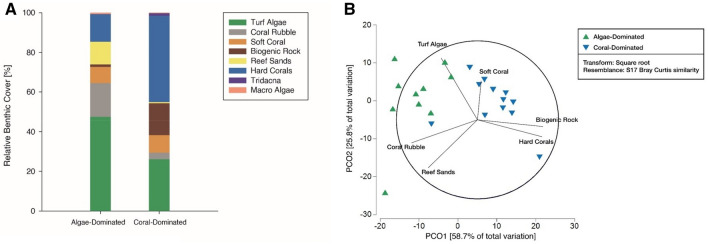
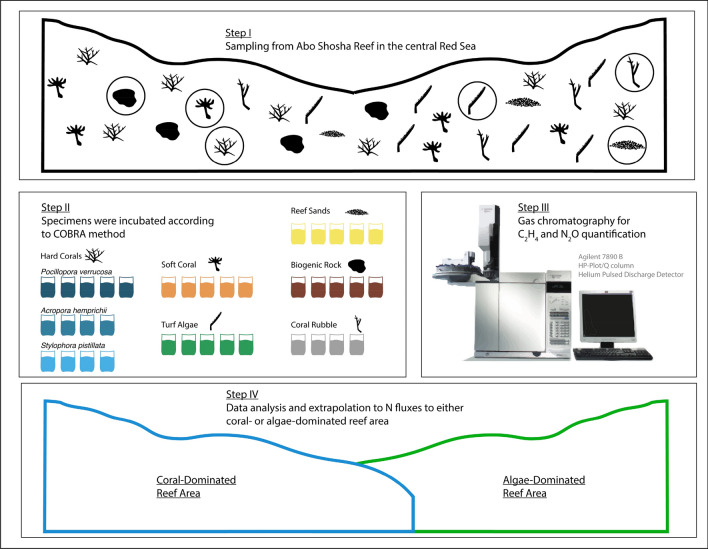
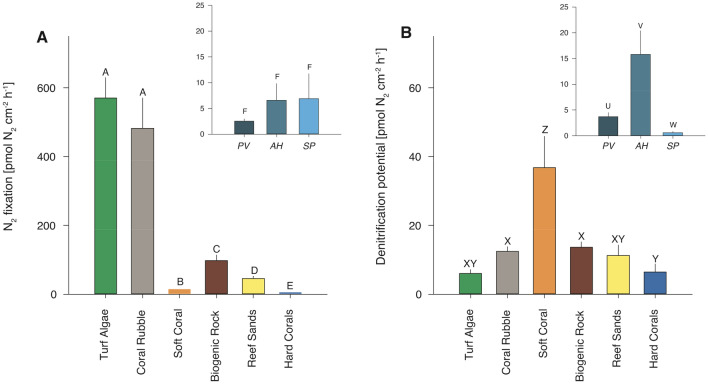
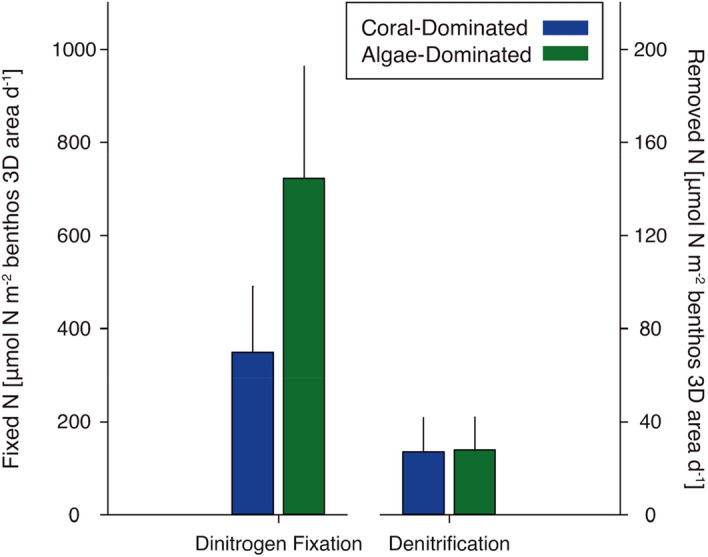
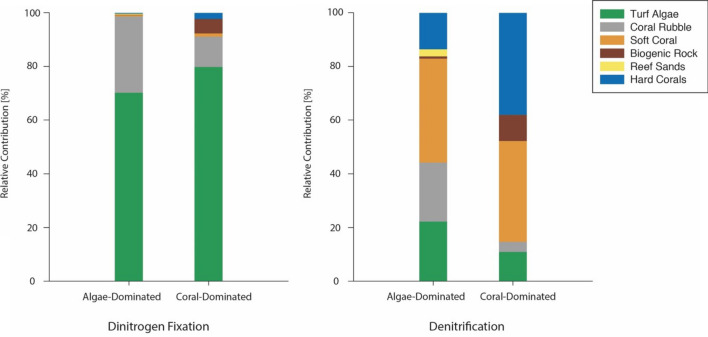
Coral reefs experience phase shifts from coral- to algae-dominated benthic communities, which could affect the interplay between processes introducing and removing bioavailable nitrogen. However, the magnitude of such processes, i.e., dinitrogen (N) fixation and denitrification levels, and their responses to phase shifts remain unknown in coral reefs. We assessed both processes for the dominant species of six benthic categories (hard corals, soft corals, turf algae, coral rubble, biogenic rock, and reef sands) accounting for > 98% of the benthic cover of a central Red Sea coral reef. Rates were extrapolated to the relative benthic cover of the studied organisms in co-occurring coral- and algae-dominated areas of the same reef. In general, benthic categories with high N fixation exhibited low denitrification activity. Extrapolated to the respective reef area, turf algae and coral rubble accounted for > 90% of overall N fixation, whereas corals contributed to more than half of reef denitrification. Total N fixation was twice as high in algae- compared to coral-dominated areas, whereas denitrification levels were similar. We conclude that algae-dominated reefs promote new nitrogen input through enhanced N fixation and comparatively low denitrification. The subsequent increased nitrogen availability could support net productivity, resulting in a positive feedback loop that increases the competitive advantage of algae over corals in reefs that experienced a phase shift.
珊瑚礁经历着从珊瑚主导到藻类主导的底栖生物群落的转变,这可能会影响引入和去除生物可利用氮的过程之间的相互作用。然而,这些过程的幅度,即固氮(N)和反硝化水平,以及它们对珊瑚礁相位转变的反应仍然未知。我们评估了主导的六个底栖生物类别的这两个过程(硬珊瑚、软珊瑚、藻坪、珊瑚碎块、生物源岩石和礁砂),它们占中央红海珊瑚礁底栖生物覆盖的>98%。这些速率被外推到同一珊瑚礁中珊瑚和藻类占主导地位的区域中研究生物的相对底栖生物覆盖。一般来说,具有高固氮率的底栖生物类具有低反硝化活性。外推到各自的珊瑚礁区域,藻坪和珊瑚碎块占总固氮的>90%,而珊瑚对珊瑚礁反硝化的贡献超过一半。与珊瑚礁占主导地位的区域相比,藻类礁的总固氮量高出两倍,而反硝化水平相似。我们的结论是,藻类礁通过增强的固氮作用和相对较低的反硝化作用促进新的氮输入。随后增加的氮供应可以支持净生产力,从而形成一个正反馈循环,增加了藻类在经历相位转变的珊瑚礁中的竞争优势。