Krefting Research Centre, Department of Internal Medicine and Clinical Nutrition, Institute of Medicine, Sahlgrenska Academy, University of Gothenburg, Gothenburg, Sweden.
Department of Biomedical Sciences, College of Veterinary Medicine, Long Island University, Brookville, NY, United States.
Front Immunol. 2021 May 18;12:677550. doi: 10.3389/fimmu.2021.677550. eCollection 2021.
Adiponectin is an important immunomodulatory mediator in inflammatory conditions. While we previously showed that adiponectin receptor 1 (AdipoR1) is expressed in murine regulatory T cells (Tregs), its expression in human Tregs remain unknown. Here, we examined the expression of AdipoR1 in human Tregs and whether its ligand, globular adiponectin (gAd) affects the Treg ability to secrete IL-10 and the role of Type 2 (T2) inflammation in such process.
Human Tregs from peripheral blood were analyzed by flow cytometry for AdipoR1, Helios and IL-10 expression. CD4 T cells enriched from peripheral blood mononuclear cells (PBMCs) were cultured in the presence or the absence of gAd or the chemical adiponectin receptor agonist, AdipoRon, or in a T2 cytokine milieu. Flow cytometry was then used to assess intracellular IL-10, IL-10 secreting cells, FOXP3 and Helios expression, and phosphorylated p38 MAP kinase (MAPK). IL-10 levels in CD4 T cell supernatants were quantified by ELISA.
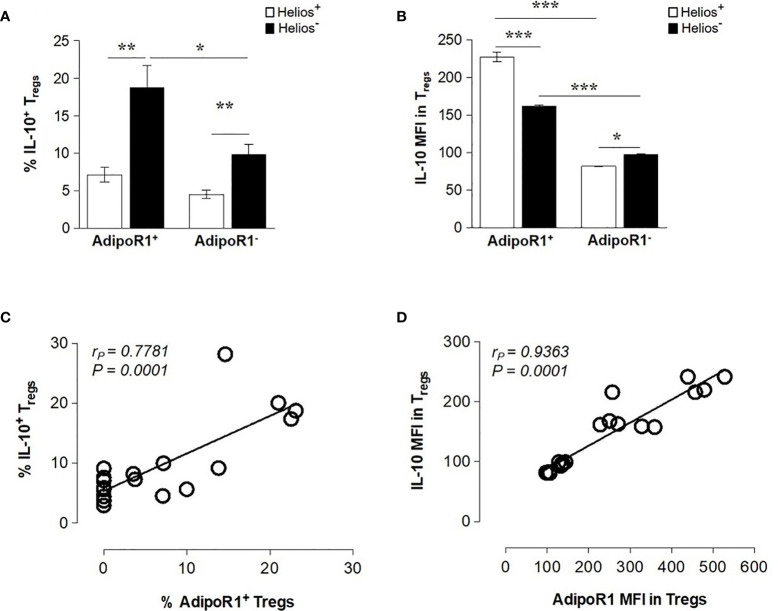
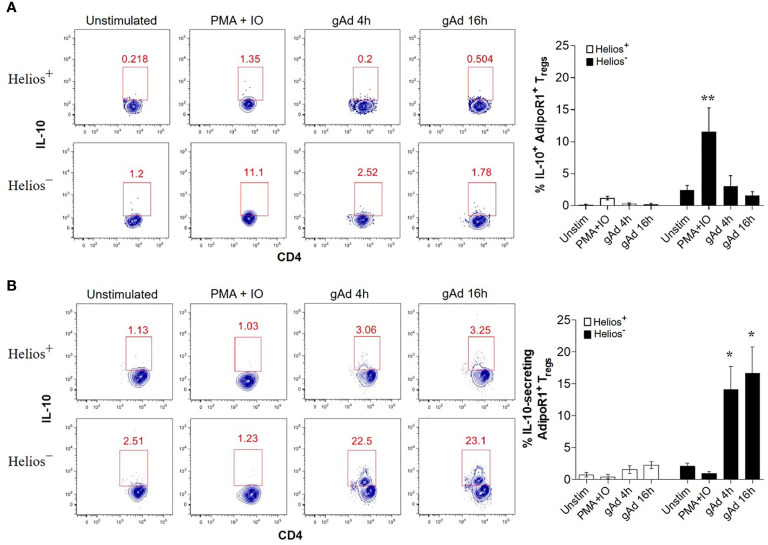
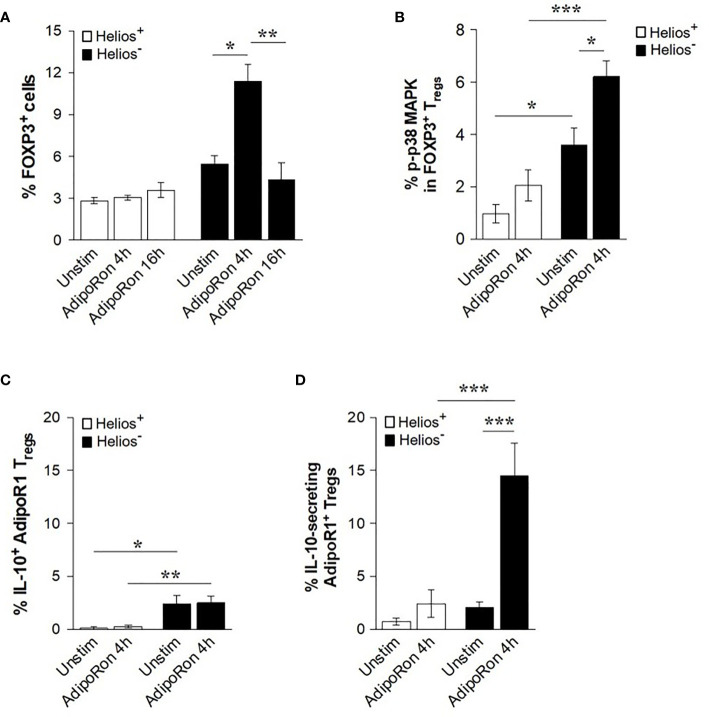
We found that a subset of human Tregs expressed AdipoR1. Importantly, more Helios cells expressed AdipoR1 than Helios cells. Likewise, there was a higher frequency of IL-10 cells within Helios AdipoR1 Tregs compared to Helios AdipoR1 Tregs. In contrast, the IL-10 mean fluorescence intensity (MFI) was higher in Helios AdipoR1 Tregs compared to HeliosAdipoR1 Tregs. When human CD4 T cells were treated with gAd or AdipoRon, a significant increase in IL-10 secretion, FOXP3 expression, and p38 MAPK phosphorylation was observed in Helios AdipoR1 Tregs. Interestingly, gAd under T2 cytokine milieu significantly increased the intracellular levels of IL-10, mainly in Helios AdipoR1 Tregs, and IL-10 levels in supernatants of CD4 T cells.
Collectively, our findings suggest that adiponectin/AdipoR1 axis promotes IL-10 release by Tregs, mainly in Helios Tregs, and the effect was amplified by T2 inflammation in Helios Tregs.
脂联素是炎症条件下重要的免疫调节介质。虽然我们之前已经表明,脂联素受体 1(AdipoR1)在鼠调节性 T 细胞(Tregs)中表达,但在人类 Tregs 中的表达仍不清楚。在这里,我们检查了 AdipoR1 在人类 Tregs 中的表达,以及其配体,球形脂联素(gAd)是否影响 Treg 分泌 IL-10 的能力,以及 2 型(T2)炎症在这一过程中的作用。
通过流式细胞术分析人外周血 Tregs 中的 AdipoR1、Helios 和 IL-10 表达。从外周血单核细胞(PBMCs)中富集的 CD4 T 细胞在存在或不存在 gAd 或化学脂联素受体激动剂 AdipoRon 的情况下,或在 T2 细胞因子环境中培养。然后使用流式细胞术评估细胞内 IL-10、分泌 IL-10 的细胞、FOXP3 和 Helios 表达以及磷酸化 p38 MAP 激酶(MAPK)。通过 ELISA 定量 CD4 T 细胞上清液中的 IL-10 水平。
我们发现人类 Tregs 中的一个亚群表达 AdipoR1。重要的是,Helios 细胞表达 AdipoR1 的比例高于 Helios 细胞。同样,Helios AdipoR1 Tregs 中 IL-10 细胞的频率也高于 Helios AdipoR1 Tregs。相比之下,Helios AdipoR1 Tregs 中的 IL-10 平均荧光强度(MFI)高于 Helios AdipoR1 Tregs。当用 gAd 或 AdipoRon 处理人 CD4 T 细胞时,在 Helios AdipoR1 Tregs 中观察到 IL-10 分泌、FOXP3 表达和 p38 MAPK 磷酸化显著增加。有趣的是,在 T2 细胞因子环境下,gAd 显著增加了 CD4 T 细胞中 Helios AdipoR1 Tregs 细胞内的 IL-10 水平,以及上清液中的 IL-10 水平。
总之,我们的研究结果表明,脂联素/AdipoR1 轴通过 Tregs 促进 IL-10 的释放,主要是在 Helios Tregs 中,并且在 Helios Tregs 中,2 型炎症增强了这种作用。