Department of Biological Science, The University of Tulsa, Tulsa, Oklahoma, United States of America.
Chiricahua Desert Museum, Rodeo, New Mexico, United States of America.
PLoS One. 2021 Jun 4;16(6):e0252049. doi: 10.1371/journal.pone.0252049. eCollection 2021.
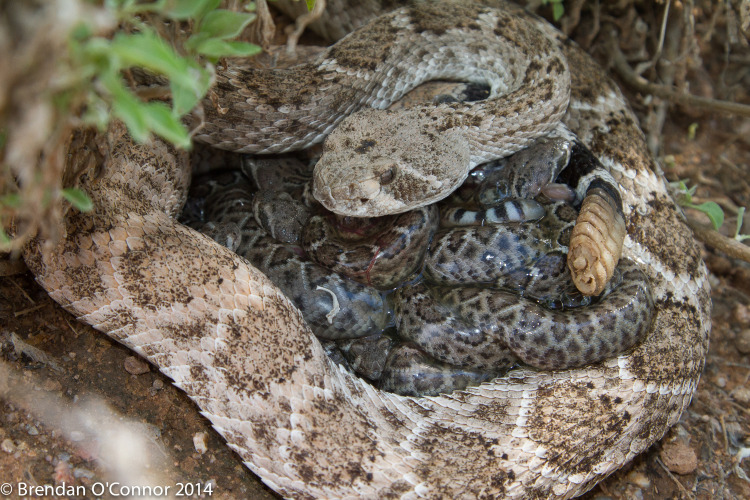
Females of many vertebrate species have the capacity to store sperm within their reproductive tracts for prolonged periods of time. Termed long-term sperm storage, this phenomenon has many important physiological, ecological, and evolutionary implications, particularly to the study of mating systems, including male reproductive success and post-copulatory sexual selection. Reptiles appear particularly predisposed to long-term sperm storage, with records in most major lineages, with a strong emphasis on turtles and squamates (lizards, snakes, but not the amphisbaenians). Because facultative parthenogenesis is a competing hypothesis to explain the production of offspring after prolonged separation from males, the identification of paternal alleles through genetic analysis is essential. However, few studies in snakes have undertaken this. Here, we report on a wild-collected female Western Diamond-backed Rattlesnake, Crotalus atrox, maintained in isolation from the time of capture in September 1999, that produced two healthy litters approximately one and six years post capture. Genetic analysis of the 2005 litter, identified paternal contribution in all offspring, thus rejecting facultative parthenogenesis. We conclude that the duration of long-term sperm storage was approximately 6 years (71 months), making this the longest period over which a female vertebrate has been shown to store sperm that resulted in the production of healthy offspring.
许多脊椎动物物种的雌性具有在生殖道内长期储存精子的能力。这种现象被称为长期精子储存,它具有许多重要的生理、生态和进化意义,特别是对交配系统的研究,包括雄性生殖成功和交配后的性选择。爬行动物似乎特别容易发生长期精子储存,在大多数主要谱系中都有记录,其中以龟鳖类和蜥蜴类(蜥蜴、蛇类,但不包括蚓螈类)为重点。由于孤雌生殖是一种解释与雄性长时间分离后产生后代的竞争假说,因此通过遗传分析来确定父本等位基因是至关重要的。然而,蛇类中很少有研究进行这项工作。在这里,我们报告了一个野生采集的西部菱斑响尾蛇(Crotalus atrox)雌性个体,从 1999 年 9 月被捕时起就被隔离饲养,大约在被捕后一年和六年分别产下了两窝健康的幼崽。对 2005 年产下的幼崽的遗传分析,确定了所有后代的父本贡献,从而排除了孤雌生殖的可能性。我们得出结论,长期精子储存的持续时间约为 6 年(71 个月),这是雌性脊椎动物储存精子并产生健康后代的最长时间。