Department of Food and Nutrition, Inha University, Incheon, Republic of Korea.
Department of Home Economics Education, Korea National University of Education, Cheongju, Republic of Korea.
PLoS One. 2021 Jun 4;16(6):e0252442. doi: 10.1371/journal.pone.0252442. eCollection 2021.
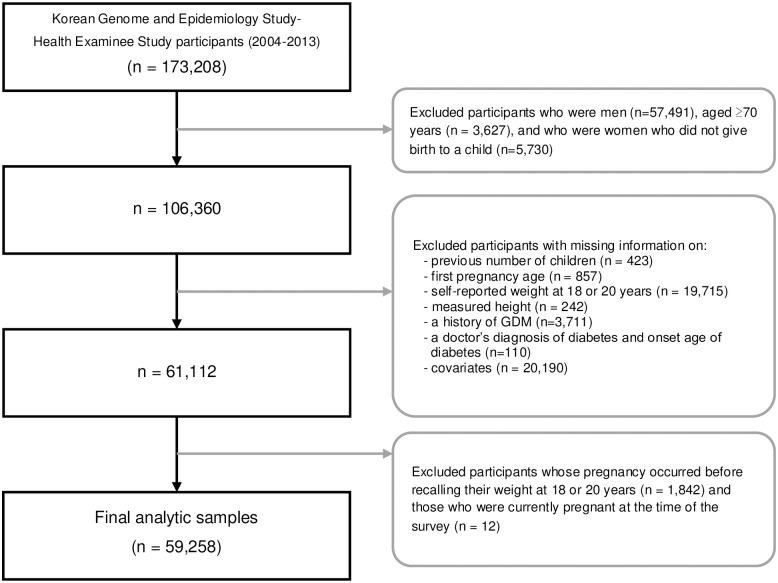
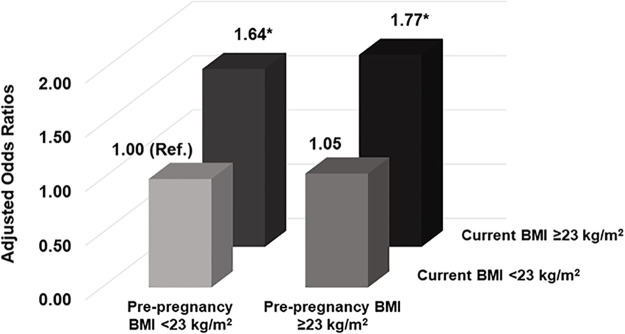
Despite the importance of pre-pregnancy body mass index (BMI) and a history of gestational diabetes mellitus (GDM) in the progression of GDM to type 2 diabetes, few studies have evaluated the combined effect of high pre-pregnancy BMI and GDM status on the future development of type 2 diabetes in Korean women. This study aimed to examine the relationship of pre-pregnancy BMI and GDM history with the risk of type 2 diabetes among Korean women. In addition, the effects of pre-pregnancy BMI and current BMI on the risk of type 2 diabetes were evaluated. Women who gave birth in the Health Examinees Study of the Korean Genome and Epidemiology Study from 2004 to 2013 (n = 59,258) were included in this study. Multivariable logistic regression was used to examine the association of pre-pregnancy BMI categories (underweight: <18.5 kg/m2; normal: 18.5-22.9 kg/m2; overweight: 23.0-24.9 kg/m2; obese: ≥25.0 kg/m2) and GDM history with the risk of type 2 diabetes after controlling for the following covariates: age, education, income, smoking status before the first pregnancy, alcohol consumption, regular exercise, menarche age, first pregnancy age, and first pregnancy outcome. Compared to women with normal pre-pregnancy BMIs, women with overweight and obese pre-pregnancy BMIs had higher odds of developing type 2 diabetes (adjusted odds ratio [AOR]: 1.13, 95% confidence interval [CI]: 1.02-1.25 and AOR: 1.29, 95% CI: 1.10-1.50, respectively) after controlling for covariates. Women with pre-pregnancy BMIs <23 kg/m2 and current BMIs ≥23 kg/m2 had increased odds of developing type 2 diabetes (AOR: 1.64, 95% CI: 1.51-1.78) compared to those with pre-pregnancy BMIs <23 kg/m2 and current BMIs <23 kg/m2. Among women without a history of GDM, those with overweight and obese pre-pregnancy BMIs had increased odds of developing type 2 diabetes compared to those with normal pre-pregnancy BMIs (AOR: 1.12, 95% CI: 1.01-1.24 and AOR: 1.23, 95% CI: 1.05-1.44, respectively). Among women with GDM, those with obese pre-pregnancy BMIs had increased odds of developing type 2 diabetes (AOR: 3.84, 95% CI: 1.52-9.87). This study showed that there was a higher likelihood of developing type 2 diabetes in women who were overweight or obese before pregnancy with a history of GDM compared to their counterparts without a history of GDM. Furthermore, high pre-pregnancy BMI or high current BMI increased the risk of type 2 diabetes in Korean women, regardless of GDM history. This emphasizes the importance of maintaining a healthy weight status before and after pregnancy to prevent the future risk of type 2 diabetes.
尽管孕前体重指数(BMI)和妊娠期糖尿病(GDM)病史对 GDM 向 2 型糖尿病的进展很重要,但很少有研究评估高孕前 BMI 和 GDM 状况对韩国女性未来 2 型糖尿病发病风险的综合影响。本研究旨在探讨韩国女性孕前 BMI 和 GDM 病史与 2 型糖尿病发病风险的关系。此外,还评估了孕前 BMI 和当前 BMI 对 2 型糖尿病发病风险的影响。本研究纳入了 2004 年至 2013 年参加韩国基因与流行病学研究健康检查的女性(n=59258)。多变量逻辑回归用于检验孕前 BMI 类别(消瘦:<18.5kg/m2;正常:18.5-22.9kg/m2;超重:23.0-24.9kg/m2;肥胖:≥25.0kg/m2)和 GDM 病史与 2 型糖尿病发病风险之间的关系,同时控制了以下协变量:年龄、教育程度、收入、第一次怀孕前的吸烟状况、饮酒情况、定期运动、初潮年龄、第一次怀孕年龄和第一次怀孕结局。与孕前 BMI 正常的女性相比,孕前 BMI 超重和肥胖的女性在控制了协变量后,发生 2 型糖尿病的风险更高(校正优势比[OR]:1.13,95%置信区间[CI]:1.02-1.25和 OR:1.29,95% CI:1.10-1.50)。与孕前 BMI<23kg/m2 和当前 BMI≥23kg/m2 的女性相比,孕前 BMI<23kg/m2 和当前 BMI<23kg/m2 的女性发生 2 型糖尿病的风险更高(OR:1.64,95% CI:1.51-1.78)。在没有 GDM 病史的女性中,与孕前 BMI 正常的女性相比,孕前 BMI 超重和肥胖的女性发生 2 型糖尿病的风险更高(OR:1.12,95% CI:1.01-1.24 和 OR:1.23,95% CI:1.05-1.44)。在患有 GDM 的女性中,与孕前 BMI 正常的女性相比,孕前 BMI 肥胖的女性发生 2 型糖尿病的风险更高(OR:3.84,95% CI:1.52-9.87)。本研究表明,与没有 GDM 病史的女性相比,有 GDM 病史且孕前超重或肥胖的女性发生 2 型糖尿病的可能性更高。此外,高孕前 BMI 或高当前 BMI 增加了韩国女性发生 2 型糖尿病的风险,无论是否有 GDM 病史。这强调了在怀孕前后保持健康体重状态的重要性,以预防未来发生 2 型糖尿病的风险。