Department of Gastrointestinal Oncology, National Cancer Center Hospital East, Kashiwa, Japan.
Department of Clinical Oncology, Aichi Cancer Center Hospital, Nagoya, Japan.
BMC Cancer. 2021 Jun 7;21(1):674. doi: 10.1186/s12885-021-08395-2.
Previous clinical trials have demonstrated the potential efficacy of rechallenge with anti- epidermal growth factor receptor (EGFR) monoclonal antibodies (mAbs) for patients with RAS/BRAF V600E wild-type metastatic colorectal cancer (mCRC). Moreover, post hoc biomarker analyses of clinical trials has suggested that RAS status in circulating tumor DNA (ctDNA) has a high probability to select patients who could benefit from anti-EGFR mAb rechallenge.
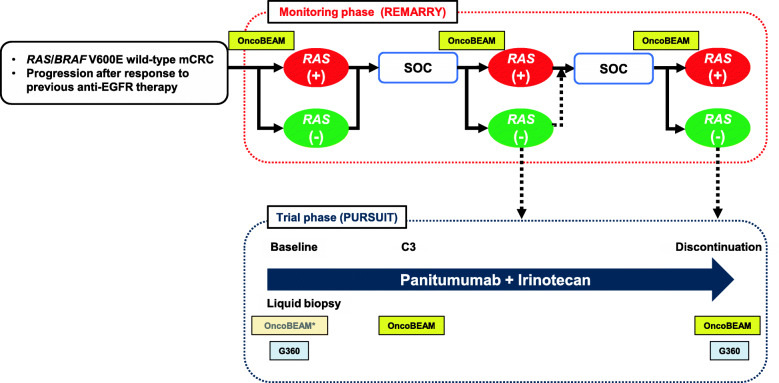
This trial is composed of 2 phases: a monitoring phase (REMARRY) and a trial phase (PURSUIT). A monitoring phase, the REMARRY study, aims to evaluate the dynamics of plasma RAS status during the subsequent treatments after refractory to anti-EGFR therapy in patients with mCRC with RAS/BRAF V600E wild-type tumors who have progressed after a response to previous anti-EGFR therapy, using a highly sensitive digital polymerase chain reaction OncoBEAM RAS CRC kit in a central laboratory (Sysmex, Japan). A trial phase, the PURSUIT trial, is a multicenter, single-arm phase II trial to assess the efficacy and safety of rechallenge therapy with panitumumab plus irinotecan in patients without RAS mutations in ctDNA (plasma RAS negative) in the REMARRY study. Key eligibility criteria of the PURSUIT trial include RAS/BRAF V600E wild-type mCRC in tumor tissue refractory or intolerant to fluoropyrimidine, oxaliplatin, and irinotecan; progression after complete or partial response to previous anti-EGFR therapy; plasma RAS negative (defined as plasma mutant allele frequencies [MAF] of all RAS ≤ 0.1%) within 28 days prior to enrollment; 4 months or more between the last administration of previous anti-EGFR mAb and the start of protocol treatment; and Eastern Cooperative Oncology Group (ECOG) Performance Status (PS) ≤ 1. The primary endpoint is the confirmed objective response rate (ORR). The target sample size of the PURSUIT trial is 50 patients. Biomarker analyses will be performed in parallel using the OncoBEAM RAS CRC kit and a next-generation sequencing-based ctDNA analysis (Guardant360).
Our trial aims to confirm the clinical benefit of anti-EGFR mAb rechallenge therapy in patients with plasma RAS negative. Moreover, through biomarker analyses, our trial will shed light on which patients would benefit from rechallenge in addition to being plasma RAS negative.
The REMARRY study: UMIN, UMIN000036424 . Registered date: April 5, 2019. The PURSUIT trial: jRCT, jRCTs031190096 . Registered date: October 1, 2019.
先前的临床试验已经证明了对于 RAS/BRAF V600E 野生型转移性结直肠癌(mCRC)患者,使用抗表皮生长因子受体(EGFR)单克隆抗体(mAb)再次挑战治疗具有潜在疗效。此外,临床试验的事后生物标志物分析表明,循环肿瘤 DNA(ctDNA)中的 RAS 状态很有可能选择出可以从抗 EGFR mAb 再次挑战治疗中获益的患者。
本试验由两个阶段组成:监测阶段(REMARRY)和试验阶段(PURSUIT)。在监测阶段(REMARRY 研究)中,使用中央实验室的高度敏感数字聚合酶链反应 OncoBEAM RAS CRC 试剂盒(Sysmex,日本),评估在先前抗 EGFR 治疗后出现耐药或不耐受的 RAS/BRAF V600E 野生型肿瘤 mCRC 患者在对先前的抗 EGFR 治疗有反应后后续治疗期间血浆 RAS 状态的动态。在 REMARRY 研究中,对先前抗 EGFR 治疗有反应后进展的、ctDNA 中无 RAS 突变(血浆 RAS 阴性)的患者,进行 panitumumab 联合伊立替康再次挑战治疗的疗效和安全性评估。PURSUIT 试验是一项多中心、单臂 II 期试验,关键纳入标准包括肿瘤组织中 RAS/BRAF V600E 野生型 mCRC,对氟嘧啶、奥沙利铂和伊立替康耐药或不耐受;先前抗 EGFR 治疗完全或部分缓解后进展;在入组前 28 天内血浆 RAS 阴性(定义为所有 RAS 的血浆突变等位基因频率[MAF]≤0.1%);在前一次抗 EGFR mAb 治疗结束后 4 个月或以上开始方案治疗;东部肿瘤协作组(ECOG)体能状态(PS)≤1。主要终点是确认的客观缓解率(ORR)。PURSUIT 试验的目标样本量为 50 例患者。将使用 OncoBEAM RAS CRC 试剂盒和基于下一代测序的 ctDNA 分析(Guardant360)并行进行生物标志物分析。
我们的试验旨在确认血浆 RAS 阴性患者抗 EGFR mAb 再次挑战治疗的临床获益。此外,通过生物标志物分析,我们的试验将阐明除了血浆 RAS 阴性外,哪些患者将从再次挑战中获益。
REMARRY 研究:UMIN,UMIN000036424。注册日期:2019 年 4 月 5 日。PURSUIT 试验:jRCT,jRCTs031190096。注册日期:2019 年 10 月 1 日。