Center for Clinical Management Research, VA Ann Arbor Healthcare System, 2215 Fuller Rd, Ann Arbor, MI, 48105, USA.
Department of Internal Medicine, University of Michigan, Ann Arbor, USA.
BMC Health Serv Res. 2021 Jun 7;21(1):561. doi: 10.1186/s12913-021-06540-y.
Although risk prediction has become an integral part of clinical practice guidelines for cardiovascular disease (CVD) prevention, multiple studies have shown that patients' risk still plays almost no role in clinical decision-making. Because little is known about why this is so, we sought to understand providers' views on the opportunities, barriers, and facilitators of incorporating risk prediction to guide their use of cardiovascular preventive medicines.
We conducted semi-structured interviews with primary care providers (n = 33) at VA facilities in the Midwest. Facilities were chosen using a maximum variation approach according to their geography, size, proportion of MD to non-MD providers, and percentage of full-time providers. Providers included MD/DO physicians, physician assistants, nurse practitioners, and clinical pharmacists. Providers were asked about their reaction to a hypothetical situation in which the VA would introduce a risk prediction-based approach to CVD treatment. We conducted matrix and content analysis to identify providers' reactions to risk prediction, reasons for their reaction, and exemplar quotes.
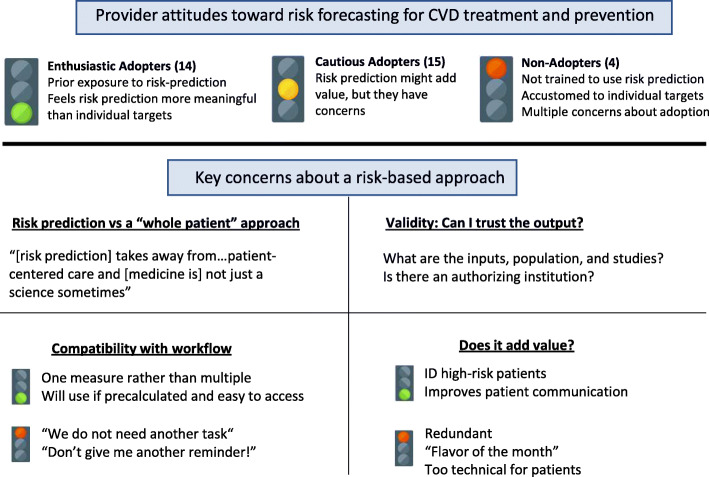
Most providers were classified as Enthusiastic (n = 14) or Cautious Adopters (n = 15), with only a few Non-Adopters (n = 4). Providers described four key concerns toward adopting risk prediction. Their primary concern was that risk prediction is not always compatible with a "whole patient" approach to patient care. Other concerns included questions about the validity of the proposed risk prediction model, potential workflow burdens, and whether risk prediction adds value to existing clinical practice. Enthusiastic, Cautious, and Non-Adopters all expressed both doubts about and support for risk prediction categorizable in the above four key areas of concern.
Providers were generally supportive of adopting risk prediction into CVD prevention, but many had misgivings, which included concerns about impact on workflow, validity of predictive models, the value of making this change, and possible negative effects on providers' ability to address the whole patient. These concerns have likely contributed to the slow introduction of risk prediction into clinical practice. These concerns will need to be addressed for risk prediction, and other approaches relying on "big data" including machine learning and artificial intelligence, to have a meaningful role in clinical practice.
尽管风险预测已成为心血管疾病(CVD)预防临床实践指南不可或缺的一部分,但多项研究表明,患者的风险在临床决策中几乎没有发挥作用。由于人们对其原因知之甚少,我们试图了解提供者对纳入风险预测以指导其使用心血管预防药物的机会、障碍和促进因素的看法。
我们对中西部退伍军人事务部(VA)设施的初级保健提供者(n=33)进行了半结构化访谈。根据地理位置、规模、MD 与非 MD 提供者的比例以及全职提供者的百分比,采用最大变化方法选择设施。提供者包括 MD/DO 医生、医师助理、执业护士和临床药师。要求提供者对 VA 采用基于风险预测的 CVD 治疗方法的假设情况做出反应。我们进行了矩阵和内容分析,以确定提供者对风险预测的反应、他们反应的原因以及示例引述。
大多数提供者被归类为热情(n=14)或谨慎采用者(n=15),只有少数非采用者(n=4)。提供者描述了采用风险预测的四个关键关注点。他们的主要关注点是,风险预测并不总是与患者护理的“整体患者”方法兼容。其他关注点包括对拟议风险预测模型有效性的质疑、潜在的工作流程负担以及风险预测是否为现有临床实践增加价值。热情、谨慎和非采用者都对上述四个关注领域的风险预测表示怀疑和支持。
提供者普遍支持将风险预测应用于 CVD 预防,但许多人持怀疑态度,包括对工作流程影响、预测模型有效性、进行这种改变的价值以及对提供者解决整体患者能力的潜在负面影响的担忧。这些担忧可能导致风险预测缓慢引入临床实践。对于风险预测以及其他依赖“大数据”的方法,包括机器学习和人工智能,为临床实践提供有意义的作用,这些担忧都需要得到解决。