Drs. Vande Voort, Shekunov, Romanowicz, Leibman, Frye, Croarkin, and Mss. Geske and Ward are with Mayo Clinic, Rochester, Minnesota; Dr. Orth is with Olmsted Medical Center, Rochester, Minnesota.
Drs. Vande Voort, Shekunov, Romanowicz, Leibman, Frye, Croarkin, and Mss. Geske and Ward are with Mayo Clinic, Rochester, Minnesota; Dr. Orth is with Olmsted Medical Center, Rochester, Minnesota.
J Am Acad Child Adolesc Psychiatry. 2022 Jan;61(1):46-55. doi: 10.1016/j.jaac.2021.03.011. Epub 2021 Jun 5.
Numerous commercial pharmacogenetics panels are now widely available for clinical use in psychiatric practice. However, there is a paucity of literature evaluating the use of combinatorial pharmacogenetics panels to enhance outcomes in the treatment of adolescents with depression. This study sought to prospectively evaluate the clinical impact of combinatorial pharmacogenetics testing in a double-blind, randomized, controlled effectiveness study for the pharmacologic treatment of adolescents with depression.
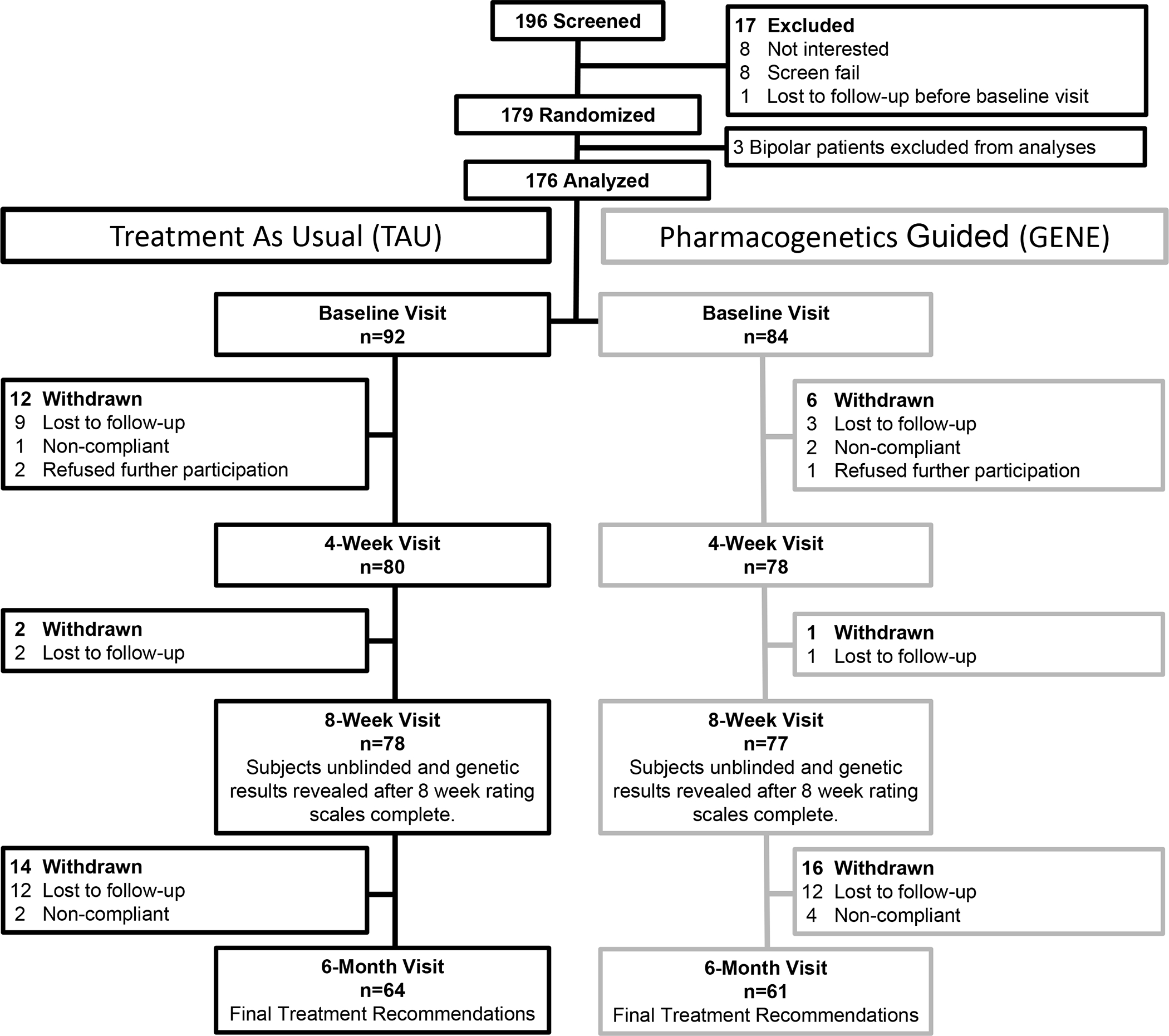
Adolescents aged 13 to 18 years (N = 176) with moderate to severe major depressive disorder (MDD) were randomized to treatment arm guided by testing in which pharmacogenetic testing results were available at the baseline visit (GENE arm, n = 84) or a treatment-as-usual arm (TAU arm, n = 92) in which testing results were not available until an 8-week visit. Raters, participants, and families were blinded to group allocation. Symptom improvement, side effects, and satisfaction were assessed throughout the study at 4 weeks, 8 weeks, and 6 months.
There were no differences between the GENE and TAU arms at 8 weeks or 6 months for symptom improvement, side effect burden, or satisfaction. Selective serotonin reuptake inhibitors were prescribed at higher rates in the TAU arm compared to the GENE arm (p = .024).
Combinatorial pharmacogenetics-guided treatment did not demonstrate improved outcomes compared to TAU in adolescents with MDD. Future research should examine how specific medication-gene pairs may affect clinical outcomes in the treatment of adolescents with depression and how best to integrate pharmacogenetics into clinical practice.
A PK/PD Genetic Variation Treatment Algorithm Versus Treatment As Usual for Adolescent Management Of Depression; https://www.clinicaltrials.gov; NCT02286440.
目前有许多商业药物遗传学检测面板广泛应用于精神科临床实践。然而,评估组合药物遗传学检测面板在治疗青少年抑郁症中的应用以改善治疗效果的文献却很少。本研究旨在前瞻性评估组合药物遗传学检测在一项双盲、随机、对照有效性研究中的临床效果,该研究旨在评估药物治疗青少年抑郁症的效果。
13 至 18 岁患有中重度重性抑郁障碍(MDD)的青少年(N=176)被随机分为两组:一组在基线检查时进行药物遗传学检测(GENE 组,n=84),另一组在 8 周检查时进行药物遗传学检测(TAU 组,n=92)。检测结果在研究过程中对评估者、参与者和家属保密。在第 4 周、第 8 周和第 6 个月评估症状改善、副作用和满意度。
在第 8 周和第 6 个月时,GENE 组和 TAU 组在症状改善、副作用负担或满意度方面均无差异。与 GENE 组相比,TAU 组更倾向于开选择性 5-羟色胺再摄取抑制剂(SSRIs)(p=0.024)。
与 TAU 相比,组合药物遗传学指导治疗并未改善 MDD 青少年的治疗效果。未来的研究应研究特定药物-基因对在治疗青少年抑郁症中的临床疗效的影响,以及如何将药物遗传学最佳地整合到临床实践中。
PK/PD 遗传变异治疗算法与青少年抑郁症治疗的常规治疗;https://www.clinicaltrials.gov;NCT02286440。