Ainsworth Matthew, Sallet Jérôme, Joly Olivier, Kyriazis Diana, Kriegeskorte Nikolaus, Duncan John, Schüffelgen Urs, Rushworth Matthew F S, Bell Andrew H
MRC Cognition and Brain Sciences Unit, University of Cambridge, Cambridge, United Kingdom, CB2 7EF
Department of Experimental Psychology, University of Oxford, Oxford, United Kingdom, OX2 6GG.
J Neurosci. 2021 Jul 14;41(28):6070-6086. doi: 10.1523/JNEUROSCI.0870-20.2021.
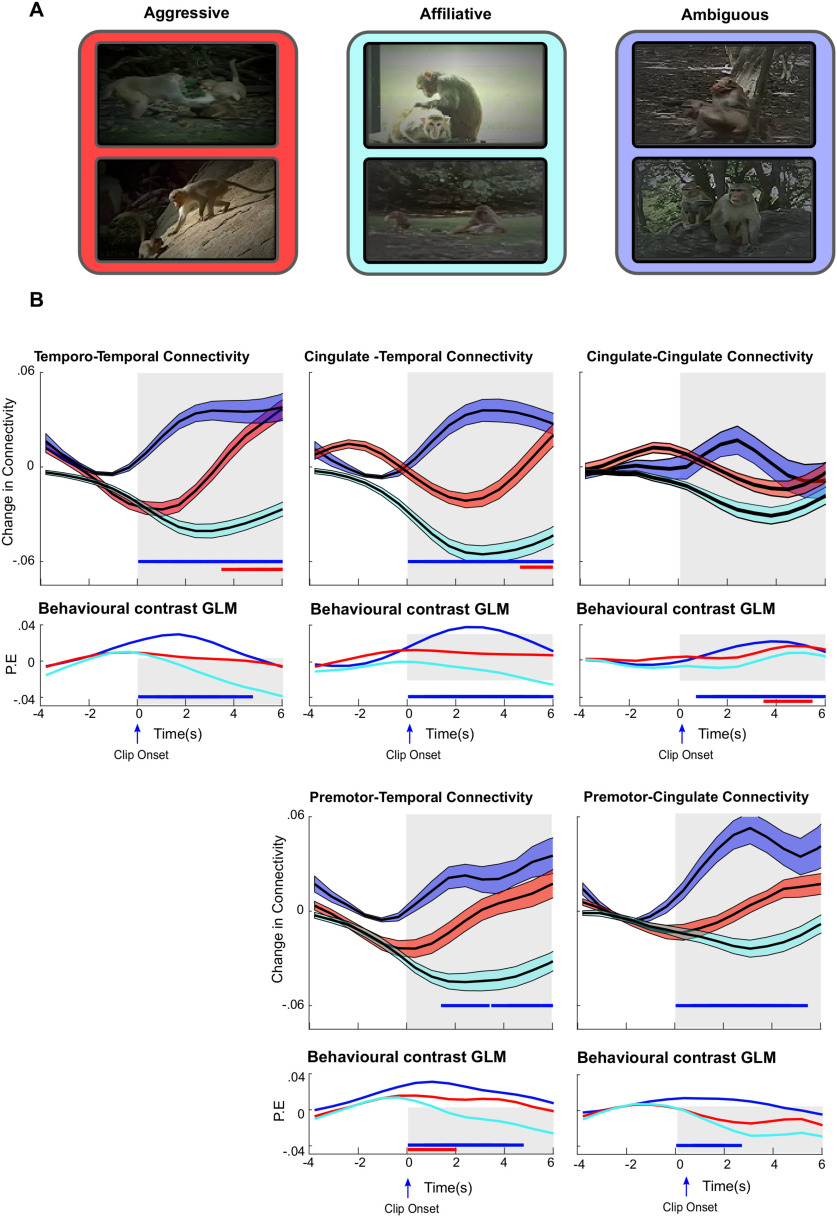
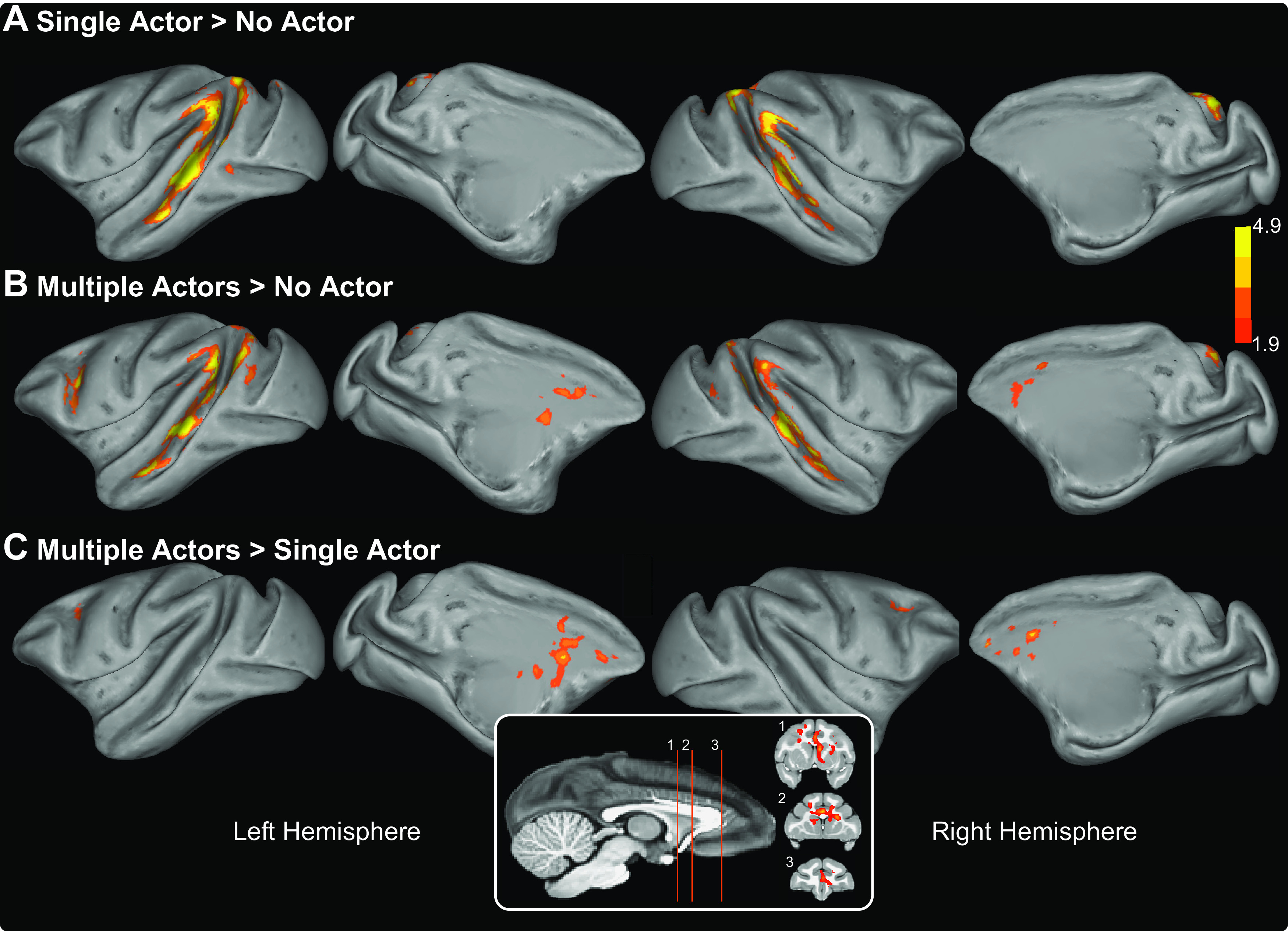
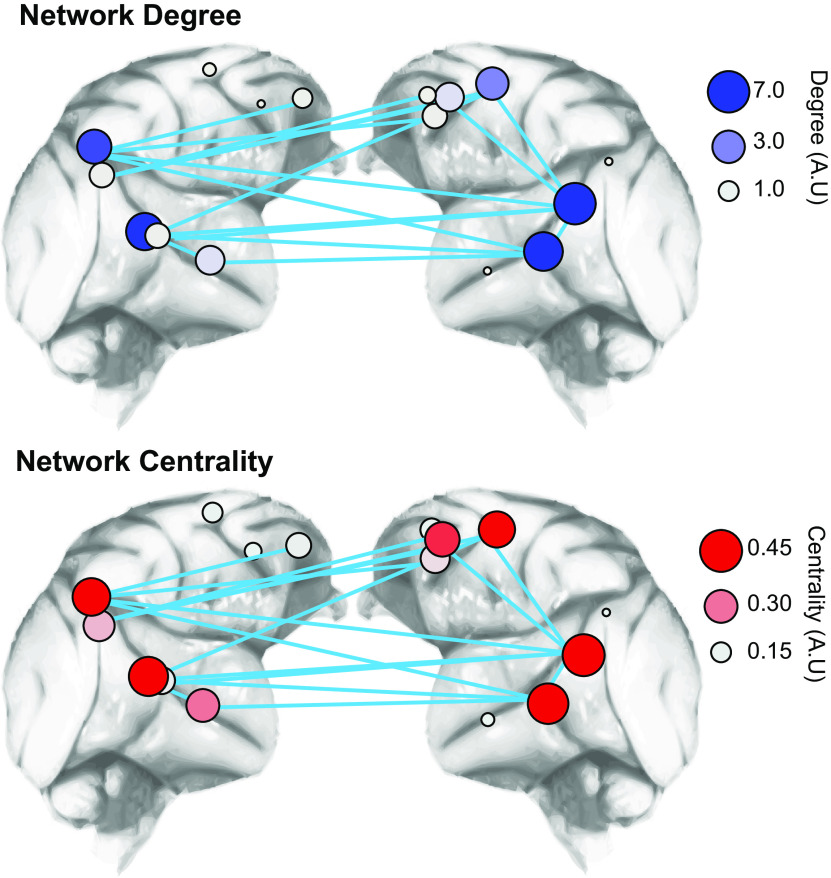
Social behavior is coordinated by a network of brain regions, including those involved in the perception of social stimuli and those involved in complex functions, such as inferring perceptual and mental states and controlling social interactions. The properties and function of many of these regions in isolation are relatively well understood, but less is known about how these regions interact while processing dynamic social interactions. To investigate whether the functional connectivity between brain regions is modulated by social context, we collected fMRI data from male monkeys () viewing videos of social interactions labeled as "affiliative," "aggressive," or "ambiguous." We show activation related to the perception of social interactions along both banks of the superior temporal sulcus, parietal cortex, medial and lateral frontal cortex, and the caudate nucleus. Within this network, we show that fronto-temporal functional connectivity is significantly modulated by social context. Crucially, we link the observation of specific behaviors to changes in functional connectivity within our network. Viewing aggressive behavior was associated with a limited increase in temporo-temporal and a weak increase in cingulate-temporal connectivity. By contrast, viewing interactions where the outcome was uncertain was associated with a pronounced increase in temporo-temporal, and cingulate-temporal functional connectivity. We hypothesize that this widespread network synchronization occurs when cingulate and temporal areas coordinate their activity when more difficult social inferences are being made. Processing social information from our environment requires the activation of several brain regions, which are concentrated within the frontal and temporal lobes. However, little is known about how these areas interact to facilitate the processing of different social interactions. Here we show that functional connectivity within and between the frontal and temporal lobes is modulated by social context. Specifically, we demonstrate that viewing social interactions where the outcome was unclear is associated with increased synchrony within and between the cingulate cortex and temporal cortices. These findings suggest that the coordination between the cingulate and temporal cortices is enhanced when more difficult social inferences are being made.
社会行为由一个脑区网络协调,这些脑区包括参与社会刺激感知的脑区以及参与复杂功能的脑区,如推断感知和心理状态以及控制社会互动。许多这些孤立脑区的特性和功能相对已得到较好理解,但对于这些脑区在处理动态社会互动时如何相互作用却知之甚少。为了研究脑区之间的功能连接是否受社会背景调节,我们收集了雄性猴子观看标记为“亲和性”“攻击性”或“模糊性”的社会互动视频时的功能磁共振成像(fMRI)数据。我们显示,沿着颞上沟两岸、顶叶皮质、内侧和外侧额叶皮质以及尾状核,均有与社会互动感知相关的激活。在这个网络中,我们表明额颞功能连接受社会背景显著调节。至关重要的是,我们将特定行为的观察结果与我们网络内功能连接的变化联系起来。观看攻击性行为与颞颞连接的有限增加以及扣带颞连接的微弱增加有关。相比之下,观看结果不确定的互动与颞颞以及扣带颞功能连接的显著增加有关。我们推测,当扣带和颞叶区域在进行更困难的社会推断时协调它们的活动时,就会出现这种广泛的网络同步。处理来自我们环境的社会信息需要激活几个脑区,这些脑区集中在额叶和颞叶内。然而,对于这些区域如何相互作用以促进不同社会互动的处理却知之甚少。在这里,我们表明额叶和颞叶内以及它们之间的功能连接受社会背景调节。具体而言,我们证明观看结果不明确的社会互动与扣带皮质和颞叶皮质内以及它们之间同步性的增加有关。这些发现表明,当进行更困难的社会推断时,扣带和颞叶皮质之间的协调会增强。