Velmovitsky Pedro Elkind, Bublitz Frederico Moreira, Fadrique Laura Xavier, Morita Plinio Pelegrini
School of Public Health and Health Systems, University of Waterloo, Waterloo, ON, Canada.
Center for Strategic Technologies in Health (NUTES), State University of Paraiba (UEPB), Campina Grande, Brazil.
JMIR Med Inform. 2021 Jun 8;9(6):e20713. doi: 10.2196/20713.
Although big data and smart technologies allow for the development of precision medicine and predictive models in health care, there are still several challenges that need to be addressed before the full potential of these data can be realized (eg, data sharing and interoperability issues, lack of massive genomic data sets, data ownership, and security and privacy of health data). Health companies are exploring the use of blockchain, a tamperproof and distributed digital ledger, to address some of these challenges.
In this viewpoint, we aim to obtain an overview of blockchain solutions that aim to solve challenges in health care from an industry perspective, focusing on solutions developed by health and technology companies.
We conducted a literature review following the protocol defined by Levac et al to analyze the findings in a systematic manner. In addition to traditional databases such as IEEE and PubMed, we included search and news outlets such as CoinDesk, CoinTelegraph, and Medium.
Health care companies are using blockchain to improve challenges in five key areas. For electronic health records, blockchain can help to mitigate interoperability and data sharing in the industry by creating an overarching mechanism to link disparate personal records and can stimulate data sharing by connecting owners and buyers directly. For the drug (and food) supply chain, blockchain can provide an auditable log of a product's provenance and transportation (including information on the conditions in which the product was transported), increasing transparency and eliminating counterfeit products in the supply chain. For health insurance, blockchain can facilitate the claims management process and help users to calculate medical and pharmaceutical benefits. For genomics, by connecting data buyers and owners directly, blockchain can offer a secure and auditable way of sharing genomic data, increasing their availability. For consent management, as all participants in a blockchain network view an immutable version of the truth, blockchain can provide an immutable and timestamped log of consent, increasing transparency in the consent management process.
Blockchain technology can improve several challenges faced by the health care industry. However, companies must evaluate how the features of blockchain can affect their systems (eg, the append-only nature of blockchain limits the deletion of data stored in the network, and distributed systems, although more secure, are less efficient). Although these trade-offs need to be considered when viewing blockchain solutions, the technology has the potential to optimize processes, minimize inefficiencies, and increase trust in all contexts covered in this viewpoint.
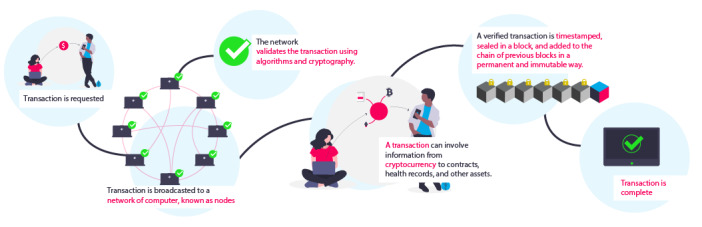
尽管大数据和智能技术有助于推动医疗保健领域的精准医学和预测模型发展,但在充分发挥这些数据的潜力之前,仍有几个挑战需要解决(例如,数据共享和互操作性问题、缺乏大规模基因组数据集、数据所有权以及健康数据的安全性和隐私性)。健康科技公司正在探索使用区块链(一种防篡改的分布式数字账本)来应对其中一些挑战。
在本观点文章中,我们旨在从行业角度概述旨在解决医疗保健领域挑战的区块链解决方案,重点关注健康和科技公司开发的解决方案。
我们按照Levac等人定义的方案进行文献综述,以系统地分析研究结果。除了IEEE和PubMed等传统数据库外,我们还纳入了CoinDesk、CoinTelegraph和Medium等搜索和新闻媒体。
医疗保健公司正在利用区块链改善五个关键领域的挑战。对于电子健康记录,区块链可以通过创建一个总体机制来链接不同的个人记录,帮助缓解行业内的互操作性和数据共享问题,并通过直接连接所有者和买家来促进数据共享。对于药品(和食品)供应链,区块链可以提供产品来源和运输的可审计记录(包括产品运输条件的信息),提高透明度并消除供应链中的假冒产品。对于健康保险,区块链可以促进理赔管理流程,并帮助用户计算医疗和药品福利。对于基因组学,通过直接连接数据买家和所有者,区块链可以提供一种安全且可审计的基因组数据共享方式,提高其可用性。对于同意管理,由于区块链网络中的所有参与者都能看到一个不可变的真相版本,区块链可以提供一个不可变且带有时间戳的同意记录,提高同意管理过程的透明度。
区块链技术可以改善医疗保健行业面临的几个挑战。然而,公司必须评估区块链的特性如何影响其系统(例如,区块链的只追加性质限制了对存储在网络中的数据的删除,并且分布式系统虽然更安全,但效率较低)。尽管在考虑区块链解决方案时需要权衡这些因素,但该技术有潜力优化流程、减少低效率并增强本观点所涵盖的所有领域的信任。
