Çağlayan Benan, Karataş Ferhan, İliaz Sinem, Uzel Işıl, Öztürk Ayşe Bilge, Demir Tuane
Department of Chest Diseases, Koç University, School of Medicine, Istanbul, Turkey.
Turk Gogus Kalp Damar Cerrahisi Derg. 2021 Apr 26;29(2):183-190. doi: 10.5606/tgkdc.dergisi.2021.20351. eCollection 2021 Apr.
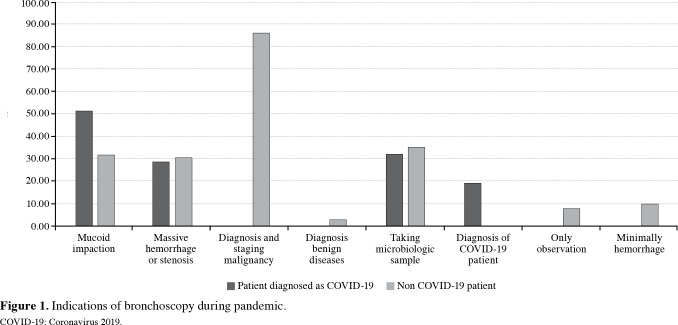
In this study, we aimed to evaluate the attitudes and behaviors of physicians performing bronchoscopy during the COVID-19 outbreak.
Between March 2020 and May 2020, a total of 153 physicians were included in the study. An invitation letter for the participation in the study with a structured questionnaire of 18 questions were sent to the mail groups twice with five-day intervals. Participation in the study was allowed, until the third day after the second mail was sent.
All participants completed the questionnaire. According to the results, 33% of the physicians did not perform bronchoscopy and the majority of the physicians performed very few procedures during the outbreak, although the participants mostly worked at the tertiary hospitals (mean: 7.2±9.3). A total of 20% of the physicians performed bronchoscopy in potential or proven COVID-19 patients. Almost all of the physicians who participated in the survey reported the use of personal protective equipment such as masks and goggles during the procedure. During the pandemic, 9.7% of the physicians who performed bronchoscopy to potential or proven COVID-19 patients and 4.1% of the participants who did not perform bronchoscopy to any potential or proven COVID-19 patients were found to be infected with the virus (p>0.05).
Physicians who perform bronchoscopy during pandemic act in accordance with the recommendations of guidelines. Although there was no statistically significant difference between the SARS-CoV-2 transmission rates of the teams who performed and did not perform bronchoscopy in potential or proven COVID-19 patients in our study, the high rate of personal protective equipment utilization might have played a role in this result.
在本研究中,我们旨在评估在新冠疫情期间进行支气管镜检查的医生的态度和行为。
2020年3月至2020年5月,共有153名医生纳入本研究。一份包含18个问题的结构化问卷的研究邀请函分两次发送至邮件群组,间隔为五天。在第二次邮件发送后的第三天之前允许参与研究。
所有参与者均完成了问卷。根据结果,33%的医生未进行支气管镜检查,尽管大多数参与者在三级医院工作(平均:7.2±9.3),但大多数医生在疫情期间进行的操作很少。共有20%的医生对疑似或确诊的新冠患者进行了支气管镜检查。几乎所有参与调查的医生都报告在操作过程中使用了口罩和护目镜等个人防护设备。在疫情期间,对疑似或确诊的新冠患者进行支气管镜检查的医生中有9.7%以及未对任何疑似或确诊的新冠患者进行支气管镜检查的参与者中有4.1%被发现感染了病毒(p>0.05)。
在疫情期间进行支气管镜检查的医生按照指南建议行事。尽管在我们的研究中,对疑似或确诊的新冠患者进行支气管镜检查和未进行支气管镜检查的团队的新冠病毒传播率之间没有统计学上的显著差异,但个人防护设备的高使用率可能在这一结果中起到了作用。