Babiker Ahmed, Ingersoll Jessica M, Adelman Max W, Webster Andrew S, Broder Kari J, Stittleburg Victoria, Waggoner Jesse J, Kraft Colleen S, Woodworth Michael H
Division of Infectious Diseases, Emory University School of Medicine, Atlanta, Georgia, USA.
Department of Pathology and Laboratory Medicine, Emory University School of Medicine, Atlanta, Georgia, USA.
Clin Transl Gastroenterol. 2021 Jun 9;12(6):e00363. doi: 10.14309/ctg.0000000000000363.
Mounting evidence demonstrates potential for fecal-oral transmission of severe acute respiratory syndrome coronavirus 2 (SARS-CoV-2). The US Food and Drug Administration now requires SARS-CoV-2 testing of potential feces donors before the use of stool manufactured for fecal microbiota transplantation. We sought to develop and validate a high-sensitivity SARS-CoV-2 reverse transcriptase polymerase chain reaction (RT-PCR) procedure for testing stool specimens.
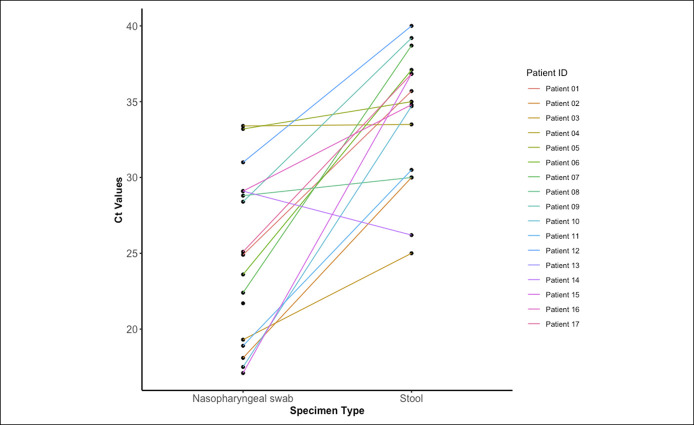
A modified extraction method was used with an RT-PCR assay adapted from the Centers for Disease Control and Prevention PCR protocol for respiratory specimens. Contrived specimens were created using pre-COVID-19 banked stool specimens and spiking in known concentrations of SARS-CoV-2-specific nucleic acid. The highest transcript concentration at which 2/2 or 1/2 SARS-CoV-2 targets were detected in 9/10 replicates was defined as the dual-target limit and single-target limit of detection, respectively. The clinical performance of the assay was evaluated with stool samples collected from 17 nasopharyngeal swab RT-PCR-positive patients and 14 nasopharyngeal RT-PCR-negative patients.
The dual-target and single-target limit of detection were 56 copies/μL and 3 copies/μL, respectively. SARS-CoV-2 was detected at concentrations as low as 0.6 copies/μL. Clinical stool samples from known COVID-19-positive patients demonstrated the detection of SARS-CoV-2 in stool up to 29 days from symptom onset with a high agreement with nasopharyngeal swab tests (kappa statistic of 0.95, P value < 0.001).
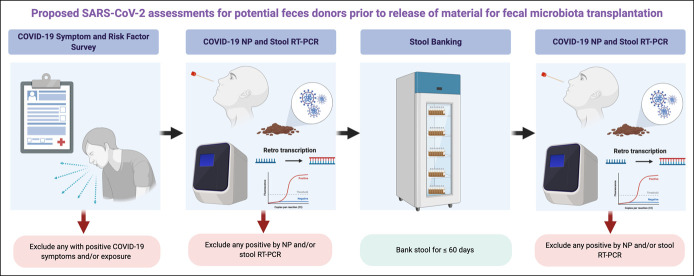
The described RT-PCR test is a sensitive and flexible approach for the detection of SARS-CoV-2 in stool specimens. We propose an integrated screening approach that incorporates this stool test to support continuation of fecal microbiota transplantation programs.
越来越多的证据表明严重急性呼吸综合征冠状病毒2(SARS-CoV-2)存在粪口传播的可能性。美国食品药品监督管理局现在要求在使用用于粪便微生物群移植的粪便制品之前,对潜在的粪便捐赠者进行SARS-CoV-2检测。我们试图开发并验证一种用于检测粪便标本的高灵敏度SARS-CoV-2逆转录聚合酶链反应(RT-PCR)方法。
采用改良的提取方法,并使用一种根据美国疾病控制与预防中心呼吸道标本PCR方案改编的RT-PCR检测法。使用COVID-19疫情前储存的粪便标本并加入已知浓度的SARS-CoV-2特异性核酸来制备人工标本。在9/10次重复检测中检测到2/2或1/2个SARS-CoV-2靶点的最高转录本浓度分别定义为双靶点检测限和单靶点检测限。用从17例鼻咽拭子RT-PCR阳性患者和14例鼻咽RT-PCR阴性患者采集的粪便样本评估该检测法的临床性能。
双靶点检测限和单靶点检测限分别为56拷贝/μL和3拷贝/μL。在低至0.6拷贝/μL的浓度下检测到了SARS-CoV-2。已知COVID-19阳性患者的临床粪便样本显示,在症状出现后长达29天的粪便中检测到了SARS-CoV-2,与鼻咽拭子检测结果高度一致(kappa统计量为0.95,P值<0.001)。
所描述的RT-PCR检测法是一种检测粪便标本中SARS-CoV-2的灵敏且灵活的方法。我们提出一种综合筛查方法,该方法纳入这种粪便检测以支持粪便微生物群移植项目的继续开展。