Chantkran Wittawat, Hsieh Ya-Ching, Zheleva Daniella, Frame Sheelagh, Wheadon Helen, Copland Mhairi
Paul O'Gorman Leukaemia Research Centre, Institute of Cancer Sciences, College of Medical, Veterinary and Life Sciences, University of Glasgow, Glasgow, UK.
Department of Pathology, Phramongkutklao College of Medicine, Bangkok, Thailand.
Cell Death Discov. 2021 Jun 10;7(1):137. doi: 10.1038/s41420-021-00496-y.
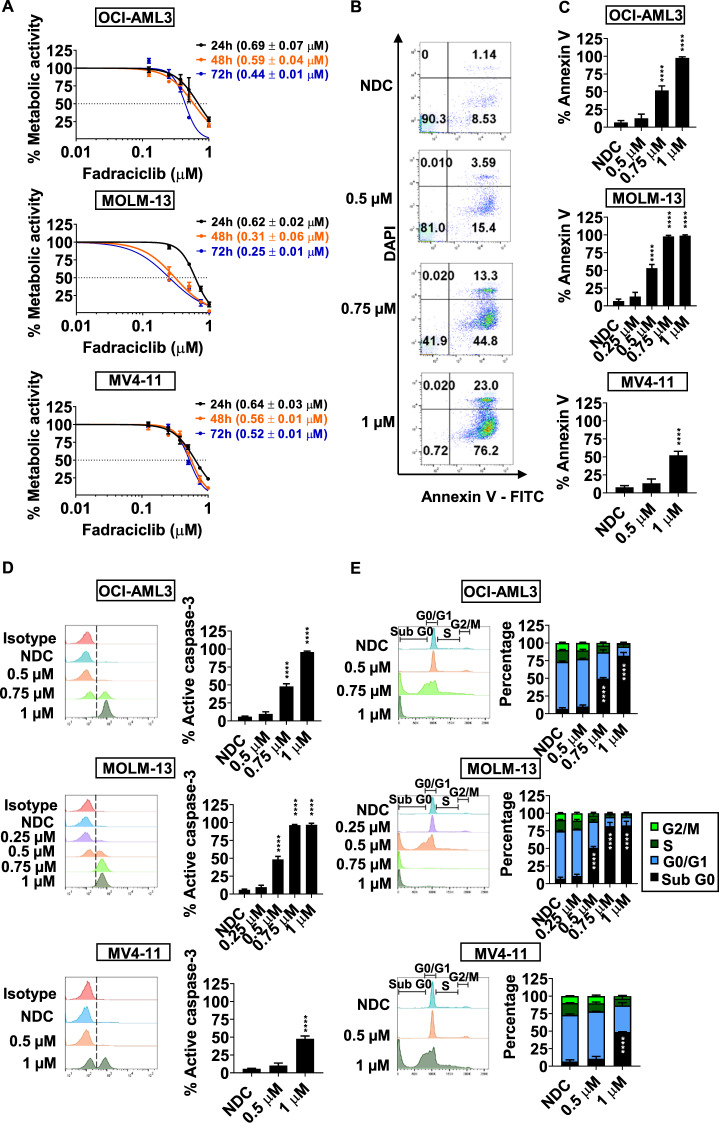
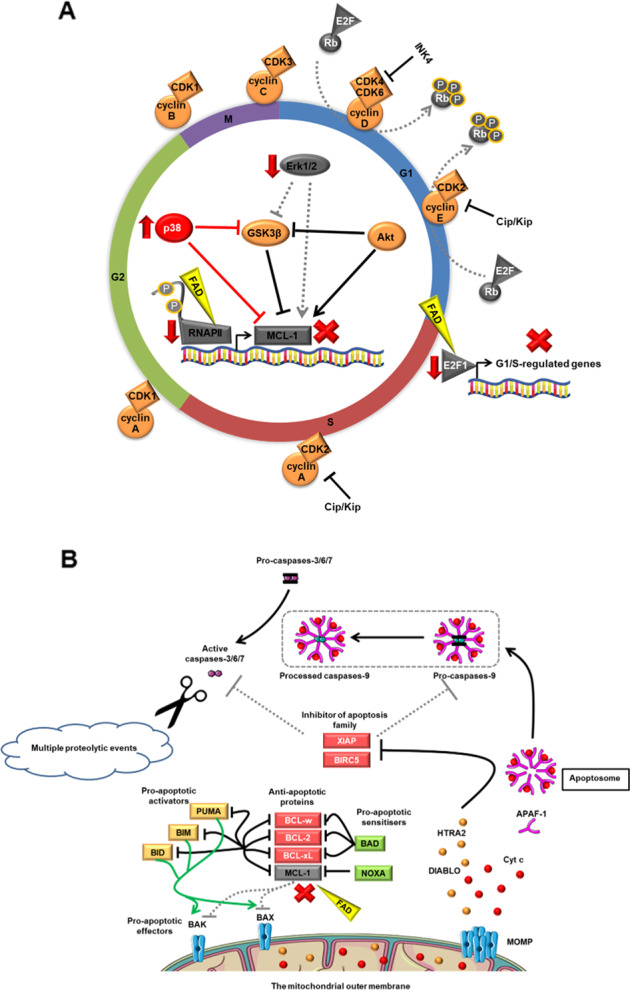
Over the last 50 years, there has been a steady improvement in the treatment outcome of acute myeloid leukemia (AML). However, median survival in the elderly is still poor due to intolerance to intensive chemotherapy and higher numbers of patients with adverse cytogenetics. Fadraciclib (CYC065), a novel cyclin-dependent kinase (CDK) 2/9 inhibitor, has preclinical efficacy in AML. In AML cell lines, myeloid cell leukemia 1 (MCL-1) was downregulated following treatment with fadraciclib, resulting in a rapid induction of apoptosis. In addition, RNA polymerase II (RNAPII)-driven transcription was suppressed, rendering a global gene suppression. Rapid induction of apoptosis was observed in primary AML cells after treatment with fadraciclib for 6-8 h. Twenty-four hours continuous treatment further increased efficacy of fadraciclib. Although preliminary results showed that AML cell lines harboring KMT2A rearrangement (KMT2A-r) are more sensitive to fadraciclib, we found that the drug can induce apoptosis and decrease MCL-1 expression in primary AML cells, regardless of KMT2A status. Importantly, the diversity of genetic mutations observed in primary AML patient samples was associated with variable response to fadraciclib, confirming the need for patient stratification to enable a more effective and personalized treatment approach. Synergistic activity was demonstrated when fadraciclib was combined with the BCL-2 inhibitor venetoclax, or the conventional chemotherapy agents, cytarabine, or azacitidine, with the combination of fadraciclib and azacitidine having the most favorable therapeutic window. In summary, these results highlight the potential of fadraciclib as a novel therapeutic approach for AML.
在过去的50年里,急性髓系白血病(AML)的治疗效果一直在稳步改善。然而,由于对强化化疗不耐受以及具有不良细胞遗传学特征的患者数量较多,老年患者的中位生存期仍然较差。法德雷西利布(CYC065)是一种新型细胞周期蛋白依赖性激酶(CDK)2/9抑制剂,在AML中具有临床前疗效。在AML细胞系中,用 法德雷西利布处理后,髓系细胞白血病1(MCL-1)表达下调,导致迅速诱导凋亡。此外,RNA聚合酶II(RNAPII)驱动的转录受到抑制,导致整体基因抑制。用 法德雷西利布处理6 - 8小时后,在原发性AML细胞中观察到迅速诱导凋亡。24小时持续治疗进一步提高了 法德雷西利布的疗效。虽然初步结果表明,携带KMT2A重排(KMT2A-r)的AML细胞系对 法德雷西利布更敏感,但我们发现该药物可诱导原发性AML细胞凋亡并降低MCL-1表达,无论KMT2A状态如何。重要的是,在原发性AML患者样本中观察到的基因突变多样性与对 法德雷西利布的可变反应相关,这证实了需要进行患者分层以实现更有效和个性化的治疗方法。当 法德雷西利布与BCL-2抑制剂维奈克拉或传统化疗药物阿糖胞苷或阿扎胞苷联合使用时,显示出协同活性,其中 法德雷西利布与阿扎胞苷联合使用具有最有利的治疗窗口。总之,这些结果突出了 法德雷西利布作为AML新型治疗方法的潜力。