Trinh Dung V, Nguyen Mai T T, Dang Hue T M, Dang Dung T, Le Hang T T, Le Huynh T N, Tran Hoang V, Huynh Chinh D
School of Chemical Engineering, Hanoi University of Science and Technology, 1st Dai Co Viet Road, Hanoi, Vietnam.
Faculty of Chemistry, VNUHCM-University of Science, 227 Nguyen Van Cu Street, Ho Chi Minh City, Vietnam.
Sci Rep. 2021 Jun 10;11(1):12280. doi: 10.1038/s41598-021-91881-1.
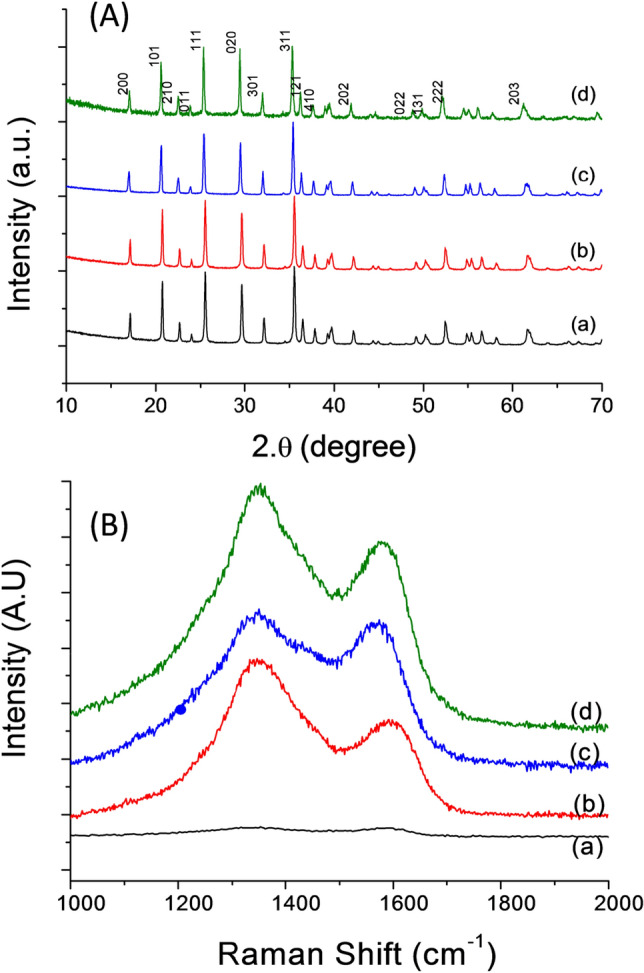
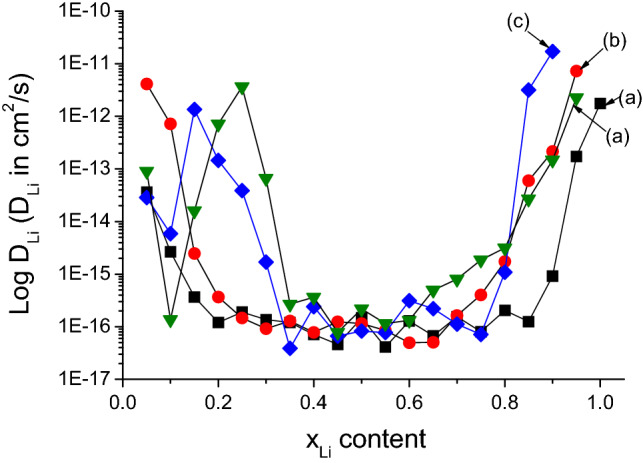
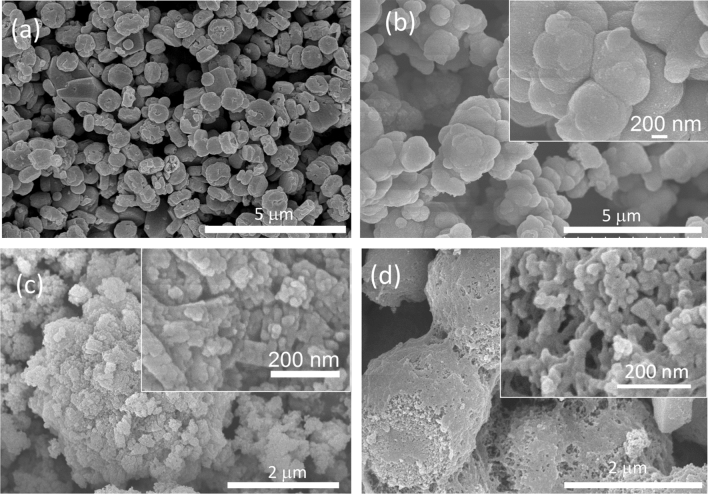
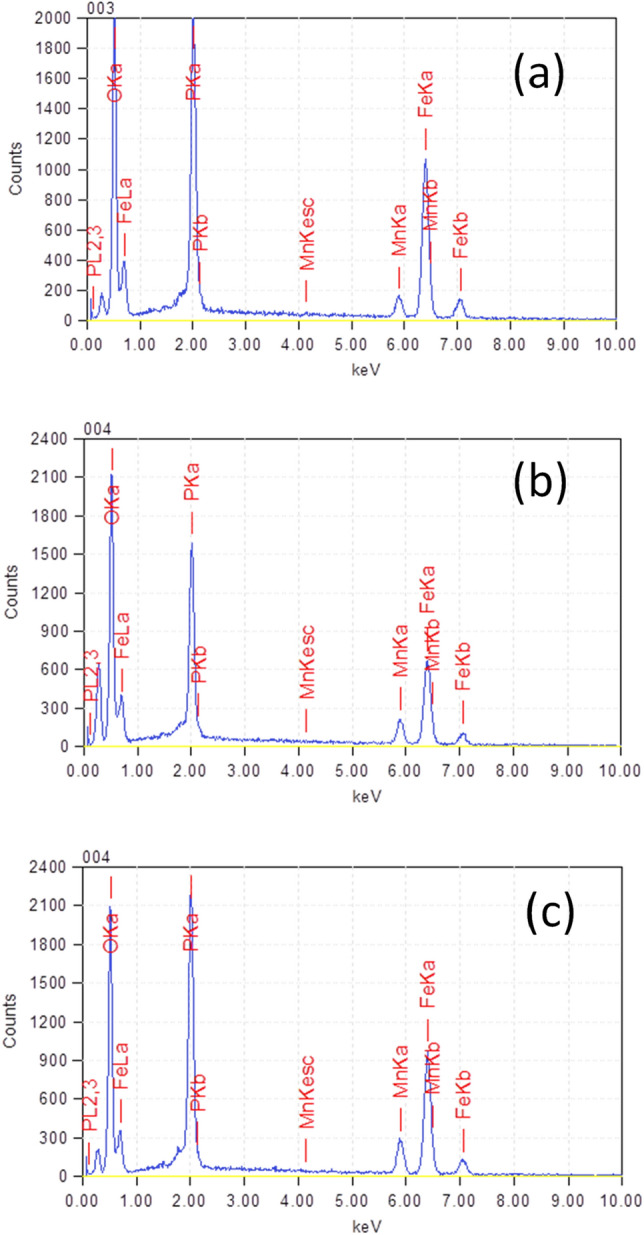
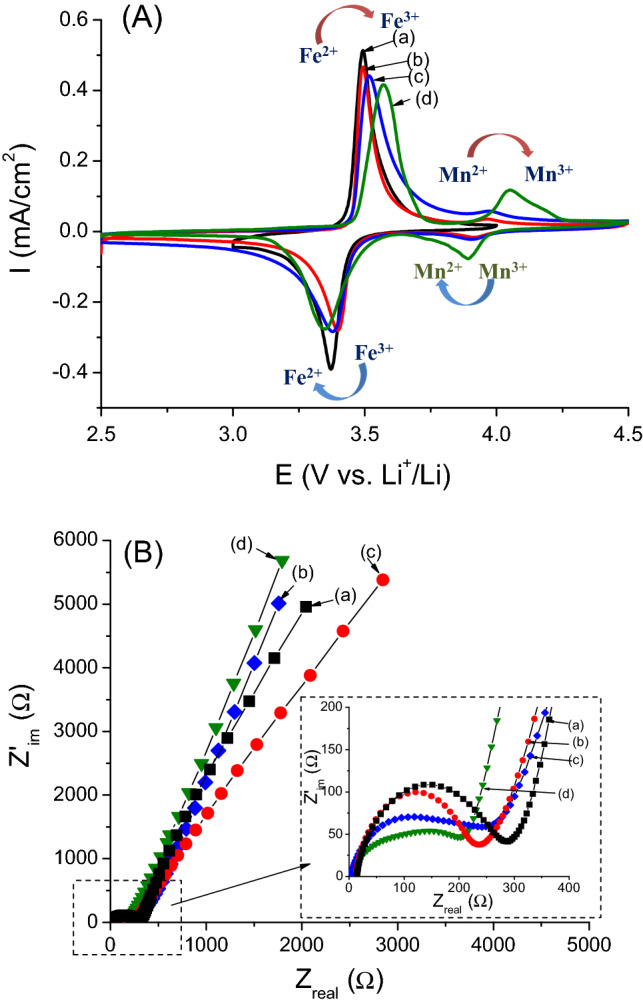
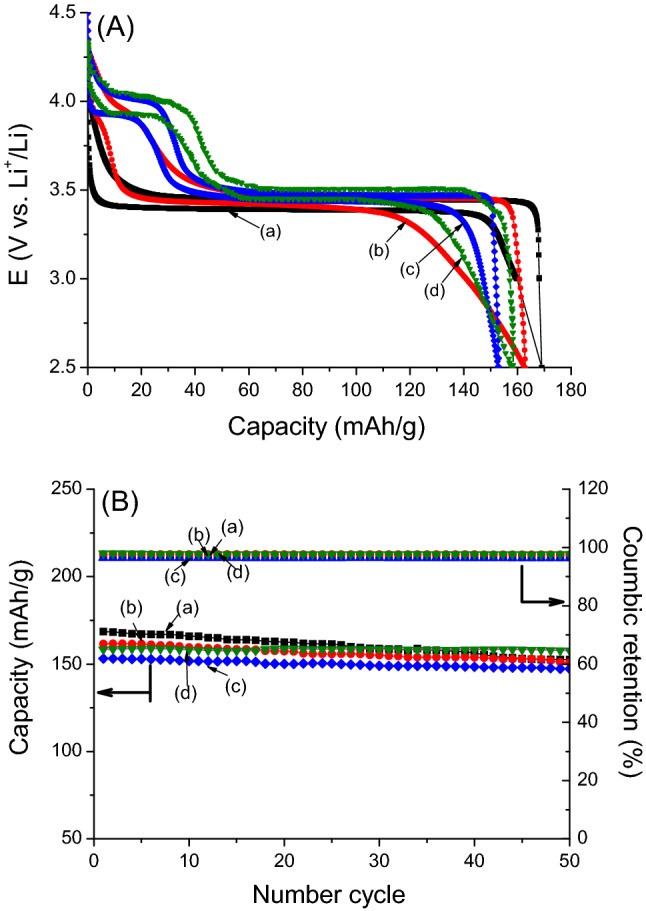
Nanostructured cathode materials based on Mn-doped olivine LiMnFePO (x = 0, 0.1, 0.2, and 0.3) were successfully synthesized via a hydrothermal route. The field-emission scanning electron microscopy (SEM) and energy-dispersive X-ray spectroscopy (EDS) analyzed results indicated that the synthesized LiMnFePO (x = 0, 0.1, 0.2, and 0.3) samples possessed a sphere-like nanostructure and a relatively homogeneous size distribution in the range of 100-200 nm. Electrochemical experiments and analysis showed that the Mn doping increased the redox potential and boosted the capacity. While the undoped olivine (LiFePO) had a capacity of 169 mAh g with a slight reduction (10%) in the initial capacity after 50 cycles (150 mAh g), the Mn-doped olivine samples (LiMnFePO) demonstrated reliable cycling tests with negligible capacity loss, reaching 151, 147, and 157 mAh g for x = 0.1, 0.2, and 0.3, respectively. The results from electrochemical impedance spectroscopy (EIS) accompanied by the galvanostatic intermittent titration technique (GITT) have resulted that the Mn substitution for Fe promoted the charge transfer process and hence the rapid Li transport. These findings indicate that the LiMnFePO nanostructures are promising cathode materials for lithium ion battery applications.
通过水热法成功合成了基于锰掺杂橄榄石型LiMnFePO₄(x = 0、0.1、0.2和0.3)的纳米结构阴极材料。场发射扫描电子显微镜(SEM)和能量色散X射线光谱(EDS)分析结果表明,合成的LiMnFePO₄(x = 0、0.1、0.2和0.3)样品具有球状纳米结构,尺寸分布相对均匀,在100 - 200nm范围内。电化学实验和分析表明,锰掺杂提高了氧化还原电位并提升了容量。未掺杂的橄榄石型(LiFePO₄)初始容量为169 mAh g⁻¹,50次循环后初始容量略有下降(10%),降至150 mAh g⁻¹,而锰掺杂的橄榄石型样品(LiMnFePO₄)在循环测试中表现可靠,容量损失可忽略不计,对于x = 0.1、0.2和0.3,分别达到151、147和157 mAh g⁻¹。电化学阻抗谱(EIS)结合恒电流间歇滴定技术(GITT)的结果表明,用锰取代铁促进了电荷转移过程,从而促进了锂的快速传输。这些发现表明,LiMnFePO₄纳米结构是用于锂离子电池应用的有前途的阴极材料。