
通过基于序列的物理化学性质计算挖掘革兰氏阴性表面活性酶候选物
Mining of Gram-Negative Surface-Active Enzybiotic Candidates by Sequence-Based Calculation of Physicochemical Properties.
作者信息
Vázquez Roberto, Blanco-Gañán Sofía, Ruiz Susana, García Pedro
机构信息
Departamento de Biotecnología Microbiana y de Plantas, Centro de Investigaciones Biológicas Margarita Salas (CIB-CSIC), Madrid, Spain.
Centro de Investigación Biomédica en Red de Enfermedades Respiratorias (CIBERES), Madrid, Spain.
出版信息
Front Microbiol. 2021 May 25;12:660403. doi: 10.3389/fmicb.2021.660403. eCollection 2021.
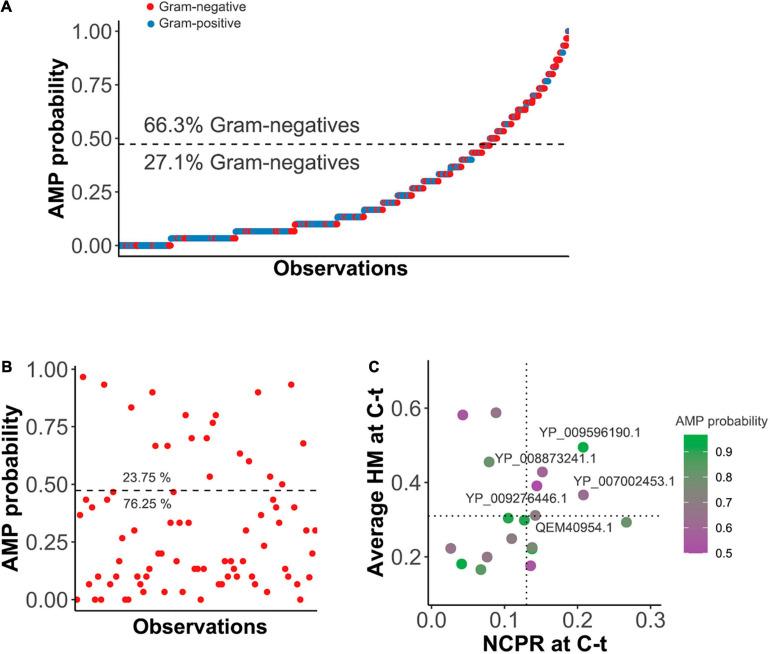
Phage (endo)lysins are nowadays one of the most promising ways out of the current antibiotic resistance crisis. Either as sole therapeutics or as a complement to common antibiotic chemotherapy, lysins are already entering late clinical phases to get regulatory agencies' authorization. Even the old paradigm of the inability of lysins to attack Gram-negative bacteria from without has already been overcome in a variety of ways: either by engineering approaches or investigating the natural mechanisms by which some wild-type lysins are able to interact with the bacterial surface. Such inherent ability of some lysins has been linked to antimicrobial peptide (AMP)-like regions, which are, on their own, a significant source for novel antimicrobials. Currently, though, many of the efforts for searching novel lysin-based antimicrobial candidates rely on experimental screenings. In this work, we have bioinformatically analyzed the C-terminal end of a collection of lysins from phages infecting the Gram-negative genus . Through the computation of physicochemical properties, the probability of such regions to be an AMP was estimated by means of a predictive -nearest neighbors (NN) model. This way, a subset of putatively membrane-interacting lysins was obtained from the original database. Two of such candidates (named Pae87 and Ppl65) were prospectively tested in terms of muralytic, bacteriolytic, and bactericidal activity. Both of them were found to possess an activity against and other Gram-negative bacterial pathogens, implying that the prediction of AMP-like regions could be a useful approach toward the mining of phage lysins to design and develop antimicrobials or antimicrobial parts for further engineering.
噬菌体(内)溶素如今是解决当前抗生素耐药性危机最有前景的方法之一。无论是作为单一疗法还是作为普通抗生素化疗的补充,溶素已进入临床后期阶段以获得监管机构的批准。甚至溶素无法从外部攻击革兰氏阴性菌的旧有模式也已通过多种方式被克服:要么通过工程方法,要么研究一些野生型溶素能够与细菌表面相互作用的天然机制。一些溶素的这种固有能力与抗菌肽(AMP)样区域有关,这些区域本身就是新型抗菌剂的重要来源。然而目前,许多寻找新型基于溶素的抗菌候选物的努力都依赖于实验筛选。在这项工作中,我们通过生物信息学方法分析了一组感染革兰氏阴性菌属的噬菌体溶素的C末端。通过计算物理化学性质,借助预测性的k近邻(NN)模型估计这些区域成为AMP的概率。通过这种方式,从原始数据库中获得了一组假定与膜相互作用的溶素。对其中两个候选物(命名为Pae87和Ppl65)进行了溶壁、溶菌和杀菌活性方面的前瞻性测试。发现它们都对[具体细菌名称未给出]和其他革兰氏阴性细菌病原体具有活性,这意味着预测AMP样区域可能是一种有用的方法,用于挖掘噬菌体溶素来设计和开发抗菌剂或用于进一步工程的抗菌部件。




 Zotero 插件