Department of Orthopedic Surgery, West China Hospital, West China Medical School, Sichuan University, #37 Guoxue Road, Chengdu, Sichuan Province, 610041, People's Republic of China.
BMC Musculoskelet Disord. 2021 Jun 12;22(1):535. doi: 10.1186/s12891-021-04418-y.
To determine whether multiple drilling is effective in postponing the need for total hip arthroplasty (THA) in early-stage nontraumatic osteonecrosis of the femoral head (ONFH).
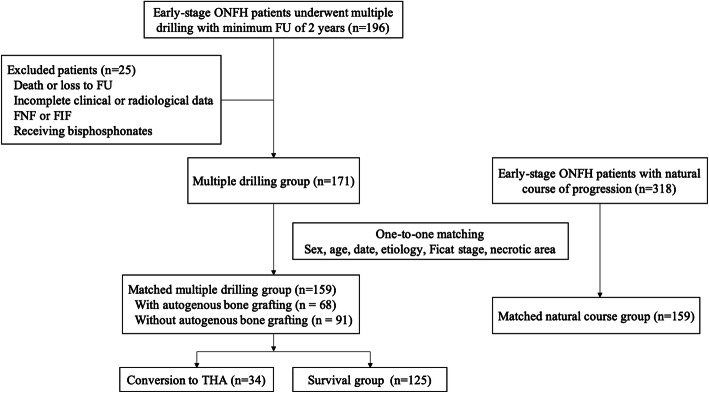
We identified 514 patients who were diagnosed with early-stage ONFH between January 2008 and December 2018. One hundred ninety-six patients underwent multiple drilling, and 318 patients had a natural course of progression. One hundred fifty-nine patients were selected for each group after case-control matching for preoperative demographics and modified Ficat and Arlet stage. The rates of THA conversion were compared. We also performed Cox regression to identify risk factors associated with THA conversion in patients who underwent multiple drilling.
Kaplan-Meier survivorship with an endpoint of THA for nontraumatic reasons were not significantly different between the multiple drilling group (75.6, 95% confidence interval 67.8-83.4%) and the natural course group (72.2, 95% confidence interval 64.8-79.6%) at 5 years (log-rank, P = .191). In the Cox regression model, a larger extent of necrotic lesion, bone marrow edema (BME), and higher postoperative work intensity significantly increased the risk of THA conversion (P < .05). Among patients treated with autogenous bone grafting, there was a lower risk of failure in patients with necrotic lesion less than 15% (P < .05).
Multiple drilling is not effective in reducing the rate of THA conversion in early-stage nontraumatic ONFH. The risk of conversion to THA after multiple drilling is increased by a larger extent of necrotic lesion, presence of BME, and higher postoperative work intensity in patients with early-stage ONFH.
The trial was registered in the Chinese Clinical Trial Registry ( ChiCTR2000035180 ) dated 2 August 2020.
为了确定多次钻孔是否能有效推迟早期非创伤性股骨头坏死(ONFH)患者行全髋关节置换术(THA)的需求。
我们纳入了 2008 年 1 月至 2018 年 12 月期间诊断为早期 ONFH 的 514 例患者。其中 196 例行多次钻孔,318 例为自然病程。每组病例均经过病例对照匹配,匹配术前人口统计学资料和改良 Ficat-Arlet 分期,最终各选择 159 例患者。比较两组 THA 转化率。同时,我们还进行了 Cox 回归分析,以确定行多次钻孔的患者中与 THA 转化率相关的风险因素。
Kaplan-Meier 生存分析显示,在非创伤性原因行 THA 方面,多次钻孔组(75.6%,95%置信区间 67.8%-83.4%)与自然病程组(72.2%,95%置信区间 64.8%-79.6%)在 5 年时的生存率无显著差异(对数秩检验,P=0.191)。在 Cox 回归模型中,更大范围的坏死病变、骨髓水肿(BME)和更高的术后工作强度显著增加了 THA 转化率的风险(P<0.05)。在接受自体骨移植治疗的患者中,坏死病变<15%的患者失败风险较低(P<0.05)。
在早期非创伤性 ONFH 患者中,多次钻孔并不能降低 THA 转化率。对于早期 ONFH 患者,坏死病变范围较大、存在 BME 和术后工作强度较高会增加多次钻孔后行 THA 的风险。
本研究于 2020 年 8 月 2 日在中国临床试验注册中心(ChiCTR2000035180)注册。